
- Tezos launched TzEL, a post-quantum privacy system designed to resist future quantum attacks
- Co-founder Arthur Breitman criticized parts of the Bitcoin community for dismissing quantum risks
- Researchers warn quantum computers could threaten current blockchain cryptography within years
Tezos is making one of crypto’s earliest serious moves toward quantum-resistant infrastructure after launching its new TzEL privacy system on testnet. The system is designed to protect encrypted blockchain data against future “harvest now, decrypt later” attacks, where attackers collect sensitive data today in anticipation of more powerful quantum computers later.
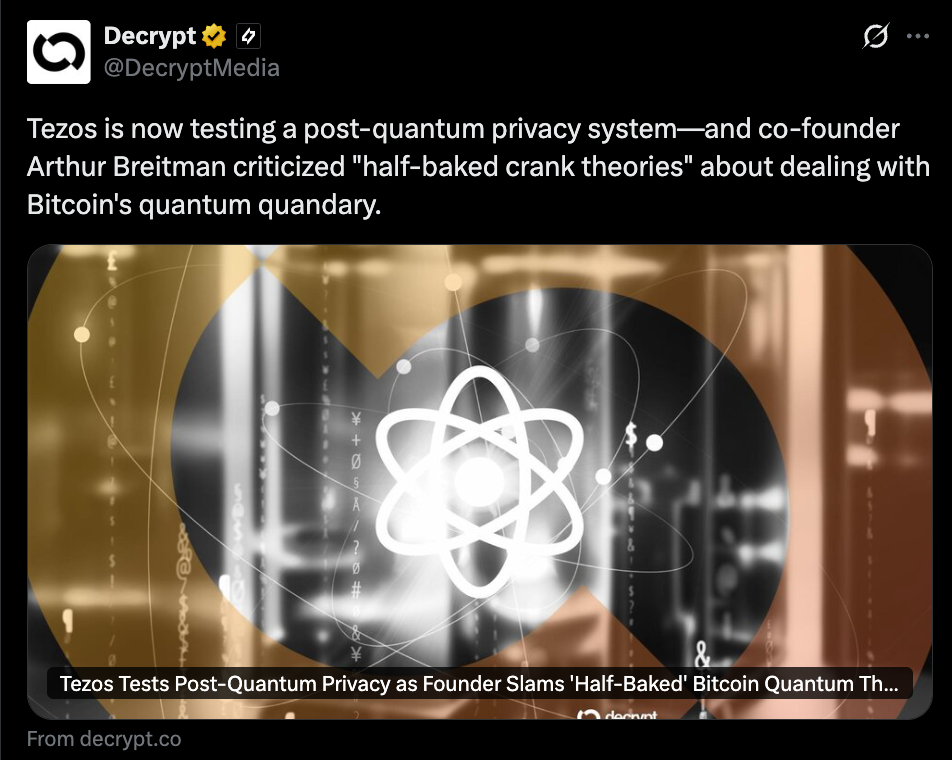
Tezos co-founder Arthur Breitman also publicly criticized parts of the crypto industry, particularly within Bitcoin circles, for treating quantum computing threats as exaggerated or pseudo-scientific. According to Breitman, the industry may not have as much time to prepare as many believe.
Why Quantum Risk Matters for Crypto
Most blockchains today rely on elliptic curve cryptography, the same security model protecting Bitcoin wallets and many other blockchain systems. The concern is that future quantum computers could eventually become powerful enough to break those cryptographic protections significantly faster than traditional computers can today.
Google researchers previously suggested advanced quantum systems could potentially crack Bitcoin-level encryption within minutes once the technology matures. Some estimates place that risk window sometime between 2029 and 2030, though timelines remain debated.
Breitman argued that while the threat is not immediate, it is serious enough that blockchain networks should already be preparing upgrades instead of dismissing the discussion entirely.

Tezos Is Building a Technical Solution
Tezos’ new TzEL system uses quantum-resistant zk-STARK proofs designed to secure private payments and encrypted transaction data against future decryption attempts. The tradeoff is that these systems require significantly larger data sizes compared to existing blockchain privacy tools, creating scalability and storage challenges.
According to Breitman, Tezos’ data availability infrastructure is specifically designed to handle those larger proof systems without overwhelming consensus operations. The project views the transition toward post-quantum security as an engineering challenge that needs active development now rather than later.
The Industry May Need to Move Faster
The broader crypto industry remains divided on how urgent the quantum threat really is. Some developers argue practical quantum computers capable of breaking modern encryption are still years away, while others believe preparation windows are already shrinking.
For now, Tezos appears determined to position itself ahead of the curve as blockchain networks begin confronting what quantum computing could eventually mean for crypto security and privacy.