- Cardano is preparing two major upgrades, including Ouroboros Leios and van Rossem
- Leios could significantly boost TPS, potentially surpassing 1,000 transactions per second
- The van Rossem hard fork will improve performance, security, and network stability
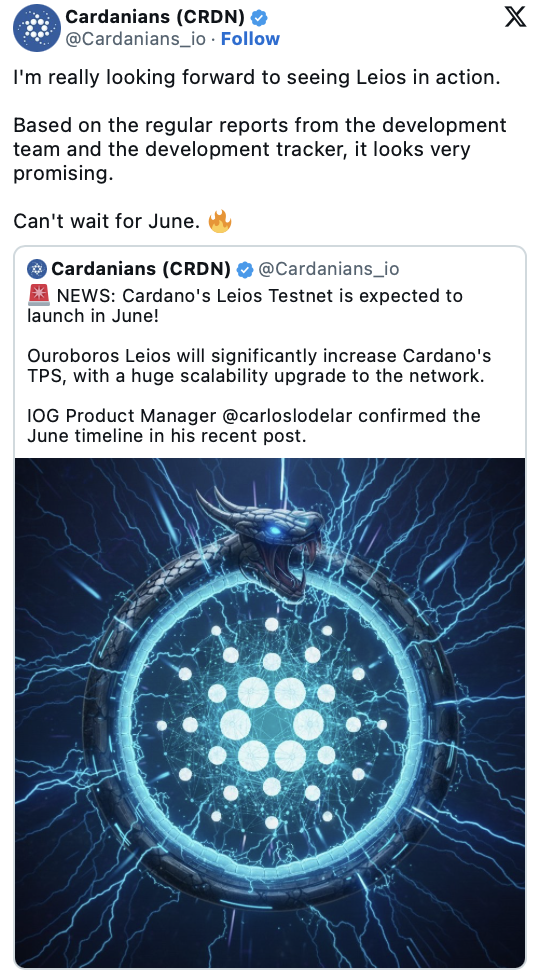
Cardano is quietly lining things up for what could be a pretty important stretch in early 2026. Two major upgrades are on the horizon, and while the timeline still feels a bit fluid, the direction is becoming clearer. One of the biggest pieces here is Ouroboros Leios, a scaling solution that’s been in development for a while now. According to updates shared by community sources like Cardanians, progress looks… steady, maybe even encouraging, based on ongoing reports and tracker data.
There’s also a tentative June target floating around for the Leios testnet. That’s not locked in, but it’s close enough to feel real. And if things land as expected, Leios could significantly boost Cardano’s transaction throughput—something the network has been aiming to improve for quite some time.
Leios Could Unlock Serious Scalability
At its core, Ouroboros Leios is about scaling, plain and simple. Early simulations suggest it could push Cardano’s throughput into the 200 to 1,000 transactions per second range, depending on how transactions are structured. That’s already a big jump, but the first full implementation—Linear Leios—might even take it beyond that, potentially crossing the 1,000 TPS mark.
Carlos Lopez de Lara from Input Output Global hinted at a June rollout for the dedicated testnet, which aligns with the broader roadmap. And behind the scenes, there’s been a bit of reshuffling to support this push. Development on Acropolis has been paused, for example, so resources can be redirected toward chain abstraction and scaling priorities. Even the planned tiered pricing model was scrapped, with about 4.1 million ADA redirected back to the treasury… a move that signals focus, if nothing else.
A Shift in Strategy Behind the Scenes
That decision to pivot away from certain initiatives says a lot about where Cardano is heading. Instead of spreading efforts thin, the team seems to be doubling down on scalability and core infrastructure. The technical groundwork for Leios is already in place too—the Linear Leios CIP was finalized and merged back in January, which gives the upgrade a more concrete foundation than just theory.
There’s a sense, maybe subtle, that Cardano is trying to reposition itself. Less talk, more execution. Or at least, that’s the idea. Whether it plays out that way is another question, but the intent is there.
The van Rossem Hard Fork Is Coming Next
Alongside Leios, Cardano is also preparing for the van Rossem hard fork, expected later in June 2026. This one is a bit different from previous upgrades. It won’t trigger a full era transition, which should make integration smoother—less disruption, ideally.
Still, the changes are meaningful. Protocol Version 11 will introduce improvements to Plutus performance, tighten ledger consistency, and enhance node security. It’s not flashy, but it’s the kind of upgrade that strengthens the network under the hood. And sometimes, that matters more than anything visible on the surface.
A Critical Moment for Cardano’s Roadmap
Put all of this together, and it starts to feel like a pivotal moment for Cardano. Leios aims to scale the network in a big way, while van Rossem focuses on stability and performance. It’s a combination that could shift how the ecosystem is perceived—assuming everything rolls out smoothly.
Of course, execution is everything. Plans can look great on paper, timelines can sound promising… but delivery is what counts. Still, for now, Cardano seems to be moving with purpose, even if a few details remain a bit uncertain.