

- EU officials warn dollar stablecoins threaten monetary sovereignty
- Most stablecoins are USD-backed and issued outside Europe
- Europe plans a digital euro rollout by 2026 to counter the trend
Europe is starting to sound a bit uneasy about stablecoins, and not without reason. France’s central bank is now openly warning that dollar-backed stablecoins could quietly reshape the region’s financial system. The concern isn’t just about crypto growing, it’s about whose currency ends up dominating that growth.
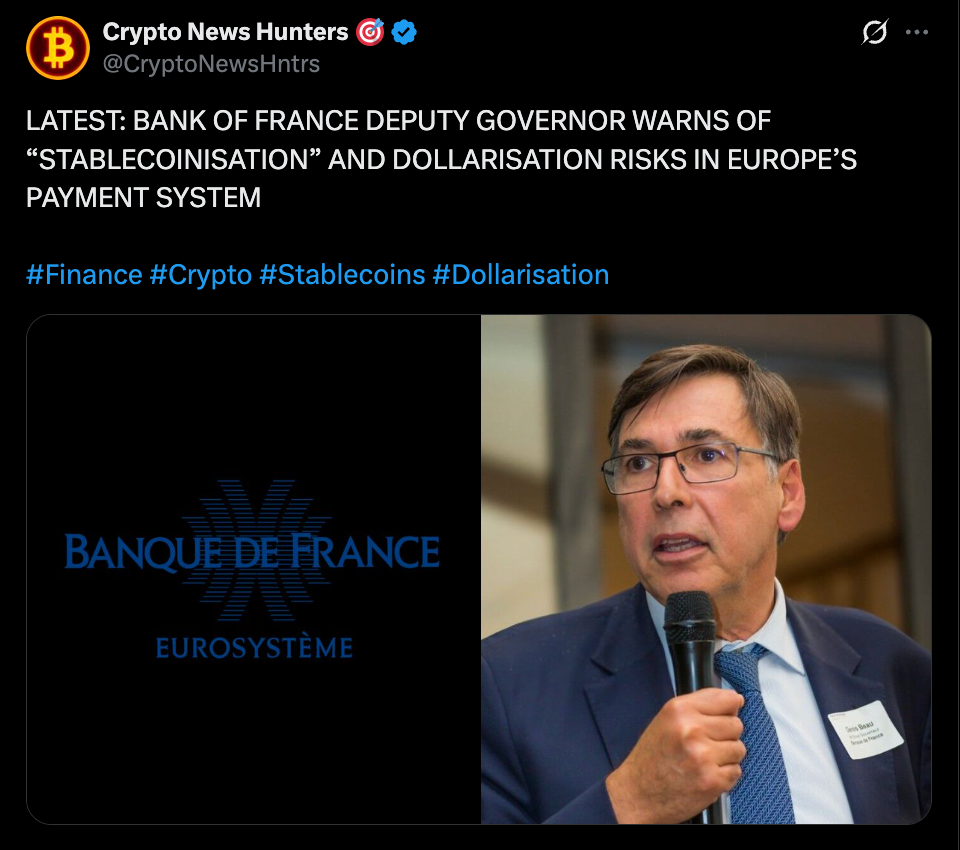
The term being used, “stablecoinisation,” points to something deeper than market trends. It’s the idea that Europe may have built advanced financial infrastructure, only to see it settle increasingly in US dollar-based assets. That shift, if it continues, could slowly erode monetary control, even if it doesn’t feel dramatic at first.
Dollar Stablecoins Are Already Leading
Right now, most stablecoins used in tokenised finance are tied to the US dollar. They’re also largely issued by non-European players, often operating under lighter regulatory frameworks. Tether tends to be the obvious example, but it’s part of a broader pattern that’s hard to ignore.
This creates a situation where European markets rely on external monetary instruments for settlement. It works, technically, but it introduces dependencies, and those dependencies come with risks. Liquidity, counterparty exposure, and regulatory gaps all start to matter more when the underlying system isn’t locally controlled.
The Risk Goes Beyond Just Currency
The concern isn’t only about the dollar gaining ground. It’s about fragmentation and stability. If multiple external stablecoins dominate settlement, financial systems can become more complex, harder to regulate, and potentially less stable during stress events.
There’s also a geopolitical angle, even if it’s not always stated directly. Moves like US policy support for dollar-backed stablecoins only reinforce the idea that this isn’t happening in isolation. It’s part of a broader shift in how financial influence is extending into digital markets.

Europe Is Trying to Build Its Own Alternative
Europe’s response is to build rather than restrict, at least for now. Through the Pontes project, the Eurosystem plans to introduce a wholesale digital euro by the end of 2026. The idea is to create a settlement layer that can integrate with existing systems while keeping control within the region.
Beyond that, the longer-term Appia project aims to connect central bank money, commercial deposits, and tokenised assets into a unified platform. It’s an ambitious approach, one that tries to match the flexibility of crypto while maintaining regulatory oversight.
Timing Might Be the Biggest Challenge
The bigger question isn’t whether Europe can build this infrastructure, it’s whether it can do it fast enough. Stablecoins are already embedded in parts of the market, and network effects tend to build quickly once adoption starts.
If a digital euro arrives after dollar stablecoins are already deeply integrated, it may struggle to replace them. Not impossible, but definitely harder. In markets like this, timing matters almost as much as design.
Crypto Stablecoin Battle Is Just Beginning
What’s happening here is less about banning stablecoins and more about competing with them. Europe isn’t rejecting the model, it’s trying to replicate it under its own framework. That shift alone shows how seriously regulators are taking the issue.
The outcome isn’t clear yet. But one thing is, stablecoins aren’t just a crypto story anymore. They’re becoming part of a much bigger conversation about control, currency, and the future of financial systems.