- Court awards $133K against MetaBirkin creator for trademark infringement
- Hermès targets ongoing NFT royalties, not just one-time damages
- Legal risk now threatens NFT liquidity, pricing, and creator income models
The Hermès vs. MetaBirkin case just did something the NFT market has been quietly avoiding for years. It put a price—and a precedent—on what happens when real-world IP collides with tokenized assets.
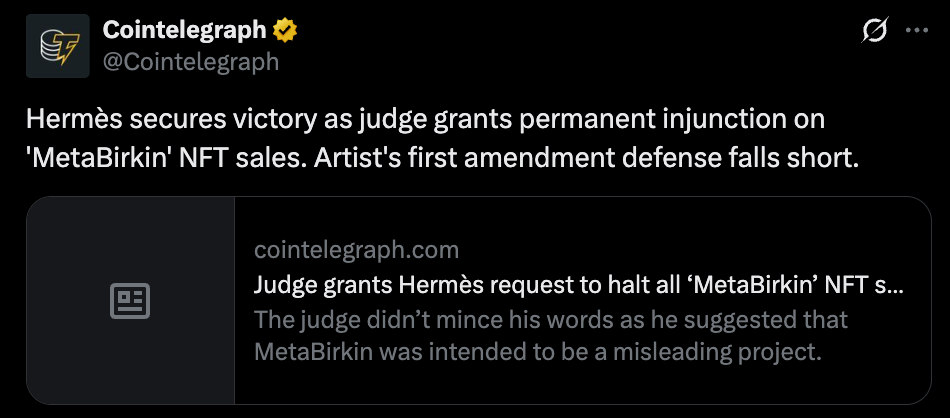
$133,000 isn’t a massive number in crypto terms. But that’s not really the point.
The End of the “Grey Area” Era
For a long time, NFTs operated in a space where inspiration, remixing, and outright borrowing blurred together. That ambiguity gave creators room to experiment, but also left brands exposed.
This ruling cuts through that fog. The court decided that using Hermès’ Birkin branding wasn’t commentary—it was infringement.
That distinction matters. It signals that traditional trademark law applies just as firmly in digital environments as it does in physical ones.
The Real Fight Is About Royalties
The damages are almost secondary compared to what Hermès is going after next. The 7.5% royalty on secondary sales.
That’s where things get interesting. NFT royalties have been one of the core promises of the space, ongoing income every time an asset changes hands.
But if courts can redirect or claim those royalties, the model changes. What looked like passive income starts to look conditional.
And once royalties become legally contestable, creators have to factor that risk into everything they build.
Liquidity Doesn’t Like Legal Risk
Markets are simple in one way. They don’t like uncertainty.
Introduce trademark disputes, potential injunctions, or royalty seizures, and behavior shifts quickly. Buyers hesitate. Sellers lower expectations. Volume quietly fades.

Platforms may respond by tightening listing standards, which reduces risk but also limits what can be traded. That kind of filtering changes the entire ecosystem.
NFTs Are Being Forced to Mature
This case doesn’t end NFTs. It just removes one of the shortcuts that defined the early days.
You can’t casually build on top of existing brand equity anymore and expect it to slide. At least not at scale.
The projects that survive this phase will likely look different. More licensing, more original IP, more structure. Less improvisation.
A Cleaner Market, But a Narrower One
There’s a trade-off here. A more legally compliant NFT space is also a more constrained one.
The wild experimentation that made early NFTs feel chaotic—and sometimes fun—becomes harder to sustain when legal boundaries tighten.
But at the same time, clearer rules may attract more serious capital and long-term builders.
A Subtle but Important Shift
The biggest impact of this case isn’t the money. It’s the precedent.
NFTs are no longer operating outside the system. They’re being pulled into it, shaped by the same rules that govern traditional assets.
And once that happens, the game changes.