

- Developer builds prototype to prove wallet ownership without signatures
- Solves risk of users being locked out during quantum defense upgrades
- Early-stage tool shows quantum solutions may be closer than expected
A quiet breakthrough just landed in Bitcoin development, and it solves a problem most people didn’t even realize existed. If Bitcoin ever upgrades to defend against quantum attacks, there’s a real chance millions of users could lose access to their own wallets in the process.
Now, there’s a potential workaround. And it didn’t come from a massive coordinated effort, just a prototype built on a laptop.
The Hidden Risk in Bitcoin’s Quantum Plan
For years, the idea of quantum computers breaking Bitcoin has been floating around as a distant threat. The proposed fix has been relatively straightforward, disable signature methods that quantum machines could exploit.
But that creates an awkward side effect. The same signatures that attackers could break are also how users prove ownership of their Bitcoin.
Remove that, and you don’t just block attackers. You risk locking out legitimate holders too. It’s been a known issue, just not one with a clear solution.
A Different Way to Prove Ownership
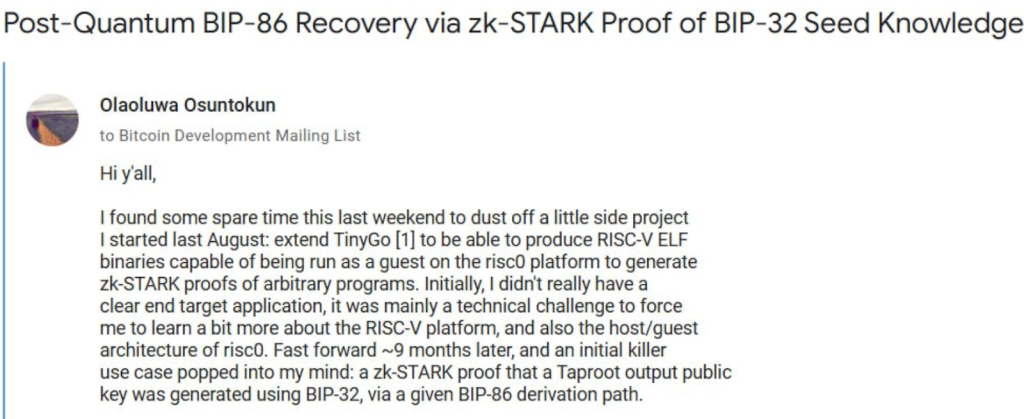
Lightning Labs CTO Olaoluwa “Roasbeef” Osuntokun built something that changes that equation. Instead of relying on signatures, his prototype lets users prove ownership using their wallet’s original seed.
It’s a subtle but important shift. Rather than signing a transaction, users demonstrate that their wallet was derived from a secret they control.
And crucially, they don’t have to reveal that secret. So one recovery doesn’t compromise everything tied to the same seed.
Surprisingly Practical, Even as a Prototype
This isn’t just theoretical code sitting in a repo somewhere. The prototype actually runs on consumer hardware.
Generating a proof takes around 55 seconds. Verification happens in under two seconds. The proof itself is about 1.7 MB, not tiny, but not unreasonable either.

For something built as a side project, those numbers are… honestly pretty solid.
Still Early, Still Uncertain
There’s no formal proposal yet. No roadmap. No guarantee the Bitcoin community adopts this approach.
That’s normal in Bitcoin development. Ideas don’t get fast-tracked just because they work. They get debated, tested, and sometimes ignored entirely.
At the same time, quantum timelines remain unclear. Some research suggests it’s decades away. Other projections are a bit more aggressive. The truth is somewhere in between, and nobody’s fully confident.
Why This Actually Matters
The biggest takeaway isn’t that Bitcoin is suddenly quantum-proof. It’s that a major gap in the defense strategy now has a plausible solution.
Before this, the conversation was stuck between two bad options, leave Bitcoin exposed, or protect it and risk breaking access for users.
Now there’s a third path. And in Bitcoin terms, that’s a big deal.
A Small Project With Big Implications
Bitcoin’s history is full of important ideas that started quietly, posted in forums, debated slowly, and eventually shaped the network.
This feels like one of those moments. Not because it’s guaranteed to be adopted, but because it proves the problem is solvable.
And once something moves from “theoretical issue” to “working prototype,” the conversation changes.