- South Korea moves to legalize RWAs and stablecoins under clear rules
- Stablecoins approved for real-world payments, not just trading
- Framework balances strict backing with broader fintech participation
South Korea is finally stepping out of its long crypto gray zone, and it’s doing it in a way that feels… deliberate. After nearly a decade of restricting domestic coin issuance, the country is now pushing forward a framework that brings tokenized assets and stablecoins under existing financial laws. Depending on how you look at it, this is either a bold pivot or something that probably should’ve happened years ago.
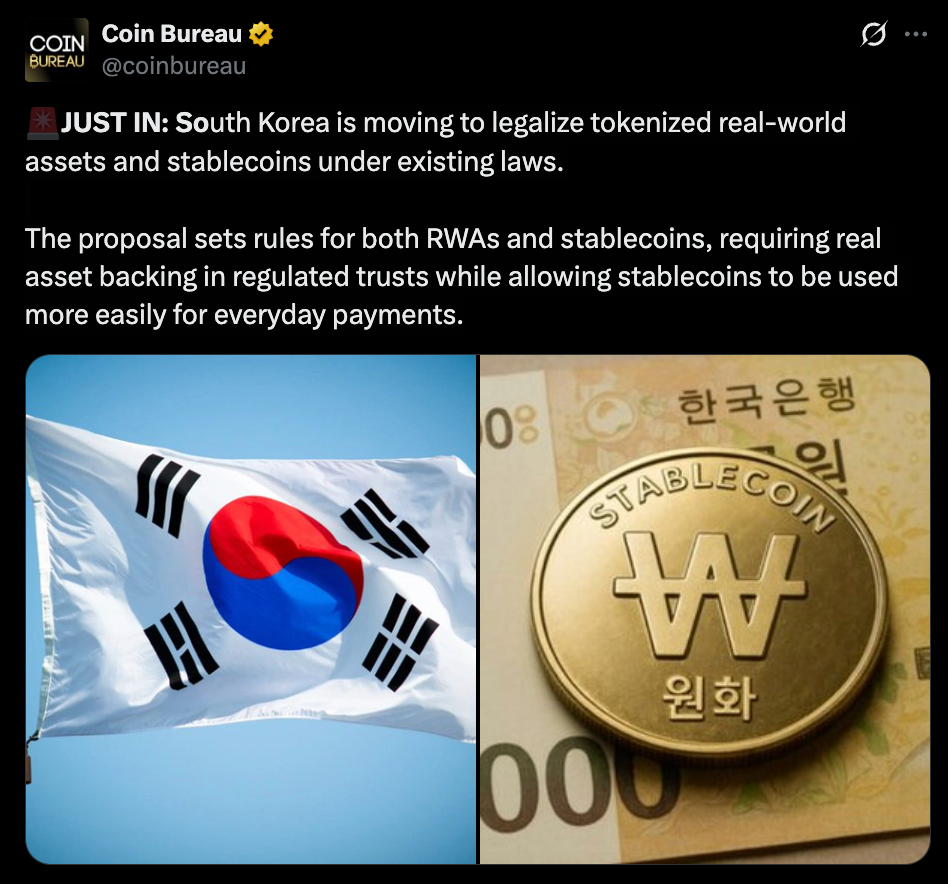
What stands out is the shift in tone. Crypto isn’t being treated as an edge case anymore. It’s being folded into the system, with rules that look a lot more like traditional finance than experimental tech.
Real Asset Backing Becomes Non-Negotiable
The proposal tackles tokenized real-world assets first, and it doesn’t leave much room for ambiguity. Tokens must be backed by actual assets, and those assets have to be held in regulated trusts. Not theoretical backing, not loosely defined reserves, but something verifiable and structured.
That approach feels intentional. It removes a lot of the uncertainty that has surrounded tokenization, especially in markets where “backed” didn’t always mean what people thought it did.
Stablecoins Move Into Everyday Use
The more interesting shift might be around stablecoins. Under this framework, they’re not just allowed, they’re positioned for real-world payments. That’s a big step beyond treating them as trading tools or speculative assets.
Issuers will need to maintain reserves exceeding 100% of supply, held at approved institutions and kept separate from their own balance sheets. That separation matters. It reduces the kind of risk that has caused problems in past stablecoin failures, where reserves weren’t as stable as advertised.
A Quiet Power Struggle Shaped the Outcome
Getting here wasn’t exactly smooth. The Bank of Korea and the Financial Services Commission have been pulling in different directions, especially over who gets to issue stablecoins.
The central bank pushed for tighter control, favoring traditional banks as primary issuers. Meanwhile, regulators leaned toward allowing fintech companies to participate, pointing to models like Europe’s MiCA framework. That tension is still there, and how it resolves could shape how open the system really becomes.
Regional Competition Is Driving the Urgency
South Korea isn’t making this move in isolation. Other financial hubs in Asia, Hong Kong, Singapore, Japan, have already established clearer crypto frameworks. Falling behind isn’t really an option anymore.
The potential size of the tokenization market, projected to reach hundreds of trillions of won by the end of the decade, adds pressure. At that scale, regulation isn’t just about control, it’s about competitiveness.
A Balancing Act Between Control and Innovation
This framework is trying to do two things at once. It sets strict rules around backing, reserves, and custody, while also leaving space for innovation, at least in theory.
Whether it leans more toward flexibility or control will determine how attractive South Korea becomes for crypto businesses. Too restrictive, and companies look elsewhere. Too loose, and risk creeps back in.
For now, though, the direction is clear. Crypto is no longer being pushed to the edges. It’s being brought into the system, with rules that are meant to make it stay.