

- $110M worth of SOL moved to exchanges, increasing potential selling pressure
- Technical breakdown below $85 and bearish crossover signal further downside risk
- Strong ecosystem growth continues despite short-term price weakness
Solana is starting to feel the weight again. Over the past few days, price has been drifting lower, now sitting somewhere around $79 to $81 — not a dramatic drop, but enough to keep traders on edge. It’s down roughly 3% on the week, and the tone… feels cautious.
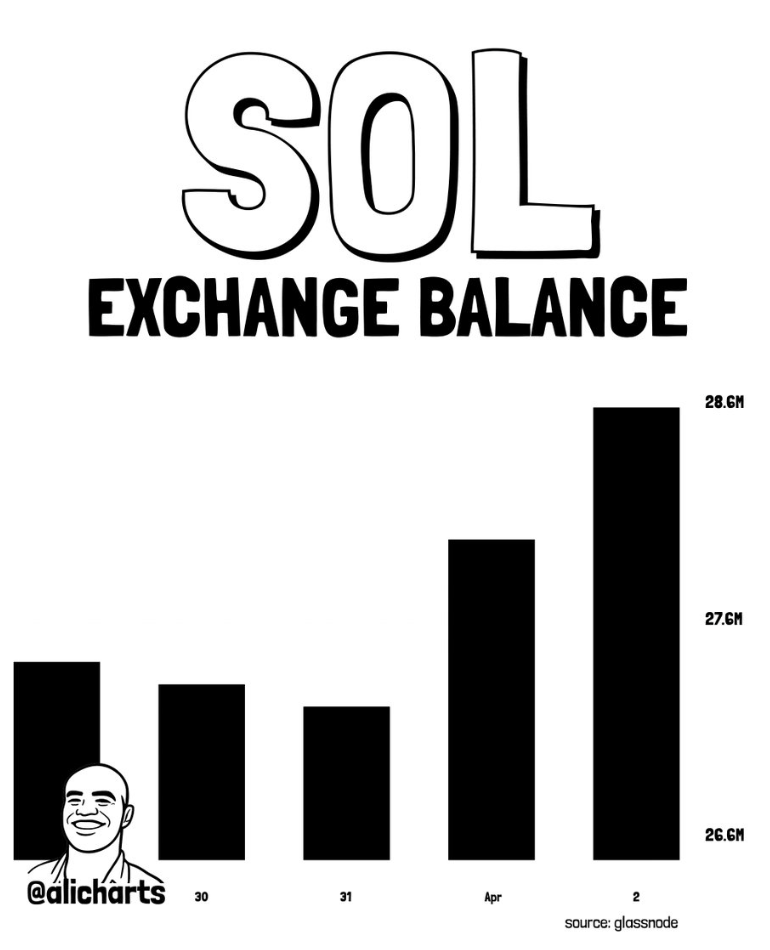
Part of that comes from on-chain data. Analyst Ali Martinez pointed out that around 1.40 million SOL — roughly $110 million worth — moved onto exchanges within just 72 hours. That kind of inflow usually isn’t random. More often than not, it suggests holders might be preparing to sell, or at least positioning themselves to.
Technical Breakdown Adds to Bearish Pressure
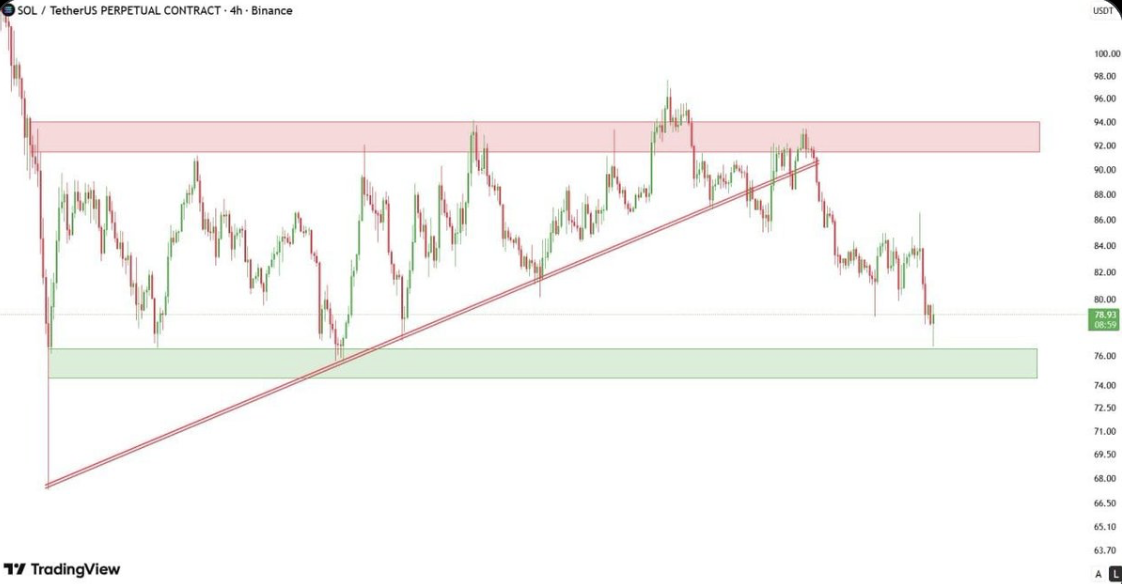
The chart isn’t helping either. According to Crypto_Scient, Solana has broken down from a daily bear flag, losing the key $85 level in the process. That zone had been acting as a sort of dividing line between bullish and bearish momentum — and now it’s gone.
There’s also a bearish crossover on the 4-hour chart, with the short-term moving average slipping below the longer one. It’s one of those signals traders watch closely, because historically… it tends to lead to more downside, not less.
Right now, price is trading below a key supply zone, and the market seems to have accepted these lower levels, at least for the moment.
Support Levels Begin to Matter More
The $77 area has been holding for now. Buyers have stepped in there a few times, trying to defend it, but repeated tests can weaken support — that’s the risk.
If that level breaks, attention shifts quickly to the $63–$67 range. That’s where stronger support might come into play, though getting there wouldn’t exactly be smooth.
Analyst Marcus Corvinus pointed out that the $92–$95 zone previously acted as strong resistance, and once sellers took control there, it pushed SOL down into this current range. He described the $75–$78 zone as a decision point — hold it, and there could be a sharp bounce. Lose it… and things might accelerate downward.
Any Bounce May Not Be a True Reversal
Even if Solana manages a short-term recovery, there’s still skepticism around how meaningful it would be. A move back toward $84–$89 could simply act as a retest of the broken structure, rather than a true trend reversal.
That’s usually how these setups play out. Price revisits old support-turned-resistance, struggles there, and then decides its next direction. So even a bounce might feel bullish at first, but not necessarily last.
Strong Fundamentals Continue in the Background
What’s interesting is that, despite all this price pressure, Solana’s ecosystem is still moving forward. Adoption hasn’t really slowed down.
SoFi recently launched an enterprise banking platform built on Solana, enabling both fiat and stablecoin settlements. At the same time, tokenized real-world assets on the network have crossed $2 billion, and major payment processors are using it for stablecoin transactions.
There’s also a regulatory angle — Solana has been classified as a commodity, which places it in a clearer category compared to some other assets. That could matter long term, even if short-term price doesn’t reflect it.
A Market Balancing Weakness and Growth
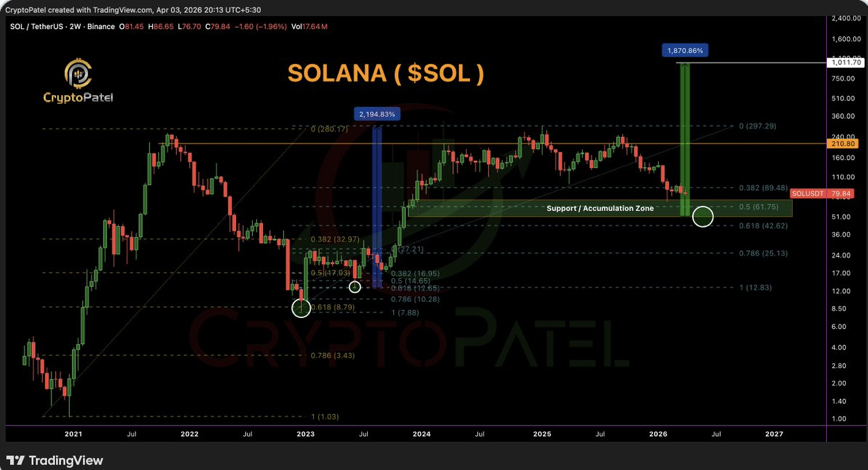
Right now, SOL is about 77% below its all-time high, which puts it in a familiar position — weak in the short term, but still relevant in the bigger picture.
Analyst RoccobullboTTom noted that long-term support continues to form between $75 and $85. If price can reclaim $100, momentum could shift more convincingly, with $120–$125 as potential targets.
But for now… that’s a bit ahead of where things stand.
There’s also added risk from a recent $285 million exploit on Drift Protocol, which has shaken confidence slightly across the ecosystem. Even so, daily trading volume remains above $1.68 billion, showing that participation hasn’t disappeared.
So the setup is mixed. Strong fundamentals, weak technicals, and a market that hasn’t fully decided which side to follow yet.