

- DeFi generated $56 million in daily fees, but lending protocols show the most consistent revenue.
- Aave produced $82 million in monthly fees and nearly $145 million over the past year.
- The protocol recently surpassed $1 trillion in cumulative loan volume despite governance tensions.
Recent revenue data from the DeFi ecosystem is starting to reveal a clear divide between speculative sectors and credit-focused protocols. Over the past 24 hours, total fees generated across the ecosystem climbed to around $56 million. At first glance that number looks impressive… but once you dig deeper, the picture becomes a bit more uneven.
Different corners of DeFi are moving in very different directions right now. Trading-heavy sectors like decentralized exchanges, NFTs, and GameFi platforms tend to swing wildly depending on market hype and user activity. Some days revenue spikes, other days it fades just as quickly. Lending protocols, however, appear to operate on a much steadier rhythm — driven less by speculation and more by ongoing borrowing demand.
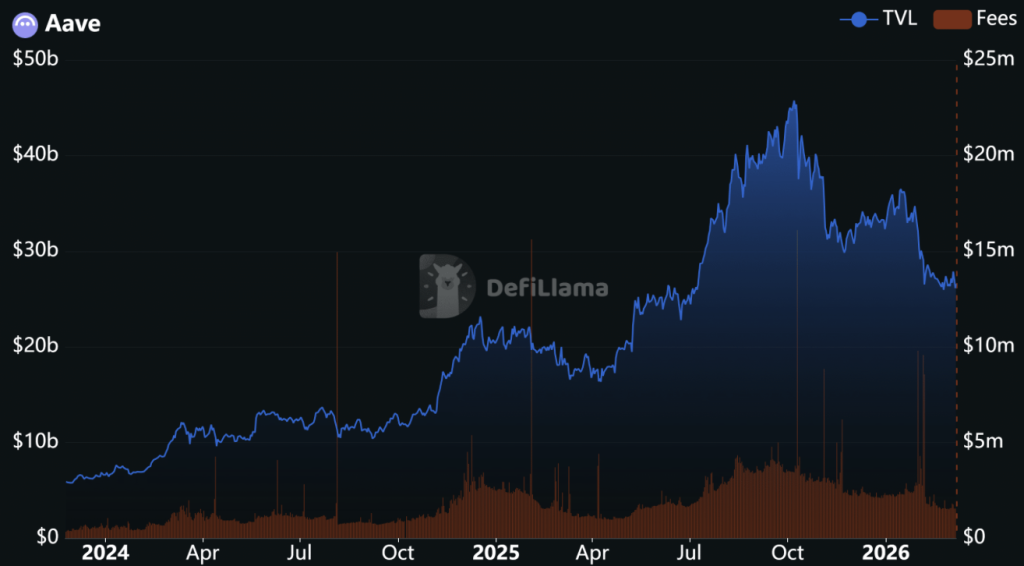
Lending Protocols Continue Producing Reliable Fees
Aave has become one of the clearest examples of this stability. The protocol recently generated about $1.62 million in fees over a single day, and roughly $82.14 million over the past 30 days. Its massive $32.4 billion total value locked continues to anchor liquidity across several major lending markets within DeFi.
Other credit-based platforms are seeing similar momentum. Morpho, for instance, has been expanding steadily, bringing in around $2.3 million in weekly fees while managing close to $7 billion in total value locked. Maple Finance has also strengthened its presence by focusing on institutional lending tied to real-world assets.
What ties these models together is their reliance on loan utilization rather than speculative trading volume. As long as borrowers continue to need liquidity, these systems keep generating fees. It’s a quieter form of growth, maybe, but often far more consistent.
Utilization Rates Show Why Credit Markets Are Resilient
One of the key indicators supporting this stability is utilization. In Aave’s stablecoin markets, utilization levels currently hover near the 60% mark — meaning a large portion of supplied liquidity is actively being borrowed. Morpho’s vaults often push even higher, sometimes exceeding 85%.
Those numbers matter. High utilization means assets are working inside the system rather than sitting idle, which leads directly to ongoing interest payments and protocol revenue.
In contrast, speculative sectors often rely on bursts of trading activity that can disappear as quickly as they arrive. Lending markets operate differently. As long as traders, arbitrage desks, and treasury managers need capital, borrowing demand tends to stick around.
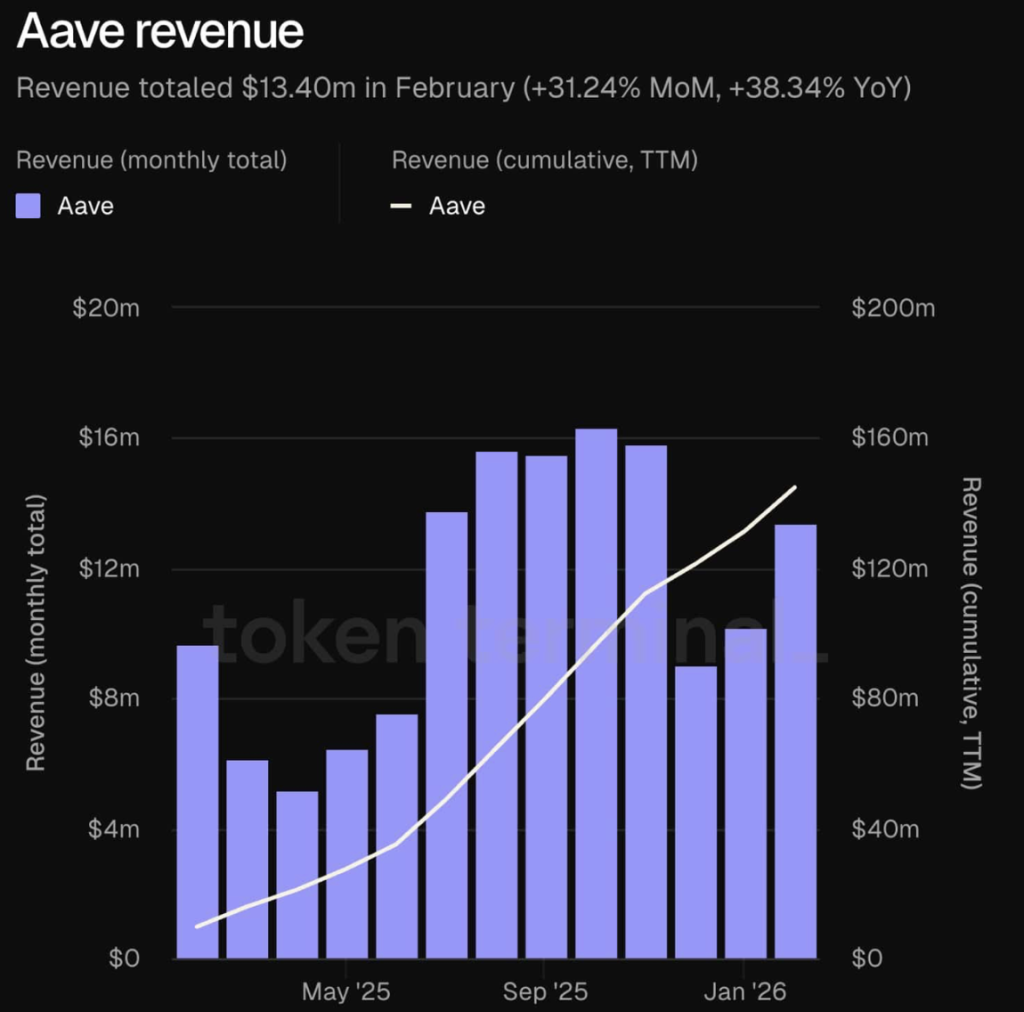
Aave’s Revenue Growth Continues Across Market Cycles
Looking specifically at Aave’s financial performance, the numbers have been trending steadily upward. Monthly revenue reached roughly $13.4 million in February, representing a 31% increase compared to the previous month. Year over year, revenue has expanded by about 38%.
There have been periods of fluctuation along the way. Earlier in the cycle, revenue dipped to around $5 million during slower market periods before climbing again. By late 2025, monthly revenue had moved beyond $15 million.
The cumulative revenue chart tells the bigger story though. Over the past twelve months alone, Aave has generated close to $145 million in protocol revenue. That type of consistency is difficult to achieve in many corners of crypto.
Much of this activity is concentrated on Ethereum, which still accounts for roughly 89% of Aave’s total revenue. Borrowing demand tied to trading strategies, arbitrage opportunities, and treasury management continues to drive usage across the platform.
Governance Challenges Appear as the Protocol Expands
Despite its economic growth, Aave has recently faced internal governance tensions. In early March, the Aave Chan Initiative announced it would step away from the project following the controversial “Aave Will Win” proposal. The vote passed narrowly, securing just 52.58% support — a result that highlighted divisions inside the community.
Not long before that, BGD Labs also exited the ecosystem, adding to concerns about governance stability. These departures have sparked debate about decision-making processes within the protocol and how leadership will evolve moving forward.
Interestingly though, the platform’s financial engine has continued expanding even amid the governance friction. Aave recently surpassed $1 trillion in cumulative loan volume across its markets — a milestone that reinforces its growing role within decentralized finance.
With borrowing demand continuing across trading desks, liquidity strategies, and treasury management, Aave is increasingly behaving like the backbone of DeFi’s credit infrastructure. Quietly, steadily… it keeps moving capital around the ecosystem. And for now, that demand doesn’t seem to be slowing.