- Buterin calls for “sanctuary technologies” built on Ethereum
- Focus shifts from pure DeFi to privacy and coordination tools
- Vision includes wallets, hardware, and open infrastructure layers
Vitalik Buterin believes Ethereum’s future cannot be confined to financial applications alone. In a recent post on X, the Ethereum co-founder urged the network to expand its mission toward building what he called “sanctuary technologies” — decentralized systems designed to protect privacy, freedom, and coordination in a world that feels increasingly unstable.
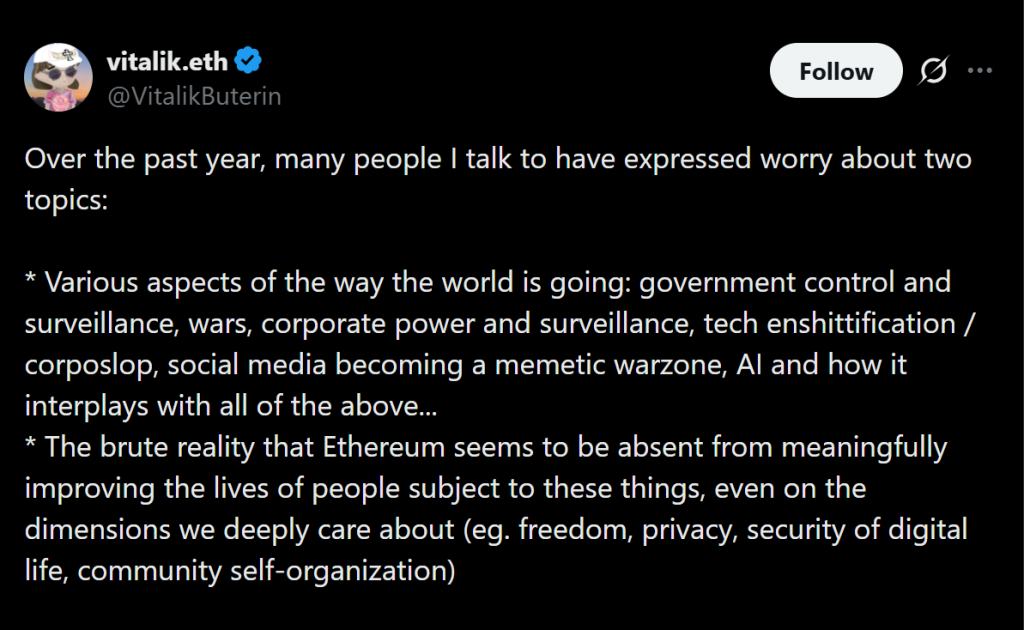
While financial autonomy remains central to Ethereum’s identity, Buterin suggested that focusing only on monetary use cases misses deeper structural challenges. Surveillance, geopolitical fragmentation, and the accelerating influence of artificial intelligence are reshaping the digital landscape. Ethereum, he argues, should respond.
What Are “Sanctuary Technologies”?
Buterin described sanctuary technologies as open, decentralized infrastructure that shields individuals from centralized control. He referenced tools already serving this role in different ways: satellite internet networks like Starlink, encrypted messaging apps such as Signal, local open-source AI models, and crowd-verified systems like Community Notes.
These systems share a common trait. They reduce dependency on single authorities and allow users to retain agency. Ethereum, in this vision, becomes part of a broader ecosystem of liberating digital infrastructure rather than just a settlement layer for tokens.
Building Shared Digital Spaces
The broader goal is not to replace global institutions entirely, which would require concentrated power incompatible with decentralization. Instead, Buterin envisions Ethereum as a foundation for shared digital environments where users can coordinate, govern, and transact without relying on centralized intermediaries.

These spaces could include payment networks, decentralized governance frameworks, and collaborative platforms built to endure beyond any one company or state. The emphasis shifts from speculation toward resilience — systems that function even when traditional structures falter.
A Full-Stack Open Infrastructure Vision
Buterin also highlighted the need for a comprehensive infrastructure stack. Development should not stop at smart contracts. It should extend upward into wallets and user interfaces while reaching downward into operating systems, hardware security, and foundational layers.
In this framing, Ethereum is less a financial protocol and more a coordination engine for open systems. The network’s next phase may not be defined solely by DeFi growth or token price cycles, but by how effectively it contributes to a more privacy-preserving and self-determined digital world.