

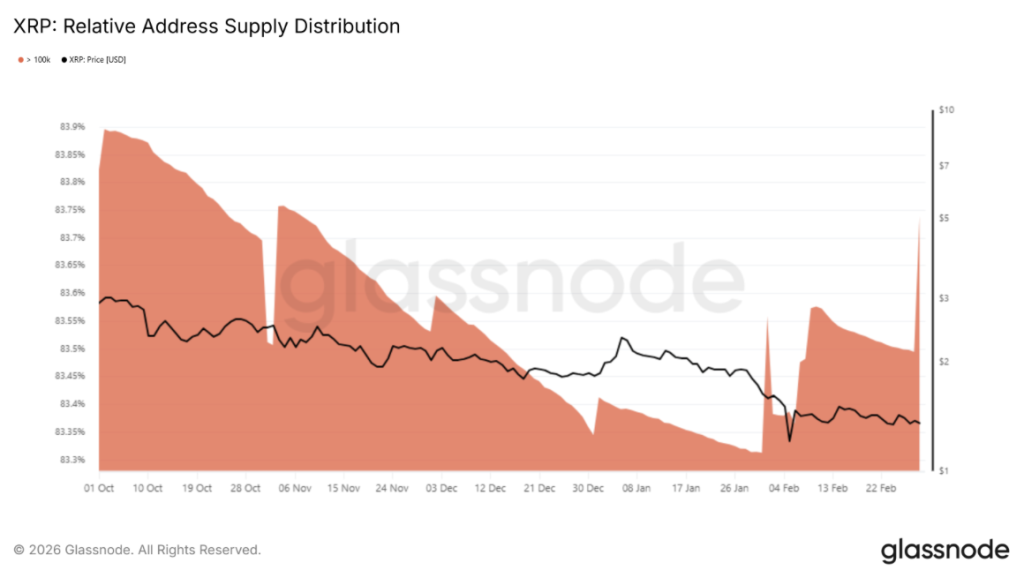
- XRP whales now control 83.7% of supply, signaling strong long-term accumulation.
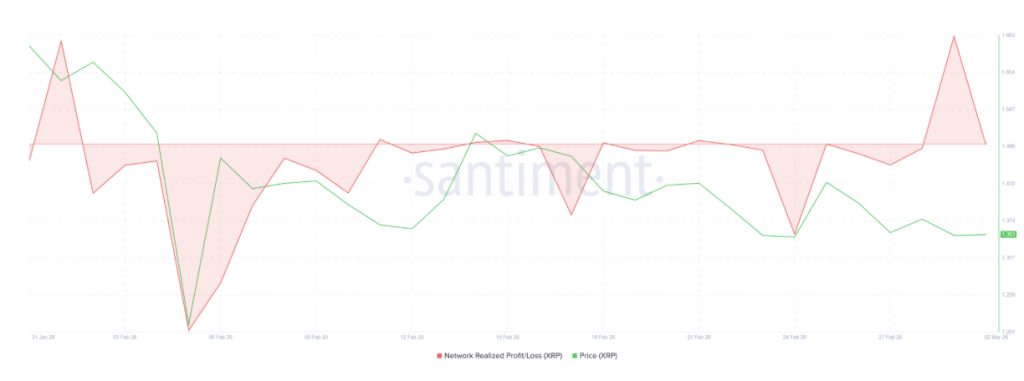
- Realized profits surged to $207M, raising the risk of short-term selling pressure.
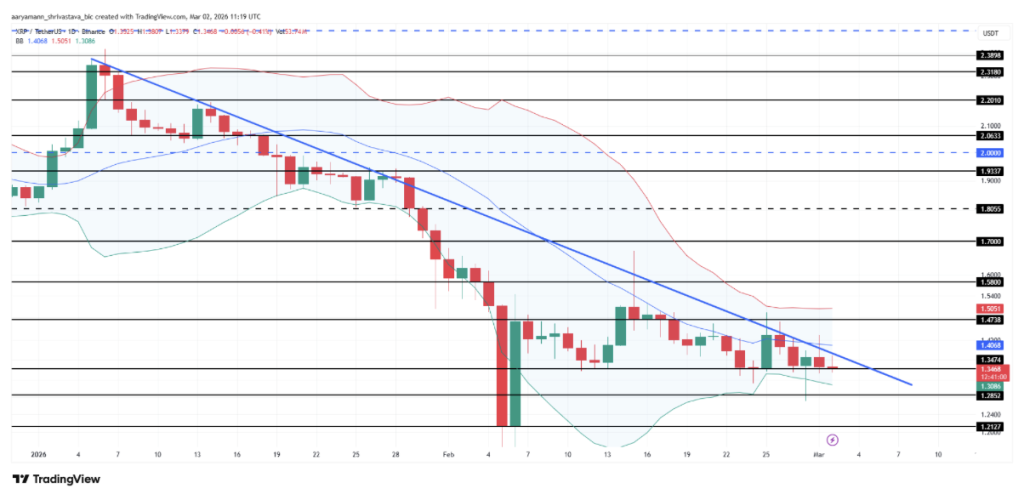
- XRP must hold $1.34 support and break $1.47 resistance to shift the broader bearish structure.
XRP just can’t seem to shake this downtrend. For months now, every attempt to reclaim higher ground has stalled beneath key resistance levels. There have been brief bursts of optimism, sure, but nothing that sticks. The broader structure still leans cautious, maybe even fragile.
And yet, beneath the surface, things aren’t so simple.
On-chain data is painting a mixed picture. Whale wallets are quietly accumulating. At the same time, profit-taking has started to tick up, and network growth looks softer than it should in a healthy expansion phase. It’s not a clean bullish or bearish setup. It’s layered.
Whales Keep Accumulating
Large XRP holders, particularly addresses holding more than 100,000 XRP, have been increasing their positions throughout February. According to supply distribution data, these wallets now control roughly 83.7% of the total XRP supply. That’s a substantial concentration.
When high-capital participants accumulate during consolidation phases, it usually signals long-term conviction. Whales rarely chase green candles. They tend to build during boredom, during weakness. Their steady buying suggests they expect recovery rather than immediate distribution.
In theory, sustained accumulation tightens circulating supply. That can dampen volatility and provide structural support over time. But whales alone can’t carry a market indefinitely. They need participation.
Profit-Taking and Network Slowdown Raise Caution
Here’s where the story gets complicated.
XRP’s network realized profit and loss metric recently spiked to $207 million within 24 hours. That’s the first notable wave of profit-taking in nearly a month. On its own, moderate profit realization isn’t unhealthy. Markets need rotation. Gains need to be booked.
The concern is scale. If that profit-taking accelerates and spreads beyond short-term holders, recovery attempts could stall quickly. Watching realized profit trends becomes important here. Stabilization is constructive. Expansion, not so much.
At the same time, new address growth isn’t particularly encouraging. Since early December 2025, monthly new address growth has remained below its yearly average. That divergence signals contraction in network activity. Fewer new participants. Slower onboarding.
Historically, when monthly growth lags yearly trends for extended periods, rallies struggle to sustain momentum. Organic demand matters. Without fresh participants entering the ecosystem, price strength depends heavily on existing holders reshuffling capital.
A reversal in this metric, where monthly new addresses climb above yearly averages, would shift the narrative. Until then, fundamentals feel cautious, even if whales are optimistic.
Price Structure Remains Under Pressure
At the time of writing, XRP trades near $1.34, hovering just above a critical support zone. Resistance at $1.47 continues to cap upside attempts. A descending trendline active since early 2026 still acts like a ceiling, quietly limiting rallies.
If selling pressure builds and XRP loses $1.34 support, downside targets around $1.28 come into focus. Below that, $1.21 sits as the next structural level. A breakdown into that region would reinforce the broader downtrend narrative.
On the other hand, stabilization in profit-taking combined with sustained defense of $1.34 could create a base. If XRP manages to break decisively above $1.47, the bearish structure would weaken significantly. A move toward $1.58 would then become realistic, signaling a potential shift in sentiment.
Right now, XRP sits in tension. Whale conviction versus cooling network growth. Support versus descending resistance. It’s a market waiting for confirmation.
And confirmation, in crypto, rarely arrives quietly.