
- UNI and AAVE remain in broader downtrends despite short-term rebounds in the crypto market.
- Monetalis Consultancy trimmed UNI holdings while maintaining significant ETH and AAVE exposure.
- Key resistance levels at $125 for AAVE and structural weakness in UNI near $4 keep DeFi sentiment cautious.
The broader crypto market has started to bounce, at least on the surface. Green candles are popping up again, sentiment feels a bit lighter. But when you zoom in on major DeFi names like Uniswap and Aave, the picture is still pretty bruised.
UNI slipped more than 1%, while AAVE lost over 2% of its market capitalization. Not dramatic collapses, but enough to remind everyone that DeFi hasn’t fully joined the recovery party. The sector remains structurally bearish, even as Bitcoin and some large caps try to stabilize.
Interestingly, institutions appear to be adjusting quietly in the background.
Monetalis Consultancy Repositions Its DeFi Exposure
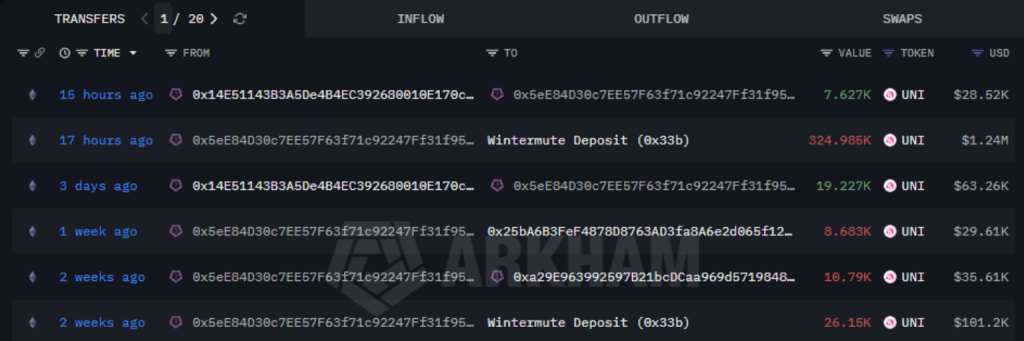
A wallet believed to be linked to Monetalis Consultancy recently moved 325,000 UNI tokens, worth about $1.24 million, to Wintermute, a well-known market maker. According to The Data Nerd, that deposit likely signals an intent to sell, or at least rebalance.
After the transfer, the wallet still held 3.27 million UNI tokens, valued at roughly $12.26 million. That’s not exactly an exit. It’s more like trimming exposure.
At the same time, the firm maintained 31,337 ETH worth approximately $63.81 million, making Ethereum its largest holding by a wide margin. UNI ranked second, followed closely by 98,896 AAVE tokens valued at $11.13 million. The allocations suggest Monetalis isn’t abandoning DeFi entirely, just adjusting weightings. Maybe responding to chart weakness rather than abandoning the thesis.
Institutional flows like this can move markets, but not always. Sometimes it’s simple portfolio management. Other times, it signals something more deliberate.
Uniswap Price Falls While Network Activity Expands
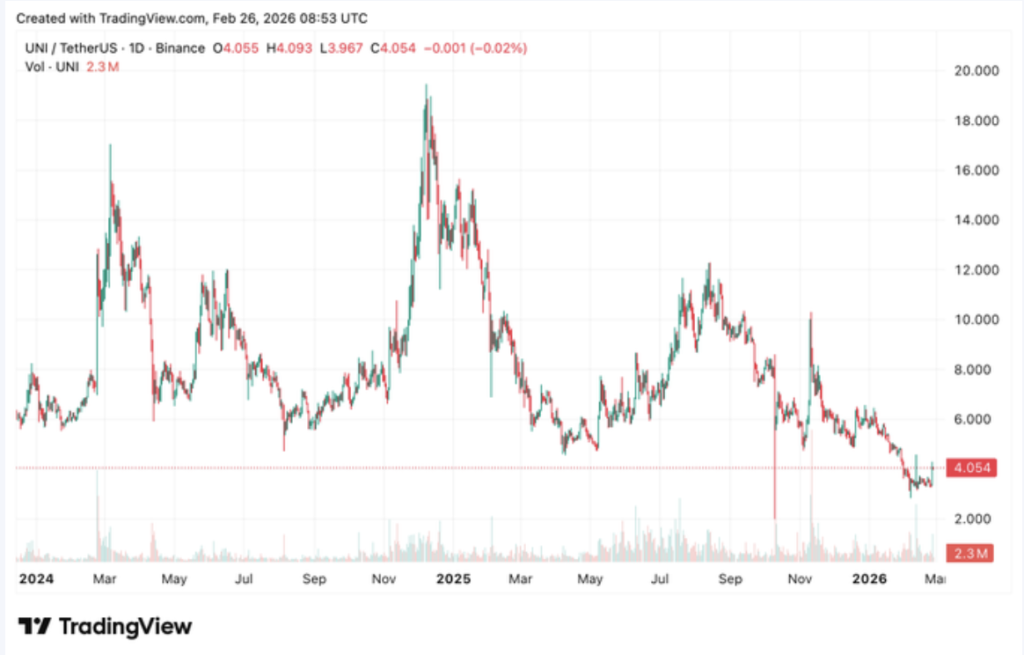
Uniswap’s price has been sliding since late December 2024, when it touched $20. There was a recovery window in mid-2025, with price bouncing toward $12, but the rebound didn’t hold. Today, UNI trades near $4. That’s a steep drop in just over a year.
And yet, the network story doesn’t fully match the chart.
Unichain recently pushed forward a proposal aimed at expanding revenue by roughly $27 million. The initiative supports token burns funded by protocol revenue, tightening supply over time. That’s a structural shift, not just a cosmetic one.
Uniswap has also expanded fee distribution across eight chains, including OP Mainnet, Base, Arbitrum, Celo, Solenium, X Layer, Worldchain, and Zora. Activity has been spreading outward rather than shrinking inward. That kind of expansion likely prevented a deeper collapse, the kind DeFi tokens sometimes face during extreme bear cycles.
Still, price hasn’t caught up to the narrative. Not yet.
AAVE Faces Descending Resistance Despite Short-Term Bounce
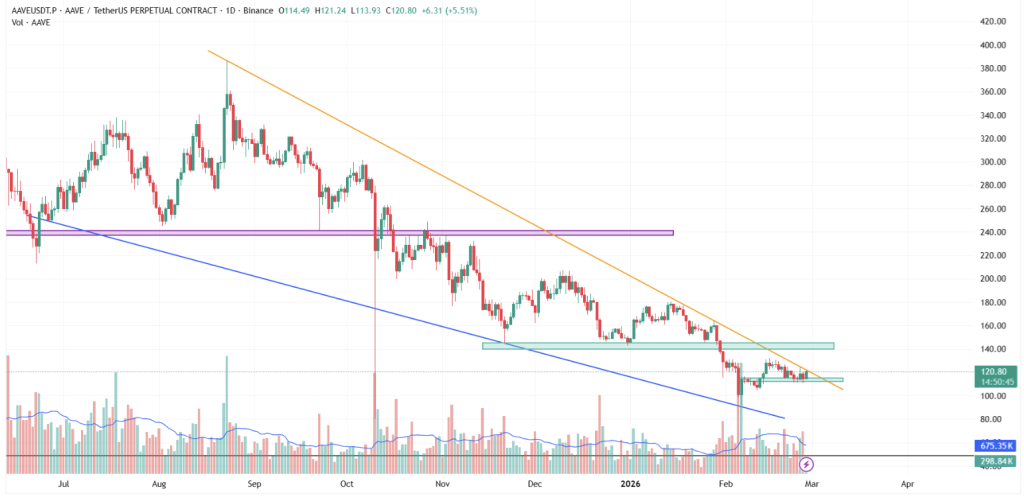
AAVE tells a similar but slightly different story. Since peaking near $390, the token has been carving lower highs, forming a descending trendline that cuts through the $125–$130 zone. That line has acted as dynamic resistance for months.
Recently, AAVE bounced from the $95–$100 support range and is now trading around $120. That move created a short-term higher low, which technically counts as progress. Bulls are trying to regain footing.
But overhead resistance between $140 and $150 remains heavy. That zone capped price last December and was decisively broken earlier this year. A reclaim above $160 would invalidate the broader bearish structure. Until then, rallies are countertrend, not confirmed reversals.
A rejection near $125 could easily send AAVE back toward $100. The short-term bounce is visible. The higher timeframe trend, however, still leans bearish.
DeFi at a Crossroads
Technically, both UNI and AAVE remain in downward structures, even if small rebounds are forming. The broader crypto market will likely determine what happens next. If sentiment strengthens and liquidity flows back into risk assets, DeFi could benefit disproportionately.
But if the recovery fades, these tokens may continue to grind lower, consolidation turning into exhaustion.
For now, institutions are adjusting. Networks are building. Prices are hesitating.
DeFi isn’t dead. It’s just… waiting.