
- XRP is increasingly framed as infrastructure for a potential post-conflict financial reset.
- Supporters argue its speed and banking integrations position it for large-scale adoption.
- A bold $73,000 projection reflects belief in XRP as core global settlement rails.
The world feels tense right now. Nations are clashing, ideologies are hardening, and global economies are absorbing shock after shock, some visible, some quietly structural. In moments like this, financial systems don’t just wobble, they get questioned.
That backdrop is exactly why certain digital assets are regaining attention. XRP, in particular, is being framed by some commentators as more than just another crypto token riding market cycles. Instead, it’s being positioned as infrastructure. Not hype, not memes, but rails, the kind that could matter if the current turbulence eventually forces a broader reset.
Rising Demand for a New Financial Rail
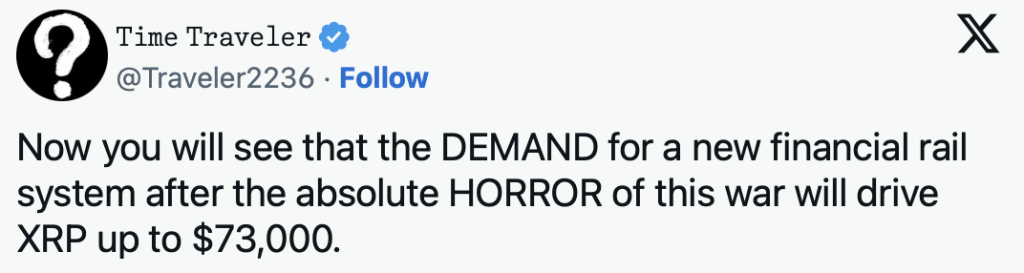
Crypto commentator Time Traveler (@Traveler2236) has repeatedly emphasized what he sees as XRP’s structural advantage. In a recent post, he suggested that once the “war” is over, XRP could help power the next financial system. He didn’t define the war directly, but the implication stretches beyond physical conflict, it touches ideological divides, economic fragmentation, and shifting global alliances.
After prolonged instability, demand for something reliable, fast, and transparent could spike sharply. XRP settles transactions in seconds, not days, and that speed becomes more than a feature when trust in traditional channels erodes. Add to that its existing partnerships with banks and payment providers, and the narrative starts to build: XRP as a bridge between old finance and whatever comes next.
Post-Conflict Reset and Infrastructure Rebuild
Time Traveler’s broader thesis hints at a global financial reset once conflict subsides. In that scenario, XRP would not simply be traded, it would be used. The network’s ability to handle high-volume cross-border payments efficiently positions it as a candidate for large-scale settlement infrastructure, something traditional correspondent banking struggles to execute without friction.
Periods of upheaval often expose structural weaknesses. If global systems require restructuring, assets built for scalability and real-time settlement gain strategic weight. Investors watching this unfold may interpret the current volatility as positioning, not just noise.
Notably, Time Traveler floated a bold projection: XRP potentially reaching $73,000. That number is eye-catching, almost jarring. Whether realistic or not, it reflects a belief that markets could eventually price XRP not as a speculative asset, but as core financial plumbing.
Institutional Interest and Retail Speculation Converge
Banks and financial institutions are already experimenting with tokenization, blockchain settlement layers, and digital liquidity solutions. XRP’s architecture allows integration with existing systems while offering near-instant settlement, a practical feature rather than a theoretical one. Institutions tend to move slowly, but they rarely ignore efficiency for long.
Retail investors, meanwhile, are navigating a world of currency debasement fears, geopolitical instability, and rapid technological change. In that context, XRP is sometimes viewed as a hedge, not just against inflation, but against structural inefficiencies in legacy finance. It’s a subtle shift in perception, but perception matters.
XRP’s future trajectory is undeniably tied to global developments. If conflict eventually gives way to reconstruction, financial infrastructure will likely evolve alongside it. Whether XRP becomes central to that transformation remains uncertain, of course, but the narrative is gaining traction.
For now, the idea lingers in the background: when systems strain, alternatives rise. And XRP, at least in the eyes of its strongest advocates, is waiting for that moment.