

- Magic Eden is shutting down its Bitcoin Ordinals and EVM-based NFT marketplaces to refocus entirely on Solana.
- The decision reflects resource concentration, as the majority of trading volume remained on Solana despite multi-chain expansion.
- Users must withdraw Bitcoin and EVM-based NFTs from the platform and migrate assets to self-custody wallets before support ends.
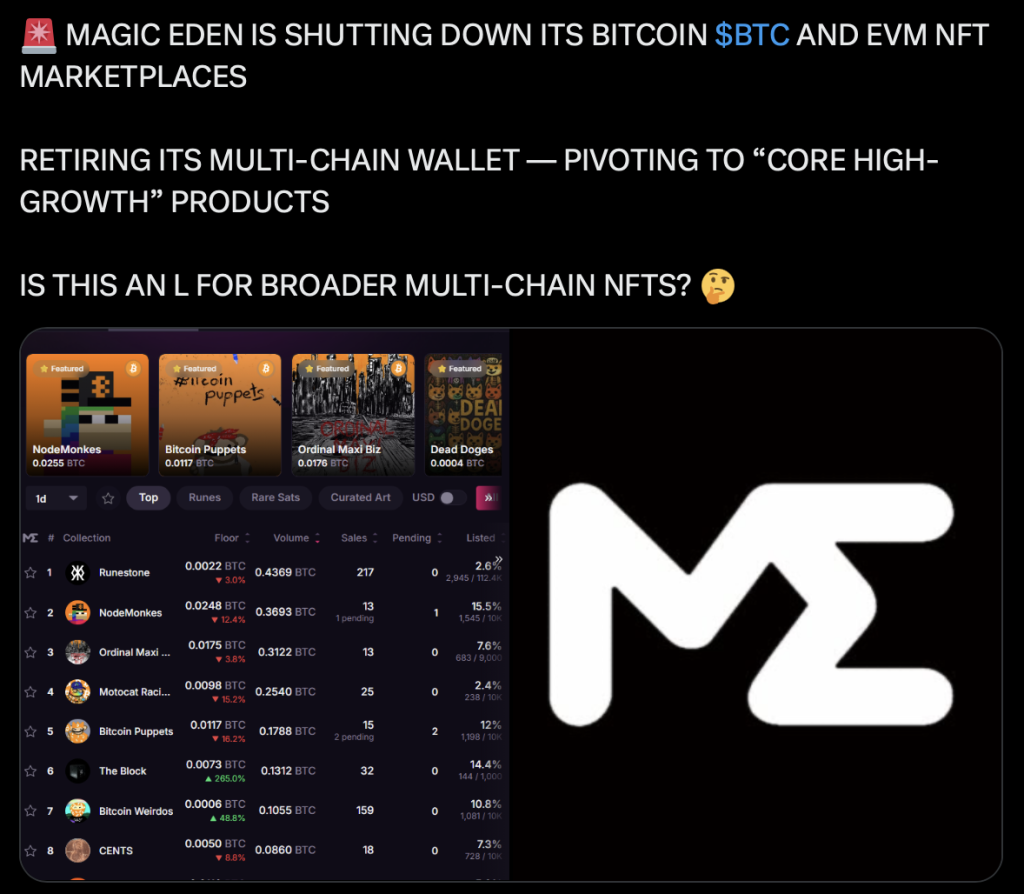
Magic Eden is making a sharp turn. The well-known NFT marketplace has confirmed it will shut down both its Bitcoin Ordinals marketplace and its EVM-based markets, stepping away from Ethereum, Polygon, Avalanche, and similar chains. Even its cross-chain wallet is being retired. In plain terms, the company is narrowing its focus and going back to where it first won — Solana.
This isn’t a small adjustment. It’s a structural reset. Magic Eden built its brand on Solana’s fast, low-cost environment, then expanded aggressively into Bitcoin and EVM ecosystems during the NFT boom of 2023 and 2024. At the time, multi-chain support sounded like the future. But maintaining three very different blockchain infrastructures at once? That’s expensive, complex, and honestly exhausting.
A Strategic Retreat, Not a Collapse
Magic Eden launched in 2021 and quickly became Solana’s dominant NFT venue. The interface was smooth, fees were low, and the timing was perfect. As the broader NFT market heated up, expansion into Bitcoin Ordinals and EVM chains seemed logical — capture more liquidity, widen the moat, compete everywhere.
But each chain comes with its own architecture and culture. Bitcoin Ordinals require a completely different technical stack compared to Solana. EVM chains, meanwhile, meant battling giants like OpenSea and Blur on their home turf, where liquidity and network effects already run deep. Splitting engineering teams across multiple codebases diluted focus. It’s hard to dominate three arenas at once.
By late 2024, the numbers told a clear story. The majority of Magic Eden’s trading volume — reportedly over 85% — still came from Solana. Bitcoin and EVM markets combined contributed a much smaller slice. From a business perspective, the imbalance likely became impossible to ignore.
The Economics Behind the Decision
Industry analysts see this as consolidation, not surrender. The NFT marketplace sector isn’t in its “expand everywhere” phase anymore. It’s maturing. Liquidity concentration, user experience, and ecosystem loyalty matter more than broad but shallow coverage.
Maintaining competitive feature sets across Solana, Bitcoin, and EVM chains requires serious engineering bandwidth. And if most revenue originates from one ecosystem, the rational move is obvious, even if it feels dramatic. Specialization is becoming the survival strategy in Web3.
In that sense, Magic Eden’s pivot looks less like retreat and more like resource optimization. Focus on what works. Strengthen the core. Defend leadership where it’s already strongest.
What Users Need to Do Now
For users, this isn’t theoretical — it’s practical. Bitcoin and EVM marketplace support will sunset, and the cross-chain wallet will be discontinued. That means NFT holders and traders must withdraw their assets before the shutdown deadlines.
Self-custody becomes critical here. Solana users can continue as usual, but Bitcoin Ordinals holders may need to migrate to wallets like UniSat, while EVM users will likely move assets to MetaMask or other native wallets. Failing to withdraw before the final cutoff could mean losing access entirely. Not dramatic — just how platform closures work.
Magic Eden has indicated it will communicate specific timelines clearly. Still, users shouldn’t wait until the last minute. Web3 transitions are smoother when handled early.
A Broader Signal for the NFT Market
This shift reflects something larger happening across Web3 infrastructure. Early on, many projects chased the “everything, everywhere” model. Multi-chain became a buzzword, almost a badge of ambition. But complexity scales fast, and ecosystems behave differently.
Deep expertise in one chain now seems more defensible than stretched presence across many. For Solana, this consolidation is likely positive — Magic Eden’s full attention could accelerate innovation around compressed NFTs, creator tooling, and new asset standards. For Bitcoin and EVM NFT communities, it opens more space for native platforms to compete and evolve.
Magic Eden’s restructuring marks a turning point, not just for the company but for how NFT marketplaces think about growth. In a market that’s no longer euphoric, discipline matters more than expansion. And sometimes, going back to your foundation is the most forward-looking move you can make.