

- SUI is compressing near $0.94 as staking-enabled ETFs tighten already constrained circulating supply.
- Over 74% of SUI is staked, meaning ETF inflows could significantly increase flow-to-price sensitivity.
- A confirmed breakout above $1.05 would validate a potential new macro expansion cycle.
While most of the crypto market drifts sideways, SUI is doing something quieter. It’s stabilizing near $0.94, not exploding, not collapsing — just compressing under resistance. On the surface, it looks uneventful. Structurally though, the pieces underneath are starting to line up in a way that doesn’t usually stay quiet for long.
Because this time, it’s not just chart patterns. It’s supply mechanics.

Institutional Access Changes the Equation
Two U.S.-listed SUI ETFs have officially entered the arena — Grayscale’s GSUI on NYSE Arca and Canary Funds’ SUIS on Nasdaq. That alone matters. But the bigger detail? Both integrate staking yield directly into the product structure.
That’s not a small design choice.
Unlike passive spot ETFs that simply mirror price exposure, these products accumulate SUI in the open market and embed staking rewards into the vehicle. So inflows don’t just track price — they actively remove tokens from circulation. In a market where Ethereum ETFs are still navigating staking clarity, SUI moved forward with yield built in from day one.
And here’s where it gets interesting. Over 74% of SUI’s circulating supply is already staked. That leaves a relatively thin liquid float compared to headline market cap numbers. When ETF inflows add incremental accumulation — and potentially stake those tokens — available supply tightens faster than most models assume.
Bitcoin needed multi-billion-dollar ETF flows to materially shift its structure. SUI doesn’t. Its smaller size lowers the threshold. Even moderate institutional participation can increase flow-to-price sensitivity when supply is constrained.
This isn’t just speculation-driven momentum. It’s regulated capital meeting locked float.
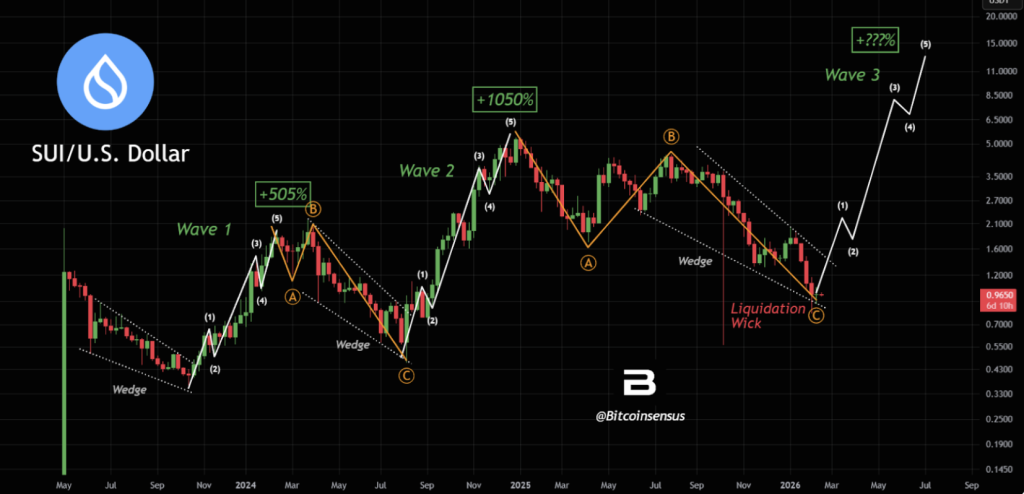
The Chart Is Echoing Prior Expansion Cycles
Technically, the structure feels familiar.
In previous macro cycles, SUI compressed inside descending wedges, printed sharp liquidity sweeps near the lows, reclaimed resistance, and then expanded aggressively — first roughly 500%, then over 1,000% in the second cycle. The pattern repeated: volatility contraction, liquidation wick, resistance reclaim, impulsive breakout.
The current structure shares similarities.
SUI recently completed a corrective wedge, printed a visible downside wick, and reclaimed descending resistance. Since then, price hasn’t retraced sharply. Instead, it’s compressing beneath the $1.00 to $1.05 band — a clear structural pivot.
That zone matters.
A sustained break and hold above $1.05 would signal acceptance above prior supply and potentially confirm the early stages of a new macro expansion wave. Until then, this remains compression — constructive, but not confirmed.
Support sits near $0.88 to $0.90, with deeper backing around $0.82. As long as those levels hold, the higher-low framework remains intact. Break them, and the thesis gets messy.
A Liquidity Corridor Waiting to Break
Derivatives positioning adds tension to the setup.
Liquidation maps show short leverage building above $1.00, while long liquidation clusters accumulate below $0.90. That effectively pins price inside a tightening liquidity corridor. When leverage stacks on both sides of a range, markets rarely drift out quietly. They accelerate.
Spot flow data reinforces the narrative. Periodic exchange outflows during stabilization phases suggest accumulation or staking rather than distribution. When spot demand absorbs supply while derivatives tension builds, volatility expansion often follows.
The decisive trigger remains simple: $1.05.
Clear it convincingly, and the macro expansion thesis gains structural validation. Fail to clear it, and SUI continues to coil beneath resistance. But compression plus institutional inflows plus constrained float is not a neutral mix. It’s pressure.
And pressure, in crypto, eventually resolves.