

- Panos warned that XRPL faces stagnation, with low DEX volume, weak TVL growth, and declining developer interest.
- He proposed a structured deployment of Ripple’s $1B ecosystem fund to attract builders, liquidity, and migrating dApps.
- Without deeper infrastructure upgrades and stronger incentives, XRPL risks falling behind faster-moving chains like Solana and Avalanche.
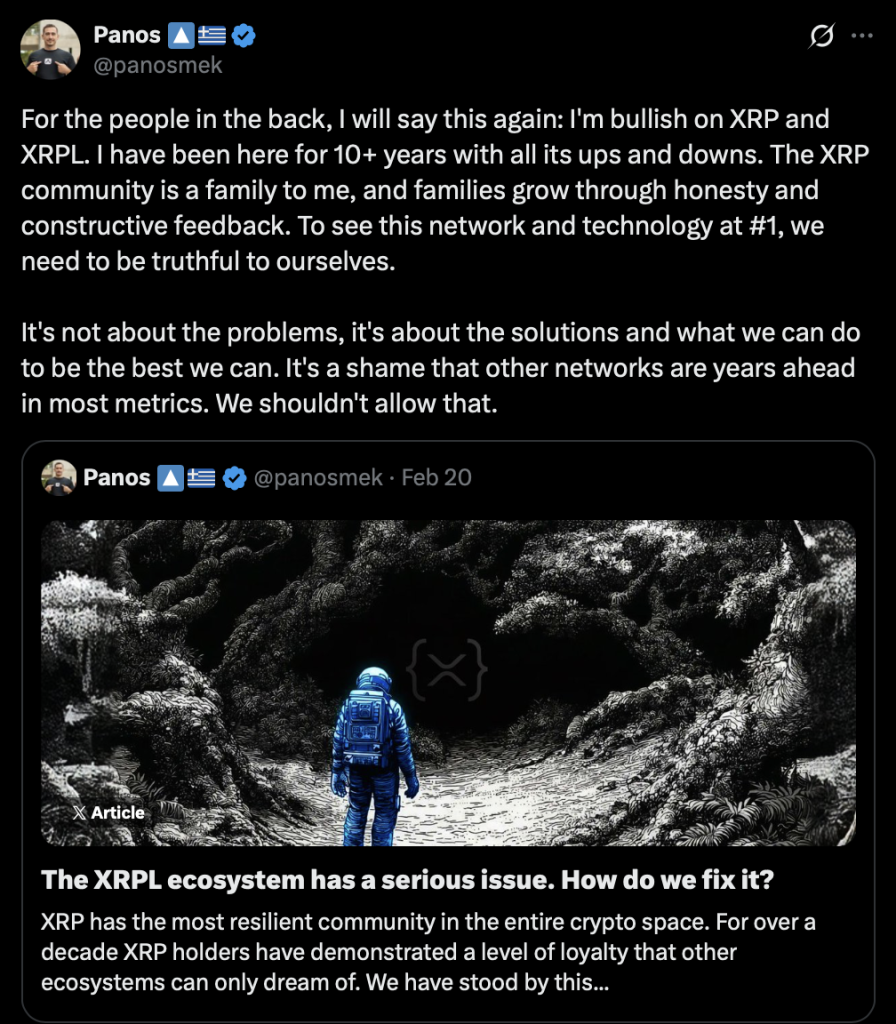
Panos, co-founder and CEO of Anodos Finance, didn’t sugarcoat it on February 20. After more than a decade inside the XRP ecosystem, he said he remains long-term bullish on XRP and the XRP Ledger — but optimism, in his view, has to be grounded in reality. And right now, that reality looks… sluggish.
A Loyal Community, But Slipping Momentum
XRPL still has one of the most loyal communities in crypto. That hasn’t changed. What has changed is the pace of growth.
Daily decentralized exchange volume sits below $10 million. The Automated Market Maker, launched with high expectations two years ago, holds less than $50 million in total value locked. In a market where competing chains routinely post multiples of that in a single day, those numbers feel thin.
Panos pointed out something even more concerning: talent outflow. Developers and builders appear to be leaving faster than they are joining. Venture capital interest remains muted, and among top-tier investors and engineers, XRPL is often viewed as a low-liquidity, low-activity chain. Fair or not, that perception matters.
Meanwhile, competitors like Solana, Base, and Avalanche continue to move aggressively. They attract liquidity. They attract developers. They create noise. Without structural change, Panos warned, XRPL risks drifting further behind — even with XRP ETFs and incremental upgrades.
The $1 Billion Plan That Could Shift the Narrative
Ripple announced a $1 billion XRPL ecosystem fund back in 2022. Panos believes that capital, if deployed strategically, could reignite momentum — but it needs sharper execution and clearer direction.
He outlined four focused grant tracks.
The Genesis Fund would distribute rapid grants between $10,000 and $50,000, helping new developers and early-stage startups launch quickly without suffocating friction. Fast money, simple applications, minimal red tape. Speed matters.
Then comes the Scale-Up Accelerator, offering up to $1 million for projects already demonstrating traction. Funding would be paired with mentorship, development support, and marketing amplification. Not just checks — infrastructure around the checks.
The Exodus Migration Fund proposes allocating $100 million to attract successful dApps from other blockchains. Instead of waiting for organic growth, XRPL could import it. Aggressively.
Finally, the Global Exposure Fund would provide up to $1 million per initiative aimed at mainstream awareness — sponsorships, events, campaigns. The idea is simple: if XRPL wants to be seen as a global financial network, it has to act like one.
Liquidity, talent, and users. That’s the trifecta Panos keeps returning to.
Infrastructure First, Hype Later
Beyond grants, Panos stressed infrastructure. Without strong foundations, incentive programs won’t stick.
He highlighted the need for seamless native deposit and withdrawal rails, deeper liquidity support for larger investors, and more structured developer tooling. Sandboxes. Standardized documentation. Regular bug bounties to keep core engineers engaged instead of drifting toward faster-growing ecosystems.
Community participation also plays a role. Governance, product testing, storytelling, organizing events — these aren’t side activities, they’re growth levers. If the ecosystem wants to shift perception, it can’t rely on Ripple alone.
In Panos’ view, XRPL doesn’t lack potential. It lacks velocity.
The bullish case for XRP still exists. But without decisive structural moves — and quickly — the gap between narrative and network activity could widen. Crypto doesn’t wait around for quiet chains to figure it out.