

- Cardano is holding a multi-year accumulation zone after a deep correction
- A breakout above $1.00–$1.20 would mark a major structural shift
- The setup favors patient, long-term positioning rather than short-term momentum chasing
Cardano has spent years sliding lower after its 2021 peak, wearing down even its most patient holders. For many traders, ADA slowly drifted into the background, overshadowed by faster narratives and louder ecosystems. But a new high-timeframe chart shared by analyst Crypto Patel suggests something important may be forming, quietly.
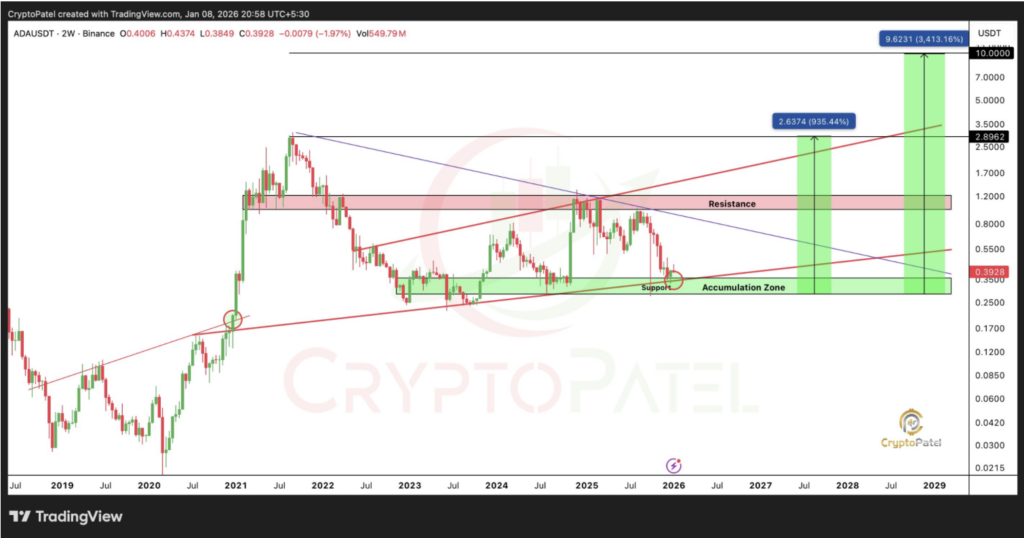
According to his analysis, Cardano is no longer just drifting. It’s sitting on a multi-year base that could determine whether ADA finally turns higher, or continues its long stretch of underperformance. At the time of the chart, ADA was trading near $0.40, far removed from its all-time high, yet notably stable given the length and depth of the correction.
A Multi-Year Base Starts to Matter
Instead of breaking down further, Cardano has settled into a wide accumulation zone that’s held across several market cycles. That alone changes the conversation. Patel points out that price has repeatedly found support between roughly $0.38 and $0.28, surviving the 2022 bear market and subsequent macro-driven sell-offs without losing structure.
On the two-week timeframe, ADA is compressing into a large symmetrical pattern that’s been forming since the 2021 top. Rising long-term support is pressing upward while a descending resistance line continues to cap price from above. That tightening range creates pressure, and markets usually don’t stay compressed like this forever.
The Level That Changes Everything
For Patel, the key zone to watch sits between $1.00 and $1.20. A sustained move above that range wouldn’t just be another relief rally. It would signal a structural shift, the kind that resets how the market views ADA altogether. Until then, Cardano remains technically neutral, building energy rather than releasing it.
If that breakout were to occur, Patel outlines longer-term targets at $2.60, $5.00, and potentially $10 over time, assuming broader market conditions cooperate. On the flip side, he’s clear about where the idea breaks down. A weekly close below $0.28 would weaken the entire bullish thesis and suggest the base has failed.
Why This Setup Feels Different
What stands out most isn’t the upside targets themselves, it’s the amount of time spent building this base. Cardano has already gone through a deep, multi-year reset that flushed out leverage and speculative excess. Those kinds of structures tend to attract patient capital, not fast money chasing momentum.
That doesn’t mean ADA is suddenly the fastest horse in the race. It still lags flashier sectors like meme coins and high-throughput chains, and volume confirmation is still missing. But from a structural standpoint, this is the strongest long-term chart Cardano has printed since the last cycle.
A Grounded Outlook for ADA
The $10 scenario should be viewed as a long-term possibility, not an imminent destination. Right now, the more important question is whether ADA can continue defending its accumulation zone and eventually reclaim the $1.00–$1.20 area. If it does, the long period of sideways frustration may start to look more like preparation than stagnation.
Until that happens, Cardano remains a patience trade. Downside levels are becoming clearer, while upside depends on whether the broader market gives ADA the conditions it needs to finally break free from its long shadow.