

- Dogecoin has slipped from its early 2026 highs, with some analysts warning of a potential 50% downside if selling pressure continues
- Weak interest in spot DOGE ETFs contrasts sharply with stronger inflows seen in other assets like XRP
- Despite bearish momentum, whale accumulation and bullish technical signals keep rebound scenarios in play
Dogecoin came into 2026 with plenty of excitement, riding a sharp early move higher. That optimism didn’t last long. Over the past few days, the largest meme coin by market cap has clearly rolled over, slipping into a steady decline that’s starting to test trader confidence again.
Now, some analysts are warning the drop may not be finished. In fact, a few are openly discussing the possibility of a much deeper correction, one that could cut DOGE’s price in half.
Bearish Pressure Creeps Back In
On January 6, Dogecoin pushed to a local high above $0.15, briefly reigniting hopes of a broader breakout. Since then, sellers have taken control. DOGE has drifted lower and now trades near $0.13, according to CoinGecko, with little sign of aggressive dip buying so far.
Analyst Ali Martinez has taken a particularly cautious stance. He suggested that if selling pressure continues, Dogecoin could slide toward the $0.06 area. That would represent a drop of roughly 53% from current levels and would place DOGE at its lowest price since November 2023. It’s not a popular call, but it’s one that’s gaining traction as momentum weakens.
ETF demand, or the lack of it, isn’t helping the bullish narrative. Grayscale launched the first spot DOGE ETF in the U.S. late last year, followed shortly by Bitwise. Expectations were high. Reality, not so much.
Data from SoSoValue shows that these DOGE-focused ETFs have pulled in less than $7 million in cumulative net inflows so far. That’s a small number by any standard, and it suggests that large institutional players, pension funds, hedge funds, asset managers, are still sitting this one out.
The contrast is sharp. Spot XRP ETFs, which also launched toward the end of 2025, have already attracted more than $1.22 billion in net inflows. Against that backdrop, DOGE’s ETF performance looks underwhelming.
The Bullish Case Still Has Believers
Despite the growing caution, not everyone is convinced Dogecoin is headed for a collapse. Several analysts argue the current pullback could be setting up the next leg higher, not a breakdown.
X user CryptoPulse outlined a bullish technical setup, pointing to strong breakout volume, an RSI golden cross, and a MACD that remains in bullish territory. Based on those signals, they believe DOGE could rebound toward the $0.20 to $0.21 range in the short term if momentum turns.
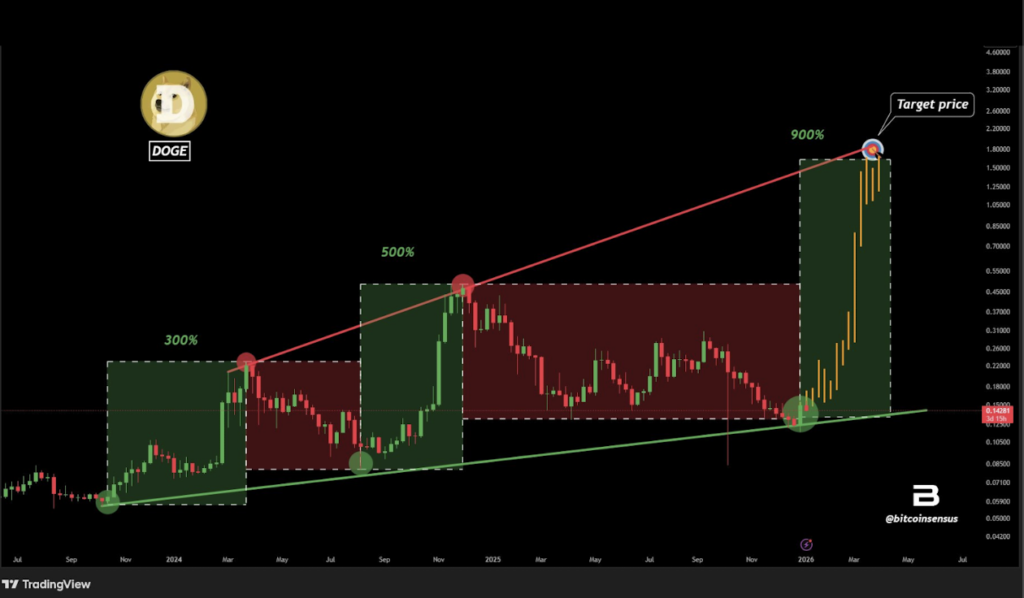
Others are far more ambitious. Bitcoinsensus suggested that Dogecoin’s current cycle could mirror past bull runs, projecting a potential 900% rally that could carry the price as high as $1.80. It’s an aggressive target, no doubt, but meme coins have a habit of surprising markets when sentiment flips.
Whales Are Buying, Quietly
One of the more constructive signals comes from whale activity. Large holders have been accumulating DOGE during the recent weakness. X user CEO reported that whales snapped up nearly 140 million DOGE, worth close to $20 million, in just a 12-hour window.
That kind of buying reduces circulating supply and can help stabilize price, especially if demand doesn’t fade further. It also tends to draw attention from smaller traders, who often follow whale behavior into positions of their own.
For now, Dogecoin sits at a familiar crossroads. Price is slipping, sentiment is split, and conviction isn’t uniform. Whether DOGE heads toward a painful reset or stages another meme-fueled comeback will depend on which side wins out first, fading momentum, or renewed demand.