

- Cardano closed 2025 down roughly 60% after extreme volatility and failed breakouts
- AI forecasts suggest 2026 could range from further downside to long consolidation
- A true bullish revival depends on real ecosystem usage, not speculation alone
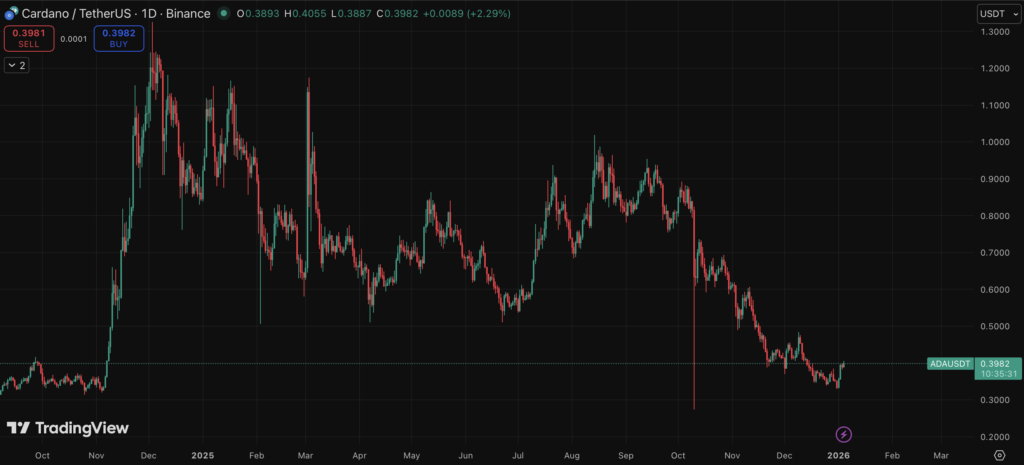
Cardano’s native token was one of the standout performers following Donald Trump’s landslide election win at the tail end of 2024. In a matter of weeks, ADA ripped from just above $0.30 to a multi-year high near $1.30, fueled in part by optimism after Charles Hoskinson hinted at potential cooperation with the incoming administration. For a moment, it felt like Cardano was back in the spotlight, and staying there.
That momentum didn’t last. After a short pullback, ADA entered 2025 trading around $0.85 and quickly became one of the more volatile large-cap assets on the board. It reclaimed $1.00 almost instantly, then collapsed below $0.55, only to surge again toward $1.20 by March. The rest of the year told a different story. A long, grinding correction followed, interrupted by a few sharp but brief spikes in late August, before ADA sold off heavily into year-end, closing 2025 down roughly 60%.
With 2026 now underway, the big question is whether Cardano can recover, or if the pain isn’t quite over yet.
A Bearish Outlook Still Looms
After such a frustrating year, some AI-based forecasts suggest the pressure could continue, at least early on. One scenario flagged by ChatGPT warns that if the broader crypto market remains selective in 2026, ADA may struggle to regain relevance among large-cap altcoins. The disappointment that followed its early-2025 surge could still be weighing on sentiment.
In that bearish case, ADA could slide toward the $0.10 to $0.15 range, levels not seen since deep bear market conditions. Losing remaining support zones could trigger capitulation among long-term holders, especially if confidence continues to erode. A move like that would represent another sharp drawdown from current prices, and would likely test even the most patient investors.
A More Likely Base Case Emerges
That said, even the AI models acknowledge such an extreme drop feels unlikely right now. The more probable outlook for 2026, according to ChatGPT, is a prolonged period of consolidation. In this base case, ADA would trade in a broad range between $0.30 and $0.80, neither collapsing nor staging a meaningful breakout.
This kind of sideways action wouldn’t be flashy, but it would allow the market to reset expectations. After years of volatility and broken narratives, a dull phase might actually be what Cardano needs, though it’s not exactly what holders are hoping for.
The Bull Case Depends on Real Traction
There is, however, a more optimistic scenario on the table, even if it leans speculative. In a bullish revival, ADA could push back above the stubborn $1.00 resistance and aim for price levels not seen in years. If Cardano’s ecosystem starts showing genuine traction, more active decentralized applications, real usage, not just announcements, then a move toward $2.00 or even $3.00 isn’t off the table.
According to the AI analysis, such a rally would likely require a familiar mix. Renewed speculative interest paired with improved on-chain activity. That combination has powered explosive moves in past cycles, and if it returns, ADA could surprise a lot of skeptics. For now though, that outcome remains a possibility, not a promise.