

- BNB Chain’s 2026 roadmap targets high-speed, trading-focused infrastructure.
- The network delivered zero downtime in 2025 while processing record transaction volumes.
- Future upgrades aim for 20,000 TPS, sub-second finality, and eventual million-TPS capacity.
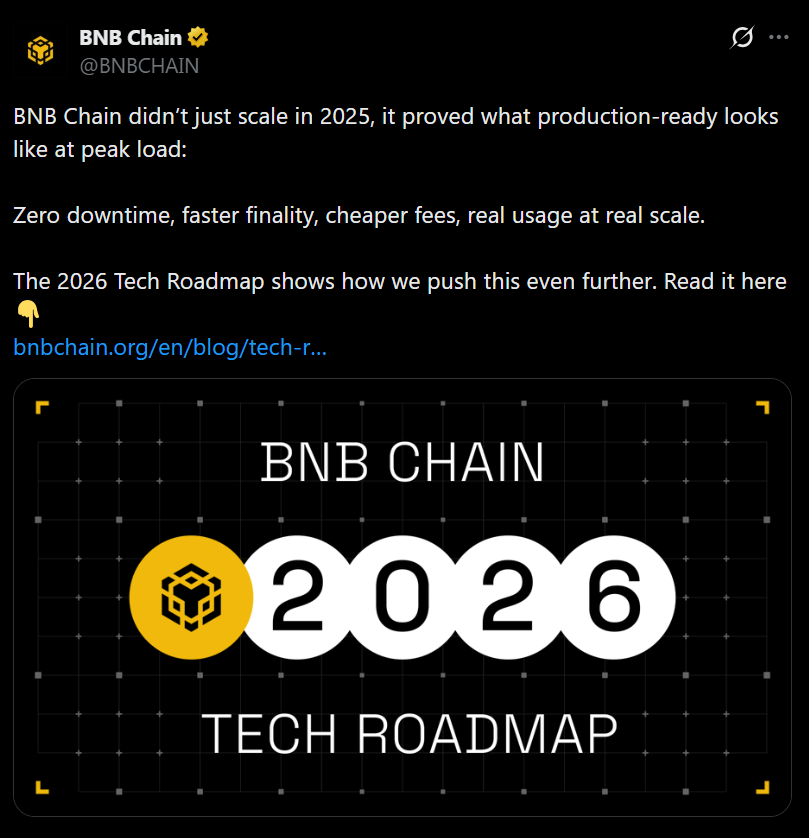
BNB Chain has published its 2026 technical roadmap, outlining an ambitious plan to evolve the network into a highly optimized, trading-focused blockchain. The update follows a strong 2025, where the chain proved it could operate at scale without downtime, even under heavy load. According to the team, last year’s performance laid the groundwork for a much bigger push toward speed, efficiency, and institutional-grade reliability.
A Strong Foundation Built in 2025
BNB Chain closed 2025 with uninterrupted uptime while processing record levels of activity, including peak days with as many as 31 million transactions. Core upgrades helped reduce block times to roughly 0.45 seconds and finality to just over one second, all while cutting transaction fees by around 20x. Notably, these improvements were made without sacrificing validator rewards, a balance many networks struggle to maintain.
Adoption and Capital Growth Accelerate
Beyond performance metrics, adoption across the network expanded rapidly. Total value locked rose more than 40% year-over-year, while transaction counts jumped 150%. Asset demand followed a similar trajectory. Stablecoin market capitalization on BNB Chain doubled to a peak near $14 billion, and real-world asset value climbed past $1.8 billion. That growth was supported by institutional issuers including BlackRock’s BUIDL, Franklin Templeton’s BENJI, and VanEck’s VBILL, signaling increasing enterprise confidence in the network.
Scaling Toward 20,000 TPS and Beyond
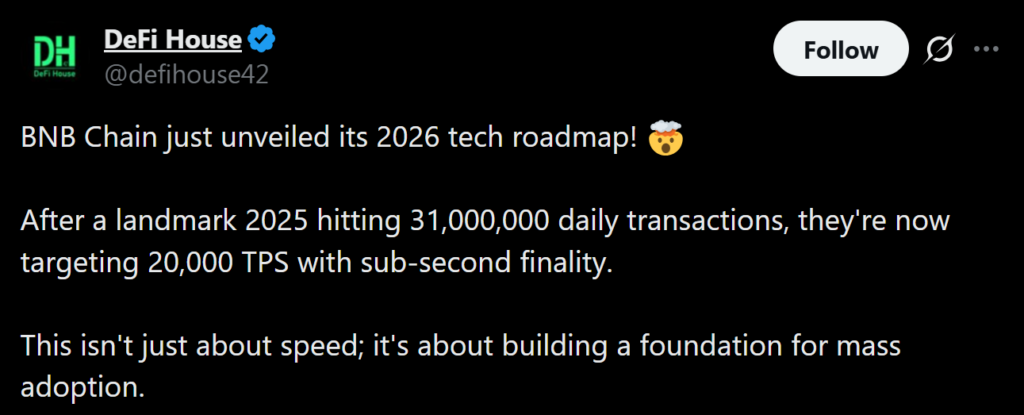
Building on those gains, the 2026 roadmap focuses on scaling throughput to roughly 20,000 transactions per second while maintaining sub-second finality and low fees. To achieve this, BNB Chain plans to introduce a dual-client setup, continuing to use Geth for stability while adding a new Rust-based Reth client designed for higher performance. Parallel execution, storage upgrades, and database improvements are also planned to manage long-term state growth more efficiently.
Preparing for a Next-Generation Trading Chain
On the developer side, the roadmap includes new middleware designed to support privacy features, AI agents, and more efficient application architectures. Longer term, the team is laying the foundation for a next-generation trading chain with near-instant confirmations and eventual capacity approaching one million TPS. Importantly, the plan includes optional migration paths, allowing existing applications to upgrade gradually rather than being forced into disruptive changes.