
- TRON reached record user and transaction growth in 2025, even as TRX suffered its weakest Q4 since 2017.
- Fee cuts and USDT dominance turned TRON into a major payment rail, but reduced short-term revenue incentives.
- The gap between adoption and price highlights why strong fundamentals don’t always drive immediate token gains.
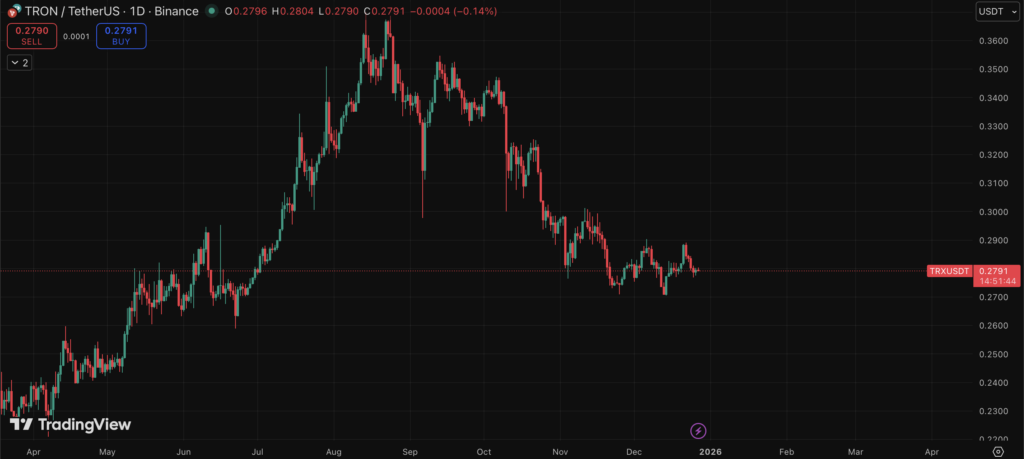
TRON just wrapped up one of its strongest on-chain growth phases ever, even as TRX holders endured the token’s roughest fourth quarter since 2017. User numbers climbed at a record pace, transactions stayed consistently high, yet the token itself slid more than 16% in Q4. It’s one of those moments that quietly reminds people new to crypto that strong fundamentals don’t always translate into quick price gains, at least not right away.
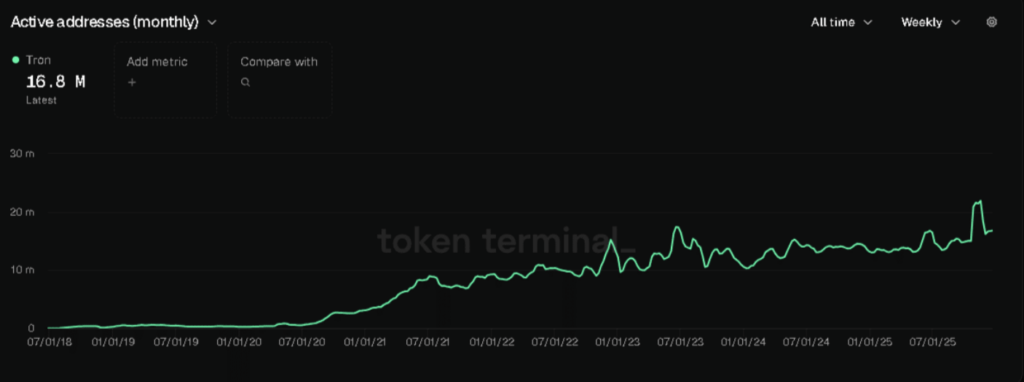
By December 2025, TRON had crossed 355 million total accounts and was regularly processing between 8.8 and 10.2 million transactions per day. That’s serious usage by any standard. Still, market attention drifted elsewhere, with Bitcoin ETFs, Solana, and Ethereum soaking up most of the narrative. TRX, meanwhile, lagged, showing just how disconnected adoption data and short-term speculation can be.
Why TRON Is Busy While TRX Falls
Think of TRON as a crowded highway and TRX as the toll ticket to use it. The highway has never been busier, but the ticket price still dropped. That feels strange at first, but the reasons are fairly straightforward once you zoom out.
In August 2025, TRON cut average network fees by roughly 60%. That single move made it significantly cheaper to move money, especially stablecoins, and helped TRON overtake both BNB Chain and Solana in daily active users. At the same time, TRON doubled down as the main settlement layer for USDT, the world’s largest stablecoin.
There was a trade-off, though. Validator income took a hit, with Super Representative revenue dropping sharply after fees were slashed. In simple terms, TRON chose volume and utility over short-term economics for its validators. USDT on TRON now accounts for more than half of all USDT in circulation and settles over $22 billion in value every day. That kind of real-world usage is massive, but it doesn’t automatically push TRX higher when traders are chasing flashier stories.
Adoption Doesn’t Always Equal Price Action
We’ve seen this pattern before. Other networks have shown rising activity while their tokens struggled, and TRON is now another clean example. People are clearly using the network, mostly as a cheap and fast rail for digital dollars, but that doesn’t guarantee speculative demand for TRX itself.
For everyday investors, this creates an uncomfortable but important lesson. Network growth can be real, measurable, and impressive, while the token price still underperforms for months. In hype-driven markets, attention often matters more than utility in the short term.
What This Means for Regular Crypto Investors
TRON’s story forces a simple question: should you only follow price momentum, or should you pay attention to where people are actually transacting? TRON’s dominance in stablecoin transfers, daily users, and retail payments points to genuine demand, even if it feels a bit boring compared to meme coins or fast-rising Layer-1s.
The network has also stepped quietly into more serious territory. The U.S. Commerce Department selected TRON to publish hashes of official GDP data on-chain. A hash is essentially a digital fingerprint, and putting it on a blockchain allows anyone to verify that the data hasn’t been altered. That’s not hype, it’s infrastructure-level trust.
Still, TRX doesn’t trade in isolation. It sits in the same risk bucket as other altcoins. When sentiment turns defensive, even useful networks feel the pressure. Ethereum’s own sharp pullbacks show how fast capital rotates away from anything that isn’t Bitcoin during uncertain periods.
Is TRX a Long-Term Opportunity or Just Another Risk?
On one side, TRON has strong user growth, dominant stablecoin flows, and even government-related use cases. That appeals to long-term thinkers who care about utility over narratives. On the other side, TRX remains a speculative altcoin competing with giants like Ethereum, Solana, and BNB Chain.
If you’re considering TRX, it’s best treated as a small, speculative position rather than a core holding. Price can drop hard during risk-off phases, regardless of how healthy the network looks on paper. A sensible approach, especially for beginners, is to understand how stablecoins and low-fee networks work first, then size any TRX exposure conservatively inside a diversified portfolio.
TRON’s divergence between usage and price is likely to stay a talking point as the market heads into 2026. Whether real-world activity eventually matters more than short-term hype is still an open question.