- XRP has flipped Binance Coin to become the fourth-largest cryptocurrency, marking a major shift in market positioning
- Strong ETF inflows and rising institutional interest are driving XRP’s recent momentum
- Falling exchange balances suggest a tightening supply as demand continues to build
For nearly five years, XRP was known less for what it did on-chain and more for where it showed up, inside a Manhattan courtroom. Legal headlines followed it everywhere, often drowning out conversations about adoption or utility. But as 2026 gets underway, that chapter appears to be closing, quietly but decisively.
XRP has now flipped Binance Coin to become the fourth-largest cryptocurrency by market cap, a move that feels symbolic as much as it is numerical. It signals a shift in narrative, one where XRP is being discussed again as a market force, not a legal case study. Naturally, the question is, what changed?
Institutional Demand Drives XRP’s Breakaway Move
At the center of XRP’s recent strength is a noticeable surge in institutional interest. Data from SoSoValue shows that Ripple-linked spot ETFs pulled in $13.6 million in net inflows in just 24 hours. That single day pushed total cumulative inflows to roughly $1.18 billion, with net assets now sitting around $1.37 billion, a sizable footprint by any measure.
This isn’t happening in isolation. Bitcoin ETFs attracted about $471 million on the same day, while Ethereum products brought in roughly $174 million, according to Farside Investors. Still, XRP’s momentum stands out in relative terms. Bitcoin and Ethereum are already deeply embedded institutional plays. XRP’s rise, by contrast, represents a redistribution of attention and liquidity away from long-established competitors, and that shift matters.
Technical Picture Confirms the Momentum
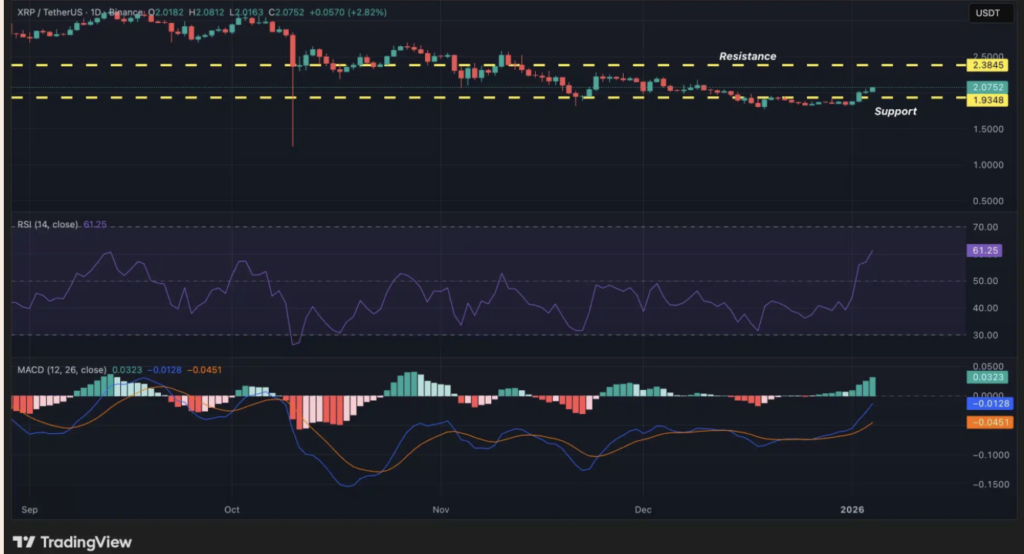
The inflow story is showing up clearly on the charts. Over the past 24 hours, XRP climbed roughly 3.84%, pushing price toward $2.07. Unlike past rallies that leaned heavily on speculation, this move is being supported by healthier technical signals.
RSI is firmly in bullish territory, sitting above neutral levels without flashing overbought warnings just yet. At the same time, the MACD line has crossed cleanly above the signal line, a classic bullish crossover that often appears at the early stages of sustained trends. The setup isn’t euphoric, but it does look controlled, which tends to be more durable.
BNB, meanwhile, told a different story. While XRP pushed higher, Binance Coin slipped about 1.48% over the same period, trading near $884.88. The contrast only sharpened the narrative around XRP’s relative strength.
Shrinking Supply Tightens the Structure
Behind the price action, on-chain data points to a deeper structural shift. Glassnode reports that XRP balances on centralized exchanges have fallen to roughly 1.6 billion tokens, the lowest level seen since 2018. That’s a steep drop, representing about a 57% decline from the highs recorded in late 2025.
Lower exchange balances don’t guarantee higher prices, but they do change the math. With fewer tokens readily available for sale, new demand tends to have a stronger impact. When that tightening supply is paired with steady ETF inflows and continued expansion of Ripple’s payments ecosystem, the setup starts to look meaningful.
If institutional demand continues to build at this pace, XRP may be approaching one of its most important inflection points in nearly a decade. Not overnight, not without volatility, but structurally, things are clearly different this time.