
- XRP exchange balances have dropped sharply, signaling reduced sell-side pressure and tightening supply
- Institutional demand remains strong, with over $1.14 billion in cumulative inflows into XRP ETFs
- As the Clarity Act approaches, XRP’s cleaner structure positions it well heading into 2026
The market is already starting to talk about 2026, and this time it’s not just noise. A few real signals are lining up, especially on the regulatory side, and traders seem to be leaning in early.
One of the biggest catalysts on the table is the upcoming Clarity Act, expected to move into markup in early January. According to AMBCrypto, this could redraw the lines for how Layer 1 blockchains compete in the U.S. market. If the rules become clearer, capital usually follows, and Layer 1 networks tend to benefit first. In that context, Ripple’s XRP appears to be quietly front-running the narrative.
XRP Supply on Exchanges Is Drying Up
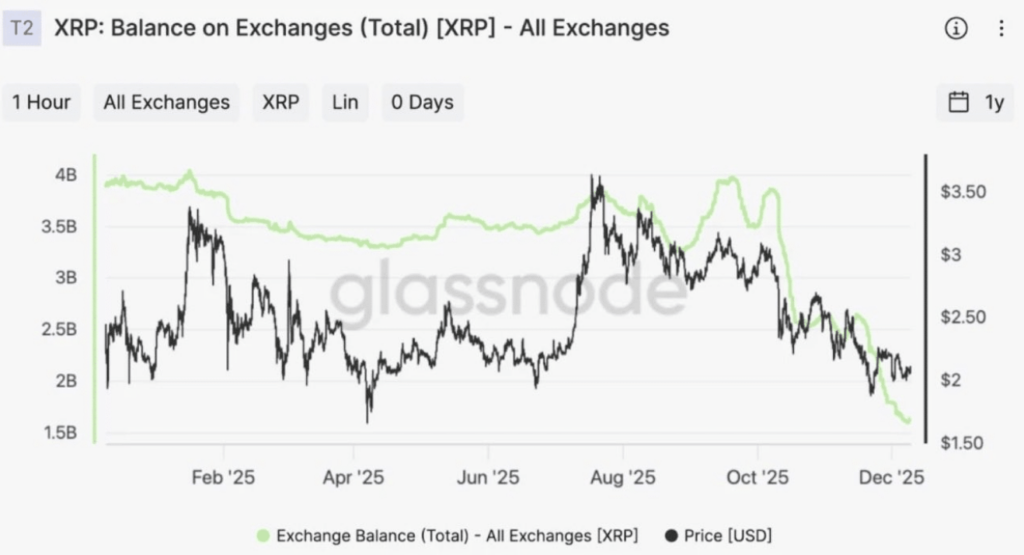
Glassnode data shows a meaningful shift happening behind the scenes. XRP balances on exchanges have dropped sharply, falling from roughly 4 billion tokens at the start of the year to around 1.5 billion today. That kind of decline typically signals thinning sell-side liquidity, which changes the supply-demand balance even if price action looks unimpressive.
At the same time, institutional interest hasn’t slowed. XRP-focused ETFs have now attracted about $1.14 billion in cumulative net inflows across five separate products. That steady capital flow lines up with AMBCrypto’s broader Layer 1 thesis and suggests larger players are positioning rather than exiting.
With on-chain demand holding firm and leverage cooling off, bulls appear to be viewing regulatory clarity as a longer-term catalyst instead of a short-lived trade.
Is XRP’s Dip Below $2 a Breakdown or a Reset?
The move below $2 has rattled sentiment, but the structure underneath tells a more balanced story. XRP hasn’t collapsed the way many altcoins have, and selling pressure appears more controlled than earlier in the cycle.
This raises a key question. Is XRP breaking down, or simply resetting after a crowded trade? Given the combination of shrinking exchange supply, ETF inflows, and steady on-chain activity, the latter looks increasingly plausible.
Altcoins Struggle as Rotation Remains Limited
Zooming out, 2025 has been unforgiving for altcoins overall. Most are still trading well below their late Q3 highs, and the Altcoin Season Index reflects that hesitation. After peaking near 80 earlier in the cycle, the index now sits closer to 37, showing how little capital has rotated into higher-risk names.
Even large caps haven’t been spared. Solana is down roughly 40% on the year, while XRP has slipped only about 12%. That relative outperformance matters, especially when the broader market remains cautious.
Leverage Flush Gives XRP a Structural Edge
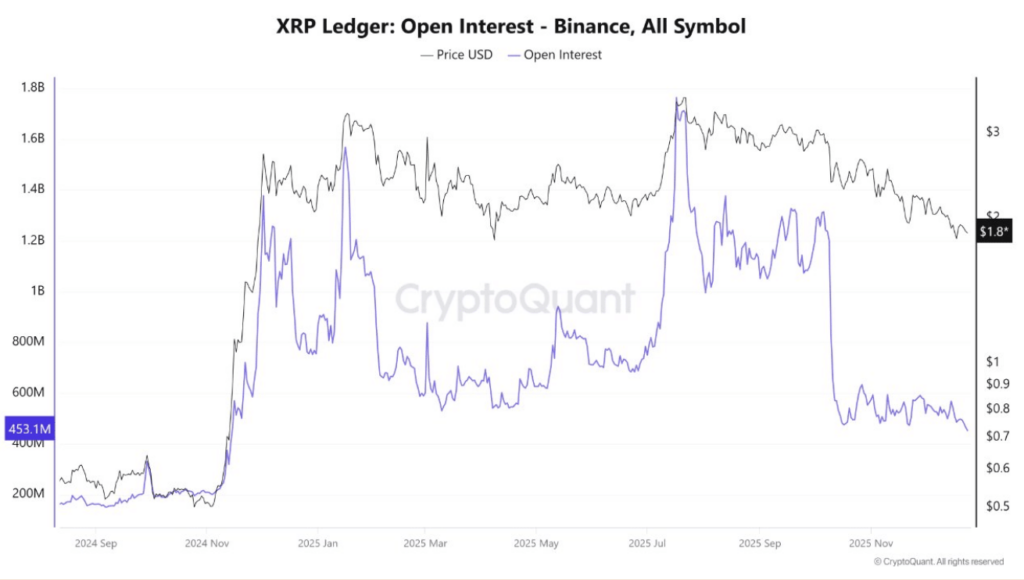
One of XRP’s quieter strengths right now is what’s missing: excess leverage. Open interest on Binance has fallen to around $453 million, the lowest level since early 2024. That suggests speculative froth has largely been cleared out.
From AMBCrypto’s view, this gives XRP a cleaner setup compared to many peers. With leverage reduced, on-chain demand intact, and regulatory clarity approaching, XRP looks structurally healthier than most large-cap alternatives.
Seen through this lens, XRP’s move below $2 feels less like a failure and more like a pause. If the Clarity Act delivers as expected, XRP could be well-positioned not just to recover, but to lead as markets begin pricing in 2026.