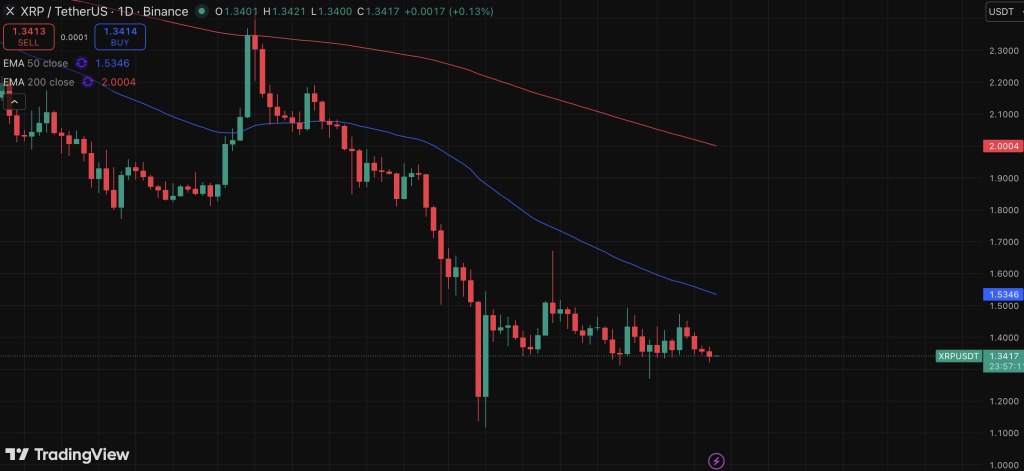
- XRP has historically experienced sudden price surges following long consolidation phases.
- Institutional infrastructure around XRPL is expanding through EVM compatibility and RLUSD.
- Regulatory developments like the CLARITY Act could influence future institutional adoption.
The crypto market has always had a strange relationship with patience. Some assets grind upward slowly over months or even years. Others… move differently. XRP has often belonged to that second category. Throughout its history, the token has spent long stretches trading quietly, almost uneventfully, before suddenly exploding into sharp rallies that catch traders off guard.
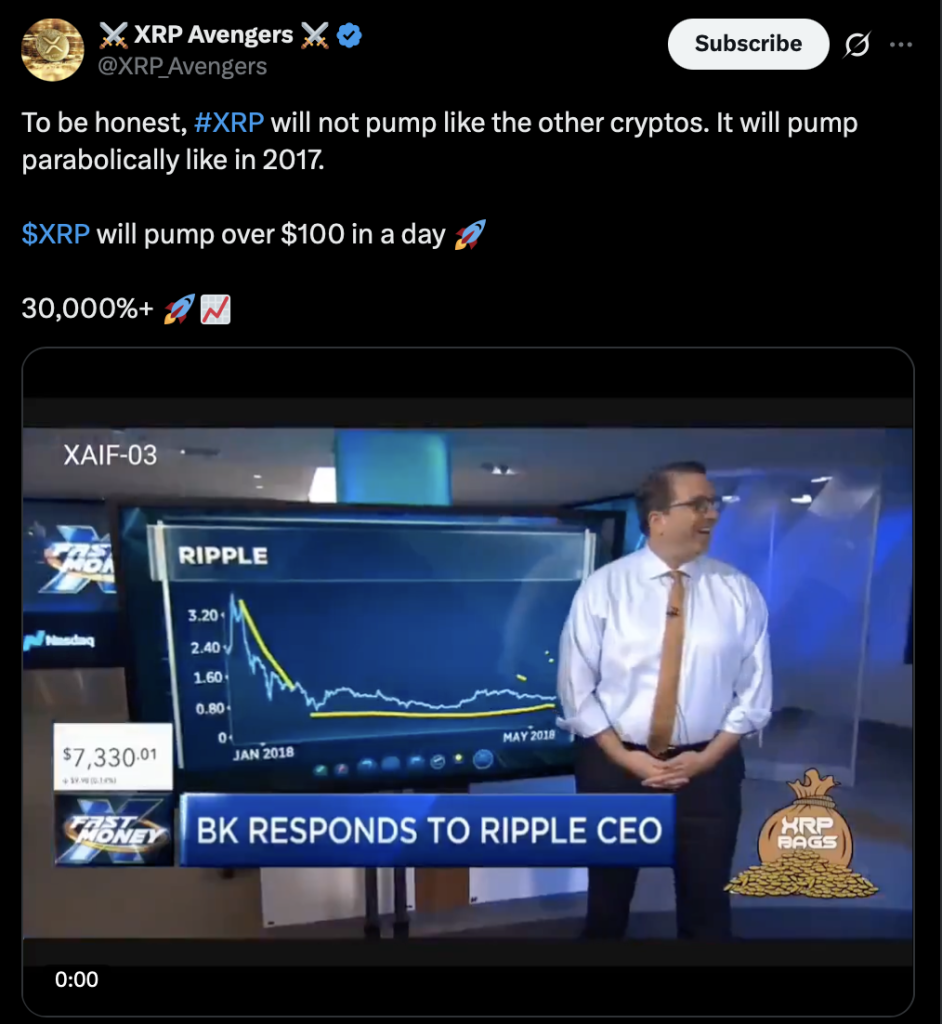
That behavior has kept analysts debating XRP’s long-term potential for years. Every time the market slows down, speculation tends to reappear about whether the asset might repeat one of its historic breakout runs. Recently, crypto commentator XRP Avengers reignited that discussion in a post on X, suggesting that XRP’s next major move could arrive much faster — and more aggressively — than many people expect.
Analysts Point to XRP’s Unusual Market Behavior
According to XRP Avengers, the token doesn’t always follow the slow, stair-step growth pattern seen in many other cryptocurrencies. Instead, its price has historically moved in bursts. Long consolidation phases often build quietly beneath the surface, and then — once momentum finally appears — the move can accelerate quickly.
The analyst argued that if XRP eventually breaks out of its current structure, the rally could become extremely steep. In fact, the post suggested a scenario where XRP might surge beyond $100 in a single day. That would represent a gain of more than 30,000% from lower price levels.
Of course, predictions like that sit firmly in the speculative category. Crypto markets are known for dramatic moves, sure, but projections of that scale still rely on a lot of assumptions. Still, the idea reflects a broader belief among some traders that XRP’s liquidity dynamics could allow rapid price discovery if demand spikes suddenly.
Institutional Infrastructure Around XRPL Is Expanding
Beyond pure speculation, several developments inside the XRP ecosystem have also started attracting attention from analysts and institutions alike. Ripple has spent the past few years quietly expanding the capabilities of the XRP Ledger, aiming to position the network as infrastructure for enterprise-level financial activity.
One of the more significant upgrades is the introduction of an EVM-compatible sidechain for XRPL. This allows developers to deploy Ethereum-style smart contracts while still benefiting from the speed and relatively low fees associated with the XRP Ledger. In practice, that opens the door for a wider range of decentralized finance applications to be built on the network.
Another important step came with the launch of RLUSD, Ripple’s regulated stablecoin introduced in December 2024. The asset was designed to function as a compliant settlement tool inside the XRPL ecosystem, particularly for institutions that require regulated payment rails when interacting with blockchain infrastructure.
Developers Push XRPL Toward Institutional Finance
The ecosystem itself has also started expanding beyond simple payments. Developers are experimenting with a variety of new tools across XRPL, including lending protocols, tokenized asset systems, and privacy-focused infrastructure designed for enterprise users.
These developments suggest a gradual shift. Rather than focusing only on retail speculation, parts of the XRP ecosystem are trying to attract institutional capital and traditional financial activity. Tokenized assets, lending markets, and on-chain settlement tools are all areas where blockchain technology is increasingly intersecting with conventional finance.
If those efforts succeed, they could significantly expand the amount of capital interacting with the network.
Regulation Could Shape the Next Phase of Growth
Another major variable in the XRP discussion remains regulation — particularly in the United States. Lawmakers continue debating the Digital Asset Market CLARITY Act, a legislative effort aimed at defining how cryptocurrencies should be classified and regulated.
The proposed framework attempts to clarify whether digital assets fall under securities law or commodity oversight, while also outlining the roles of agencies like the SEC and the CFTC. Supporters argue that clearer rules could remove a large portion of the uncertainty that has historically slowed institutional participation in crypto markets.
For XRP specifically, regulatory clarity could play an outsized role in shaping future adoption.
Speculation Continues as the Market Watches
Predictions of a sudden $100 rally remain highly speculative, and even optimistic analysts acknowledge that such a move would require extraordinary market conditions. But XRP’s history of sudden price expansions — combined with ongoing development around XRPL and shifting regulatory discussions — keeps the possibility alive in the minds of some market watchers.
For now, traders and analysts continue watching two things closely: technological progress inside the XRP Ledger ecosystem, and policy developments in Washington. Somewhere between those forces may lie the next major chapter in XRP’s market story.