
- A new XRP valuation model suggests prices between $23 and $514 depending on adoption levels across global financial markets.
- The framework focuses on cross-border payments, tokenized assets, and the replacement of traditional banking liquidity systems.
- Analysts argue XRP’s regulatory clarity and potential settlement role could become key drivers of future demand.
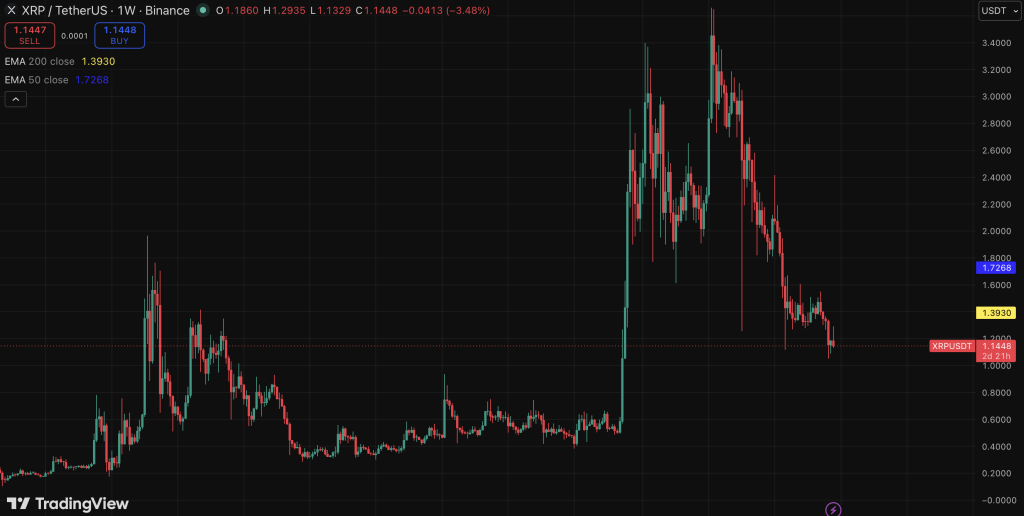
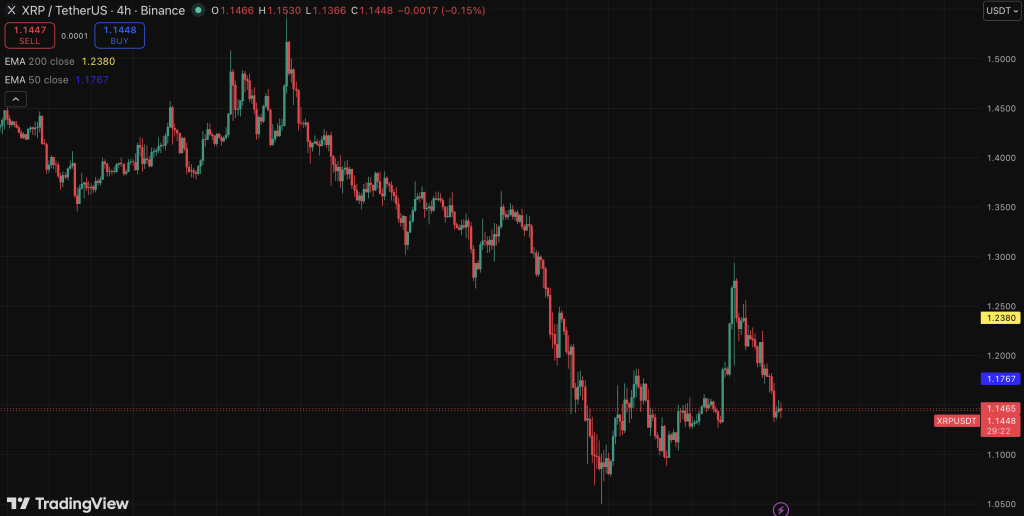
XRP is currently trading around $1.16, but one analyst believes the token’s long-term potential could be dramatically higher if it secures even a small share of global financial settlement activity.
Using what he describes as a conservative mathematical framework, the analyst estimates XRP could eventually be worth anywhere from $23 to $514 per coin. The projection is based on three specific use cases: cross-border payments, tokenized asset settlement, and the gradual replacement of traditional nostro and vostro banking accounts.
While these figures remain theoretical, they highlight how some investors are viewing XRP not simply as a cryptocurrency, but as infrastructure for moving value across global financial networks.
Cross-Border Payments Could Create Trillions in Demand
The first part of the model centers on international payments.
According to the analysis, SWIFT currently facilitates roughly $150 trillion in cross-border payment messages every year. Ripple’s growing connectivity with global payment systems has fueled speculation that XRP could eventually be used as a settlement layer that reduces the need for banks to maintain large pools of pre-funded capital in foreign currencies.
Under the model, if XRP captured just 1% of that annual settlement volume, it would represent approximately $1.5 trillion flowing through the network each year.
That may sound ambitious, but supporters argue it remains a relatively small slice of the overall market.
Tokenized Assets Add Another Layer of Demand
The second piece of the framework focuses on tokenization.
The Bank for International Settlements has projected that tokenized assets could grow into a $16 trillion market by 2030. Every time a tokenized bond, stock, commodity, or real-world asset changes hands, some form of settlement infrastructure is required behind the scenes.
Assuming those assets change ownership twice per year and XRP captures just 1% of the associated settlement activity, the model estimates roughly $320 billion in annual demand could be created.
As tokenization continues attracting institutional attention, many analysts see this market as one of the biggest long-term opportunities for blockchain-based settlement networks.
Nostro and Vostro Accounts Could Be a Major Opportunity
The third component examines liquidity trapped inside the traditional banking system.
Today, financial institutions collectively hold trillions of dollars in nostro and vostro accounts around the world. These accounts exist to facilitate international transactions, but they also lock up enormous amounts of capital.
The model estimates that even a 5% migration of the roughly $10 trillion currently tied up in these accounts would create around $500 billion in settlement demand during the early stages of adoption.
That figure alone would represent a significant increase in transactional activity flowing through a network designed to move value quickly across borders.
The Numbers Begin to Scale Quickly
When the three use cases are combined using a modest 1% market share assumption for each, total annual settlement demand reaches approximately $2.32 trillion.
Using XRP’s fixed maximum supply of 100 billion coins, the model arrives at a theoretical structural value of roughly $23.20 per XRP.
However, the analysis doesn’t stop there.
Looking at a broader addressable market estimated at around $514 trillion, including derivatives, tokenized assets, and global payments, a 1% share would imply a valuation closer to $51 per coin. If XRP eventually captured 10% of that market, the model projects a potential value of approximately $514 per token.
Naturally, such projections rely on adoption assumptions that remain highly speculative and far from guaranteed.
Regulatory Clarity Could Be XRP’s Biggest Advantage
Supporters of the thesis argue that XRP’s regulatory position may be one of its strongest competitive advantages.
Following Ripple’s lengthy legal battle with U.S. regulators, XRP achieved a level of regulatory clarity that many other digital assets are still seeking. The asset’s classification and legal standing have become central talking points among institutional investors evaluating blockchain settlement solutions.
According to the analyst, this matters because major financial infrastructure providers are unlikely to integrate assets that face unresolved regulatory uncertainty.
In that sense, the years of litigation may have created a competitive moat that could become increasingly valuable if institutional adoption accelerates.
The Real Question Is Adoption
At its core, the model isn’t really about supply. XRP’s maximum supply is already known.
The bigger variable is demand.
Whether global payment providers, banks, tokenization platforms, and financial institutions choose to route meaningful settlement volume through XRP remains the key unknown. The framework assumes only a small percentage of market penetration, but even that requires significant real-world adoption.
For now, the debate continues. Some investors see XRP as a future pillar of financial infrastructure, while others remain skeptical that institutional settlement demand will ever materialize at the scale being modeled.
Either way, the math highlights why XRP continues to generate some of the most ambitious long-term price projections in crypto.