- U.S. lawmakers are pushing stronger restrictions on a potential Federal Reserve digital currency.
- XRP Ledger transactions are recovering, averaging around 2.5 million daily.
- RLUSD stablecoin now represents roughly 83% of XRPL’s stablecoin liquidity.
The debate around a potential U.S. central bank digital currency — often called a CBDC — is entering a much more serious phase in Congress. Lawmakers are now pushing to tighten restrictions on any effort by the Federal Reserve to develop a digital dollar. And judging by the tone coming out of Washington lately, the resistance is growing rather than fading.
Representative Michael Cloud recently sent a letter urging congressional leaders to strengthen the language inside the proposed 21st Century ROAD to Housing Act. The concern centers around a provision tied to CBDC development. In the Senate’s earlier version, the bill suggested only a temporary ban on CBDCs that would last until December 2030. Critics argue that kind of timeline weakens earlier efforts that aimed for a much more permanent restriction.
This effort builds on previous legislation as well. The Anti-CBDC Surveillance State Act, known as H.R.1919, already passed the House with bipartisan support. Fourteen representatives have now signed Cloud’s letter backing stronger limits, signaling that opposition to a government-issued digital dollar is gaining traction inside Congress.
Global CBDC Development Continues to Accelerate
While the U.S. debate intensifies, the rest of the world is moving in a slightly different direction. Across the globe, interest in central bank digital currencies has been rising steadily. Current estimates suggest around 137 jurisdictions are now exploring some form of CBDC.
Even more notable, roughly 49 countries have already moved into active pilot programs. These experiments range from limited payment trials to full-scale financial infrastructure testing.
Against that backdrop, the United States appears to be leaning toward a different approach — favoring private blockchain systems instead of a centrally issued digital currency. Whether that strategy holds long term is still an open question, but for now the political momentum clearly leans that way.
XRP Ledger Activity Shows Signs of Recovery
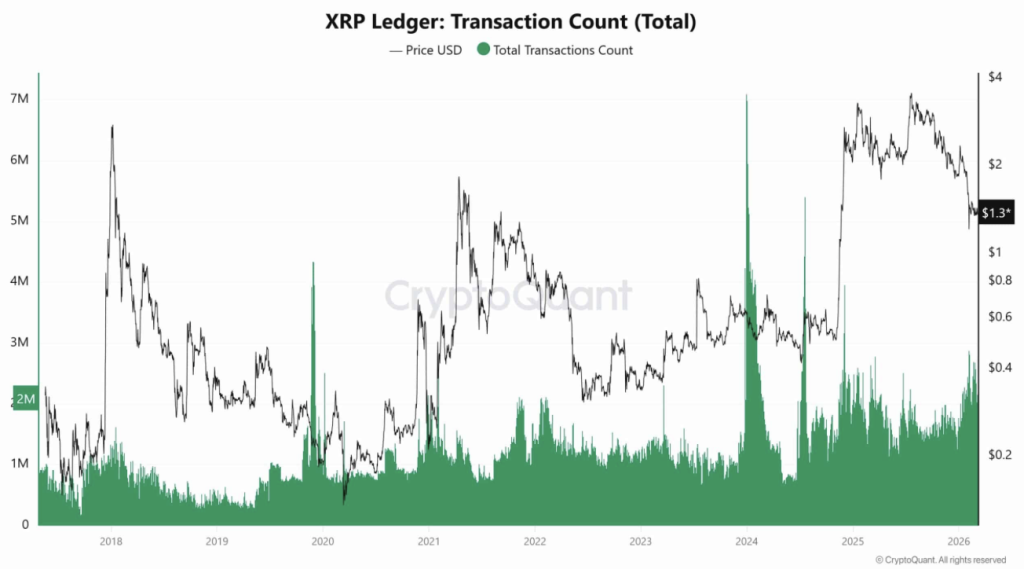
At the same time, activity on the XRP Ledger is beginning to show signs of life again after a quieter stretch. Transaction counts had been sliding gradually since December 2024, which often happens during bearish market phases when overall participation drops.
Recently though, the trend has started to reverse. Network activity is climbing again, with daily transactions averaging around 2.5 million. That increase suggests renewed engagement across the ecosystem — including payments, tokenized asset transfers, and various on-chain financial operations.
Tokenization activity is also expanding on the ledger. Represented Asset Value has reached roughly $1.49 billion, while Distributed Assets Value has grown to about $453 million. These numbers point to growing experimentation with blockchain-based asset issuance on XRPL.
Tokenized Asset Transfers Surge on the Network
One of the most striking developments is the rapid increase in real-world asset transfers. Over the past 30 days alone, RWA transfer volumes jumped by an enormous 1,282%, reaching about $139.85 million.
That surge appears tied to new issuers testing tokenized assets on the network. Commodities, private credit instruments, and other alternative financial products are increasingly being explored on XRPL. While Ethereum still dominates institutional tokenization overall, the XRP Ledger seems to be attracting early-stage experimentation from certain financial players.
In other words, the ecosystem may be slowly expanding its role beyond simple payments.
RLUSD Stablecoin Strengthens Liquidity Across XRPL
Another major factor shaping the XRPL ecosystem is the rapid growth of its stablecoin liquidity layer. RLUSD — Ripple’s dollar-backed stablecoin — has now reached a market capitalization of roughly $1.589 billion. That figure represents about 83% of the total stablecoin supply circulating on the XRP Ledger.
Liquidity across the network largely flows through XRPL’s built-in exchange infrastructure. Trading pools such as RLUSD/XRP allow users to move value cheaply and settle transactions quickly while maintaining programmable liquidity inside the system.
Zooming out, the global stablecoin market has also expanded rapidly. Regulated stablecoins alone now exceed $313 billion in market value worldwide. That growth reinforces a broader trend: private blockchain infrastructure is increasingly becoming a core layer for payments, tokenized finance, and digital asset markets.