
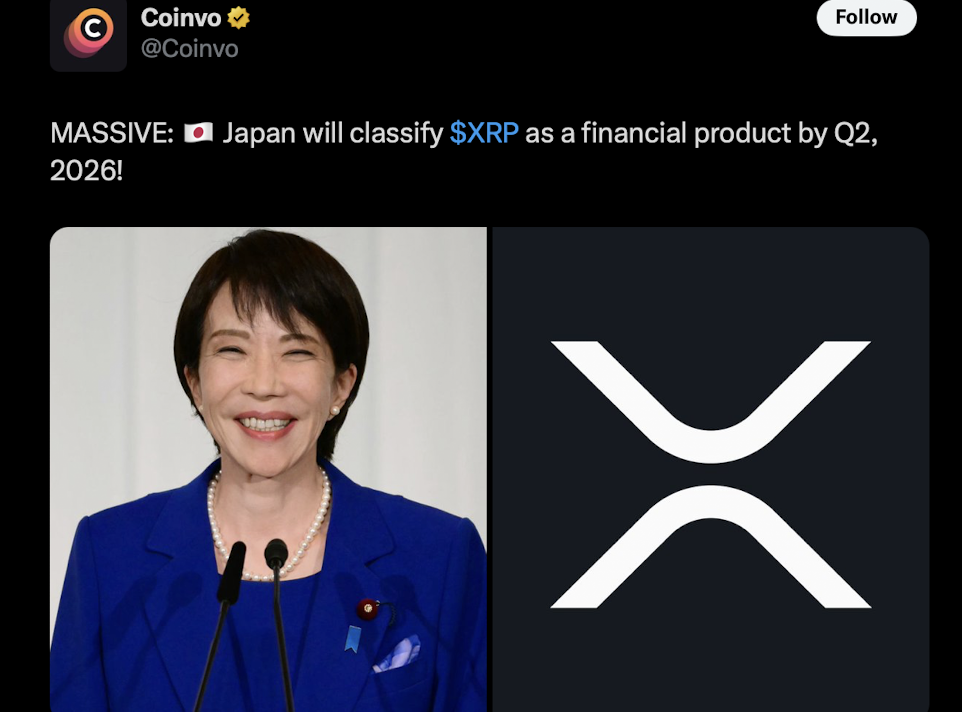
- Japan may classify XRP as a financial product by Q2 2026, improving legal clarity
- XRP’s existing role in payments strengthens the case for formal regulation
- Clear rules could boost institutional adoption and reduce compliance risk
Japan may be on the verge of a regulatory shift that could reshape how certain digital assets are treated, with XRP sitting right at the center of the discussion. Regulators are reportedly considering classifying XRP as a financial product by Q2 2026, a move that would significantly tighten legal definitions around crypto-based payments and settlements. It also fits into Japan’s broader strategy of supporting blockchain adoption, but under clear, structured rules rather than loose oversight.
This push comes as institutional interest in digital assets continues to grow. Japanese authorities have been working to align crypto regulation with existing financial frameworks, instead of building something entirely separate. XRP has naturally become part of that conversation, largely because it’s already embedded in domestic and cross-border payment systems across the country.
Regulatory Direction and XRP’s Legal Status
Regulators in Japan are actively reviewing whether XRP should fall under the same category as traditional financial products. If approved, that would place it closer to regulated payment instruments, offering much-needed legal certainty for banks and enterprises. The goal here is straightforward, reduce ambiguity so businesses can operate without constantly second-guessing compliance risks.
Officials have been consulting closely with blockchain firms and financial institutions throughout the process. This cooperation aims to balance innovation with oversight, allowing growth without opening the door to unnecessary risk. One regulator familiar with the discussions summed it up simply, clear definitions help markets function more smoothly, especially when large pools of capital are involved.
If XRP is formally classified, related products could be offered under clearer disclosure standards. Financial institutions would be able to use XRP for settlement purposes with fewer regulatory grey areas. That alone could lower the barrier for firms handling large transaction volumes who have been sitting on the sidelines.
XRP’s Role in Japan’s Payment Infrastructure
XRP isn’t a theoretical case study in Japan, it’s already in use. Several financial firms rely on XRP to power faster and cheaper cross-border transfers, especially in remittance-heavy corridors. These systems prioritize speed and cost efficiency, two areas where traditional rails tend to struggle.
Industry data shows XRP accounts for a meaningful share of crypto transaction volume within Japan. Liquidity remains one of its biggest strengths, which is why banks and payment providers continue to lean on it. That existing adoption makes a stronger argument for formal recognition, rather than forcing usage to exist in a regulatory limbo.
By classifying XRP as a financial product, regulators could align real-world usage with existing laws. This would also help integrate Japan’s payment systems more cleanly with global frameworks, potentially opening the door to broader enterprise deployment over time.
Tax Structure and Compliance Considerations
Alongside regulatory changes, Japan is also reviewing how crypto is taxed. A proposed flat capital gains tax of 20 percent has gained traction, mainly because it simplifies reporting and reduces confusion for both individuals and companies. Authorities believe clearer rules could improve compliance without discouraging participation.
Predictable tax obligations tend to attract serious market players. When firms know what’s expected, reporting becomes cleaner and risk management gets easier. This matters especially for institutions that operate under strict accounting standards.
The Financial Services Agency has reiterated that investor protection remains central to its approach. Clear tax rules work hand-in-hand with consumer safeguards, helping support steady, orderly market growth instead of speculative excess.
Japan’s Broader Role in Global Crypto Policy
Japan continues to position itself as a regulated crypto hub rather than a hostile one. Its strategy leans toward collaboration, not outright restriction, which has made the country appealing to both startups and established financial institutions. XRP’s potential reclassification fits neatly into that philosophy.
If XRP gains financial product status by Q2 2026, legal risks around its use would likely decline. Institutions could increase exposure under defined rules, rather than navigating uncertainty. In the bigger picture, Japan’s framework could become a reference point for other jurisdictions watching how regulated crypto integration actually works in practice.