

- Vitalik Buterin warned that Europe’s Digital Services Act could leave no space for controversial or privacy-focused tools to exist online.
- Privacy coins like Zcash and Monero have outperformed the broader crypto market in 2025 as regulation intensifies.
- As Europe enforces stricter crypto rules, capital appears to be rotating toward assets designed to preserve user autonomy and privacy.
The privacy coin surge unfolding in 2025 didn’t come out of nowhere. It’s the byproduct of growing tension between regulation and digital freedom, a tension that’s been building for years and is now spilling into market behavior.
Once again, the pushback is coming from inside crypto itself. This time, it’s Ethereum co-founder Vitalik Buterin adding fuel to the debate.
Vitalik Pushes Back on Europe’s Regulatory Direction
Buterin has been openly critical of the European Union’s Digital Services Act (DSA). In a recent post on X, he warned that the law risks creating a digital environment where there’s simply “no space” left for controversial ideas, tools, or products to exist at all.
He argued that Europe should rethink its approach and lean more toward user empowerment rather than blanket enforcement. In his words, he hopes European governments avoid this path and instead adopt something closer to a Pirate Party philosophy, one centered on individual control.
The core issue, according to Buterin, isn’t that extreme or unpopular ideas exist online. It’s that centralized algorithms amplify them at scale. Trying to erase those ideas entirely, he said, doesn’t solve the root problem. Instead, it encourages heavier surveillance, stricter enforcement, and a narrower digital space overall.
In one of his sharper comments, Buterin suggested there’s still an opportunity to defend freedom of speech in a new way, one that prioritizes pluralism and resists attempts to overly shape or manipulate public discourse. That framing matters, especially as regulation tightens.

Privacy Coins Start Moving Against the Market
The numbers are already reacting.
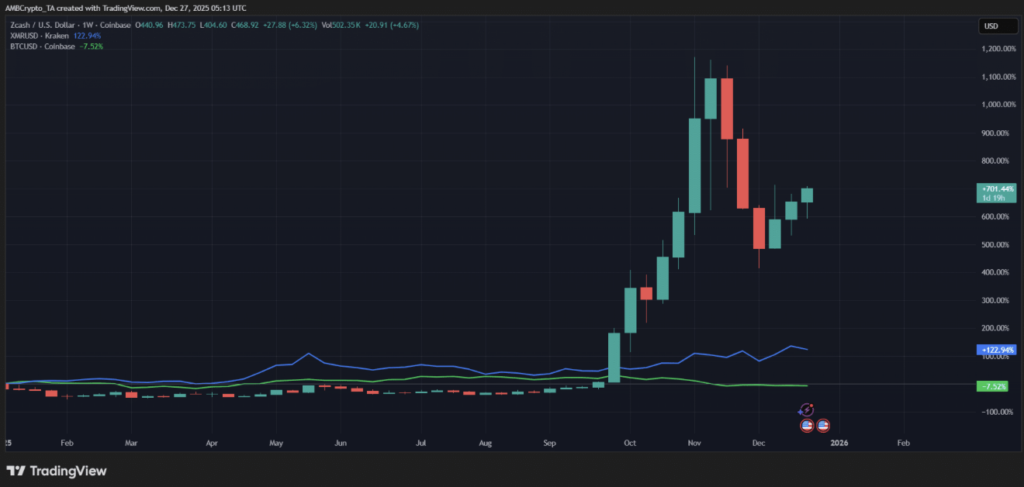
While much of the crypto market has struggled to find direction this year, privacy coins have quietly moved the other way. Data from Artemis shows that privacy-focused assets are the best-performing sector year-to-date, outperforming every other major crypto category by a wide margin.
Bitcoin remains the market’s anchor, but its performance this cycle has been relatively muted. During the same stretch where BTC has struggled to push meaningfully higher, Zcash has exploded, posting gains north of 700%. Monero hasn’t rallied as aggressively, but it’s shown far less downside than most large-cap alternatives.
That divergence is telling. Trading activity around privacy coins is picking up too, with several climbing the rankings by volume and market cap. As regulatory pressure increases, capital appears to be rotating toward assets explicitly designed to preserve user autonomy, not dilute it.
Europe Tightens the Screws in 2025
All of this is unfolding during a pivotal year for crypto regulation in Europe. In 2025, the EU shifted from debating rules to actively enforcing them. MiCA officially went live, forcing crypto companies to secure licenses, update disclosures, and rethink which assets they’re even allowed to offer.
Stablecoins have landed squarely in regulators’ crosshairs, with platforms asked to phase out tokens that don’t meet compliance standards. At the same time, new cybersecurity and operational risk rules kicked in, adding another layer of oversight.
Anti-money laundering authorities have also made it clear that crypto is no longer a fringe concern. It’s a priority. Add in fresh sanctions and tighter supervision, and Europe’s crypto market now looks far more controlled than it did just a few years ago.

We’ve Seen This Pattern Before
None of this is entirely new.
When the U.S. sanctioned Tornado Cash, what was once a niche privacy tool suddenly became a global debate about control, censorship, and financial freedom. Exchanges quickly followed by delisting privacy coins like Monero, not because demand vanished, but because compliance became harder.
Japan banned privacy coins years ago. Other countries followed with their own restrictions. And every time access gets squeezed, interest tends to move elsewhere. Even recent court decisions tied to Tornado Cash were followed by renewed attention on privacy-focused assets.
That’s why this moment matters. Europe is pulling regulation tighter, and at the same time, privacy coins are rising again. Buterin’s warning about leaving “no space” for controversial tools fits perfectly into that pattern.
When systems try to squeeze privacy out of the equation, people don’t stop wanting it. They usually start looking for it even harder.