
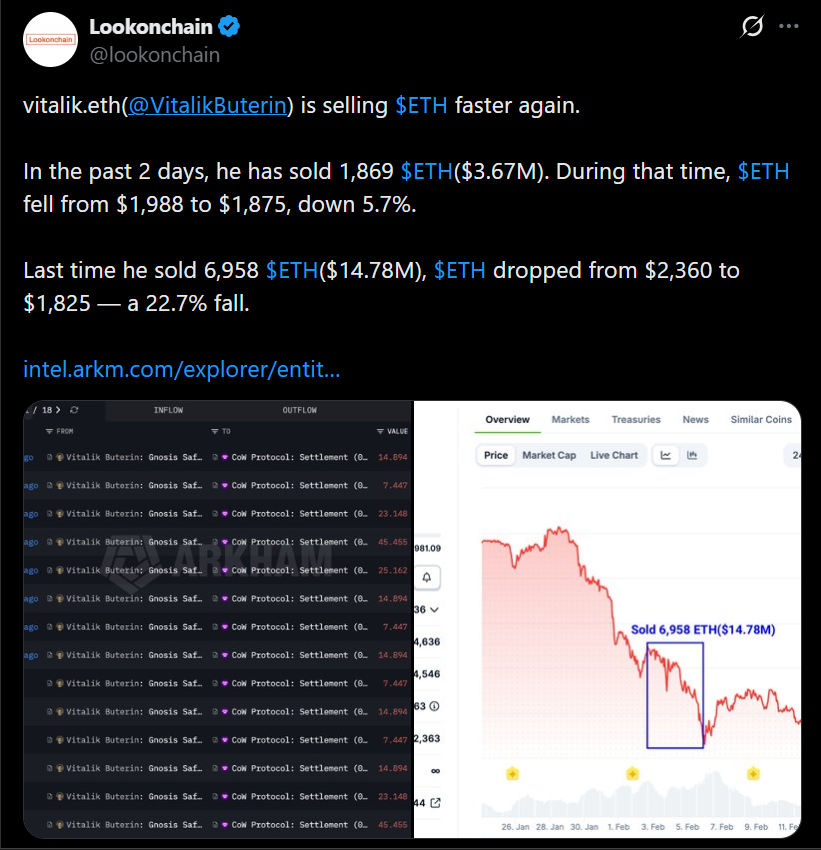
- Vitalik Buterin sold 1,869 ETH worth about $3.7 million in two days
- Ethereum dropped nearly 6% during the same period
- Buterin says prior withdrawals funded open-source security projects
Ethereum co-founder Vitalik Buterin has sold 1,869 ETH over the past two days, worth approximately $3.7 million, according to onchain data tracked by Lookonchain. The sales come after a brief two-week pause and bring his total ETH disposals in 2026 to nearly 9,000 ETH, valued around $18 million.

The timing raised eyebrows. During the two-day selling window, Ether fell from roughly $1,988 to $1,875, a decline of about 5.7%. Market watchers quickly drew comparisons to a prior sale in which Buterin offloaded 6,958 ETH and ETH subsequently dropped more than 20% in the following stretch.
Macro Pressure Adds to the Decline
The broader crypto market was already under pressure. Ether slid from $1,957 to $1,856 on Sunday evening as markets reacted to President Trump’s decision to increase the proposed global tariff from 10% to 15%, alongside hints of further trade measures.
Macro uncertainty continues to weigh on digital assets, and Ethereum has not been immune. When liquidity tightens and geopolitical risk rises, large onchain transactions — especially from prominent figures — can amplify short-term volatility.
Buterin Still Holds a Massive ETH Position
Despite the recent sales, Buterin remains one of the largest known individual ETH holders. He still controls over 224,000 ETH, valued at approximately $429 million at current prices.
In January, Buterin disclosed that he had withdrawn 16,384 ETH to fund open-source initiatives focused on security, privacy, and decentralized infrastructure. He emphasized support for projects advancing verifiable software, self-sovereignty, and long-term ecosystem resilience. His past sales have often been tied to philanthropic or ecosystem funding efforts rather than speculative positioning.
Should Investors Be Concerned?
Large ETH transfers from Buterin’s wallet often spark speculation, but context matters. The amounts sold represent a small fraction of his total holdings. However, in fragile market conditions, sentiment can shift quickly when influential insiders move funds.
Ethereum’s price reaction appears more closely linked to macro forces than to Buterin’s transactions alone. Trade tensions, liquidity constraints, and broader risk-off positioning are currently stronger drivers than insider sales.
The Bigger Picture
Buterin’s ongoing funding of ecosystem projects highlights Ethereum’s long-term development focus, even during volatile periods. Short-term price swings may continue as macro uncertainty persists, but structural investment in open-source infrastructure remains active.
For now, Ethereum faces the same reality as the rest of crypto: liquidity is thin, volatility is elevated, and macro policy remains the dominant force.