
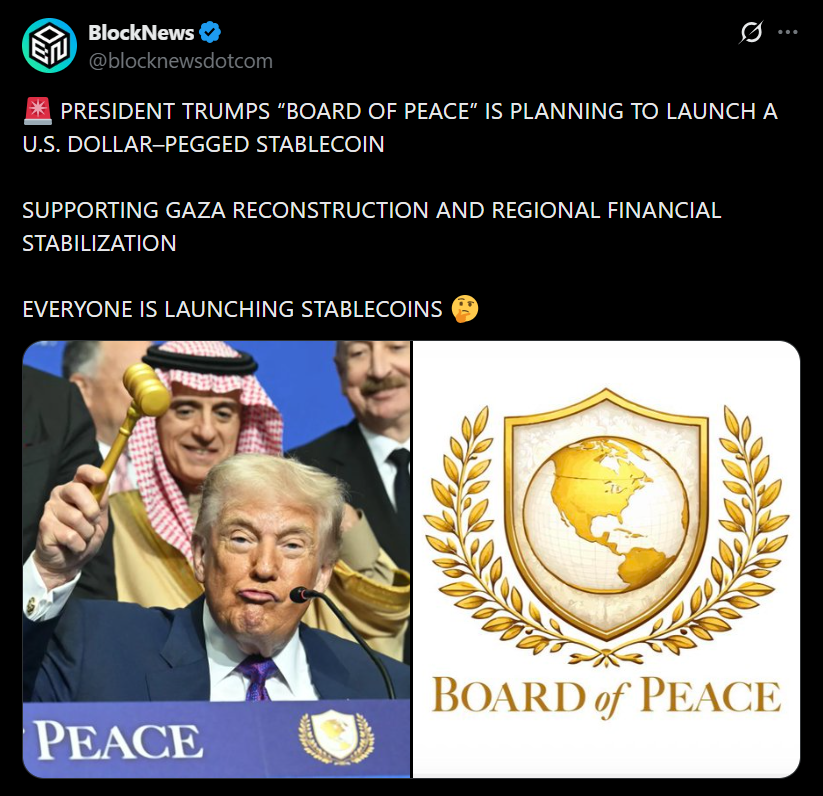
- Officials linked to Trump’s “Board of Peace” are exploring a dollar-backed stablecoin for Gaza
- The proposal aims to rebuild payments infrastructure after severe banking disruption
- Governance, connectivity, and political risks remain significant obstacles
Officials working with Donald Trump’s so-called “Board of Peace” are reportedly exploring the launch of a US dollar–backed stablecoin for Gaza, according to a Financial Times report. The idea is not to introduce a new Palestinian currency, but to create a digital payments layer in a region where traditional banking systems have been heavily damaged since the 2023 war.
Access to physical Israeli shekels has been constrained, and cash shortages have complicated everyday commerce. A dollar-pegged stablecoin could, in theory, offer a frictionless medium of exchange where physical notes are scarce and banking rails unreliable.
Who Is Behind the Proposal
The effort is reportedly being led by Israeli tech entrepreneur Liran Tancman, now advising the US-led body coordinating reconstruction efforts. Officials from Gaza’s technocratic administration are also said to be involved, with potential implementation support from Gulf Arab and Palestinian digital asset firms.
The structure under discussion would peg the token directly to the US dollar. This would align Gaza’s transactional base with global dollar liquidity rather than introducing a sovereign monetary experiment.
Why Supporters See Strategic Value
Advocates argue that digital payments could reduce reliance on cash, improve transaction traceability, and limit illicit financial channels. In fragile post-conflict economies, digital systems can sometimes leapfrog broken infrastructure.
There is also a geopolitical dimension. A US dollar–backed stablecoin would reinforce dollar dominance in a reconstruction environment. In theory, it could increase financial transparency while helping small businesses and aid programs operate more efficiently.

The Risks Are Not Technical — They’re Structural
Critics warn that a Gaza-specific stablecoin could deepen economic separation from the West Bank. Monetary fragmentation carries long-term political implications. Governance questions also loom large: who controls issuance, custody, compliance, and oversight?
Infrastructure remains another major challenge. Gaza faces persistent power outages and heavy reliance on 2G mobile networks. Stablecoins require connectivity, device access, and reliable digital rails. Without those foundations, implementation could prove uneven.
Crypto as a Policy Tool
The proposal underscores how stablecoins are evolving beyond trading tools into geopolitical instruments. Digital dollars are increasingly seen as mechanisms for influence, reconstruction, and economic control.
Whether this plan advances remains uncertain. But its mere discussion signals something bigger: crypto infrastructure is no longer confined to markets. It is entering the arena of statecraft and post-conflict rebuilding.