
- Stripe’s Tempo is built for stablecoin payments, not speculation or trading
- AI agents can execute payments autonomously through machine payment protocols
- This could unlock massive transaction volume driven by software, not humans
Stripe’s Tempo isn’t just another blockchain launch trying to compete with existing Layer 1 networks. It’s something more focused, and honestly, more practical. The network is designed specifically for stablecoin payments, cross-border transfers, and real-world financial flows, rather than trading or DeFi speculation.
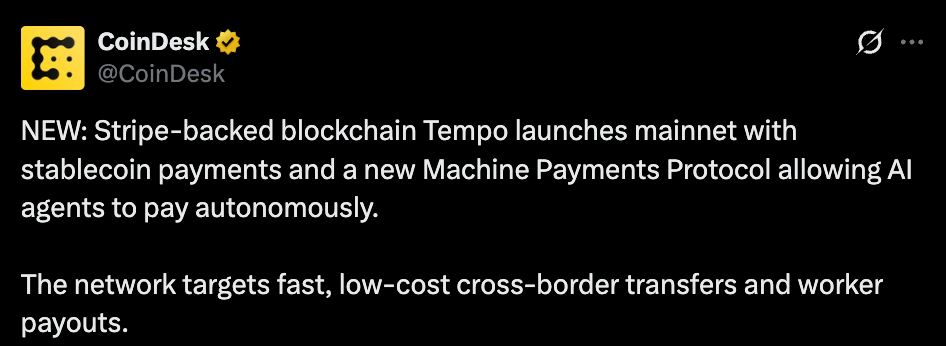
That shift in design changes the conversation entirely. Instead of optimizing for liquidity or token activity, Tempo is built around throughput, predictable fees, and near-instant settlement. Those aren’t just technical upgrades, they’re requirements if you want to handle payroll, remittances, and global payments at scale.
Built for Payments, Not Speculation
Most blockchain infrastructure today still revolves around trading activity. Tempo moves in a different direction, focusing on stablecoin-native transactions as its core function.
That means sub-second finality, low and predictable costs, and systems that can support real-world financial operations without friction. In that sense, it feels less like a crypto experiment and more like financial infrastructure being rebuilt from scratch.
Stripe isn’t positioning this as optional. It’s clearly aiming to own a piece of the payment rails themselves.
AI Agents Enter the Payment Loop
The more interesting part of Tempo is the integration of machine-driven payments. The network is designed to support AI agents that can send and receive payments autonomously.
That opens the door to something new. AI systems paying for APIs, compute power, data access, or services in real time, without requiring human approval or manual workflows.
Traditional payment systems struggle with that kind of activity. They rely on accounts, approvals, and batch processing. Tempo, combined with stablecoins, removes those bottlenecks.
A Shift Toward Machine-Driven Volume
If AI agents begin transacting at scale, the volume of payments could increase dramatically. Instead of thousands of transactions, you’re looking at potentially millions or even billions of microtransactions happening continuously.
Tempo appears to be built for exactly that kind of environment. High throughput and low-cost settlement aren’t just helpful features, they’re necessary for a system where software becomes an active economic participant.
This isn’t just about innovation for its own sake. It’s about preparing for a different type of demand.

Redefining How Value Moves Online
What Stripe is building points toward a broader shift in how payments function on the internet. Instead of humans initiating every transaction, software could begin to handle large portions of economic activity.
That changes how platforms are built, how services are priced, and how value flows across systems. Payments become embedded into software behavior rather than something triggered manually.
The Bigger Picture
Tempo isn’t just a faster way to send money. It’s infrastructure for a world where AI systems can earn, spend, and transact independently.
And if that model scales, the definition of a “user” in financial systems may start to change. Not disappear, but evolve into something where humans set the rules… and machines handle the execution.