

- Global stablecoin supply has grown by about $75B over the past year
- Rising supply often signals capital preparing to enter crypto markets
- Stablecoins are becoming the core infrastructure of on-chain finance
Stablecoins rarely dominate headlines the way Bitcoin rallies or meme coin frenzies do. Yet historically, they’ve been one of the clearest signals of liquidity entering the crypto ecosystem. The latest market data shows global stablecoin supply reaching a new all-time high after roughly $75 billion in additional issuance over the past year.
That kind of expansion usually isn’t random. When investors mint large amounts of stablecoins like USDT or USDC, they are effectively converting traditional money into blockchain-based dollars. The capital has already entered the crypto ecosystem, it’s just waiting for the right moment to move into risk assets.
Stablecoins Represent Crypto’s “Dry Powder”
In crypto markets, stablecoins often function as dry powder. Traders move funds into stablecoins between positions, hedge funds use them for arbitrage strategies, and institutions rely on them to move capital quickly across exchanges.
Because they settle instantly on blockchain networks, stablecoins have become one of the most efficient ways to move dollar-denominated liquidity around the digital asset ecosystem. When supply rises sharply, it usually means capital is quietly accumulating inside the system before being deployed.
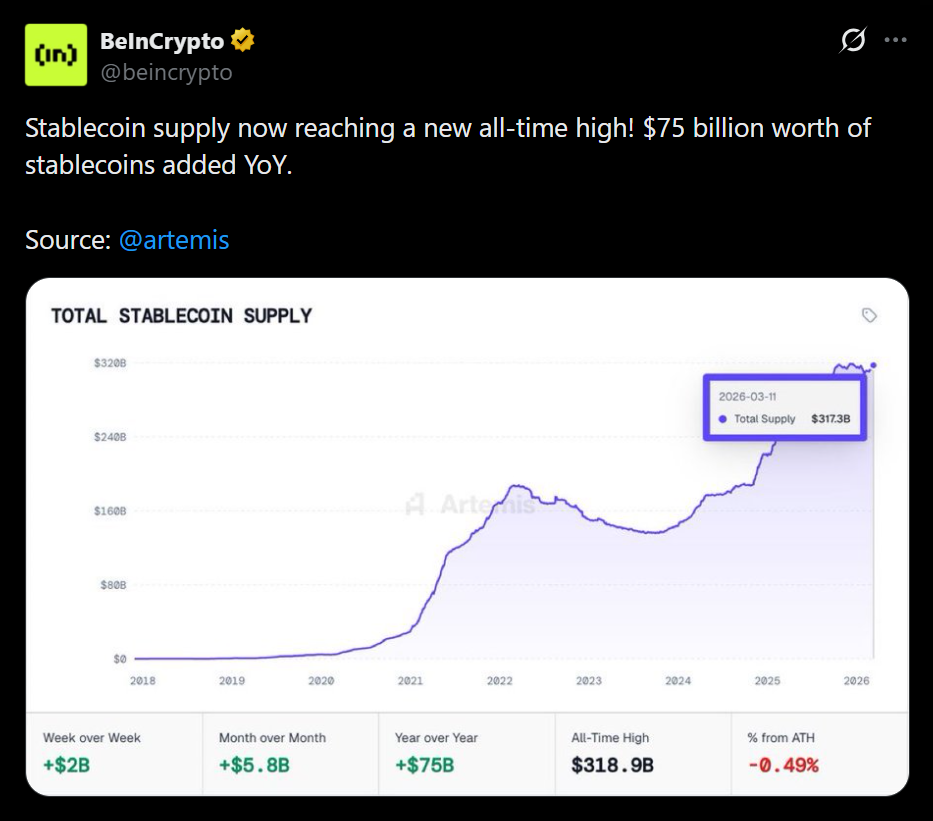
Historically, this pattern has appeared before major market expansions. In previous cycles, large increases in stablecoin supply preceded rallies in Bitcoin, altcoins, and decentralized finance activity.
Crypto Infrastructure Is Expanding Rapidly
The growth in stablecoin supply is not driven by trading alone. Over the past few years, stablecoins have become a core building block of on-chain financial infrastructure. Decentralized lending platforms, derivatives markets, tokenized treasury products, and cross-border payment systems all rely heavily on stablecoins as their base currency.
This expanding ecosystem requires a constant supply of programmable digital dollars to function. As more applications launch and more users interact with on-chain financial tools, the demand for stablecoins naturally increases.
In addition to DeFi growth, businesses and financial institutions are increasingly using stablecoins for cross-border payments. Transactions that once required days through traditional banking systems can now be completed almost instantly on blockchain networks.
Stablecoins Are Becoming Digital Finance Infrastructure
Because of these advantages, stablecoins are gradually evolving beyond simple trading tools. They are beginning to function as the operating system for digital finance, supporting everything from payments to lending to settlement across global markets.
The ability to move millions of dollars instantly without relying on traditional banking rails is a powerful capability. For companies operating internationally, stablecoins offer a faster and often cheaper alternative to legacy financial infrastructure.
This growing utility helps explain why stablecoin supply continues expanding even during periods when the broader crypto market remains uncertain.
Record Supply Often Signals Future Market Activity
A record stablecoin supply rarely stays idle forever. Historically, large pools of stablecoin liquidity tend to flow into Bitcoin, altcoins, and decentralized applications once market sentiment improves.
The additional $75 billion entering the ecosystem represents potential buying power sitting on the sidelines. It reflects both growing financial infrastructure and a buildup of capital preparing for the next phase of market activity.
For now, that liquidity appears to be waiting. But in crypto markets, capital rarely sits still for long.