
- Solana highlights progress in post-quantum cryptography with Falcon-512
- Ethereum L2s remain reliant on current cryptographic standards
- Quantum security becoming a growing focus across blockchain networks
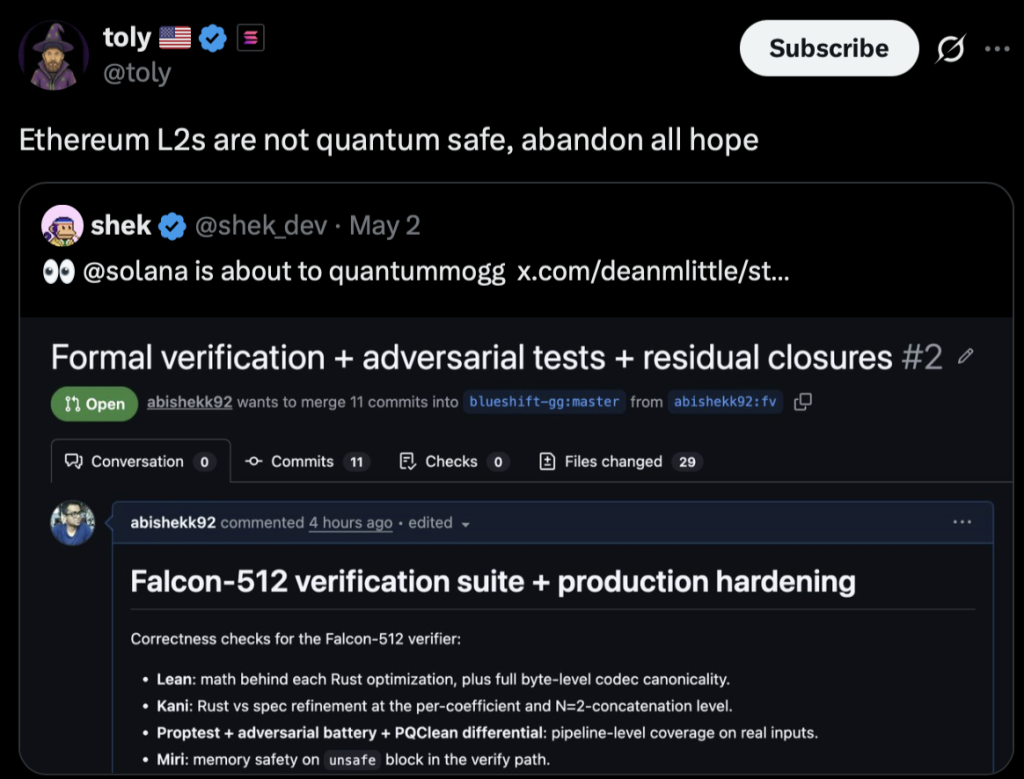
The conversation around blockchain security just took a sharper turn, and it’s not exactly subtle. On May 2, Solana co-founder Anatoly Yakovenko stirred things up by claiming Ethereum Layer 2 networks aren’t quantum safe, going as far as telling users to “abandon all hope.” It’s a bold statement, maybe a bit dramatic, but it points to a growing concern that’s been quietly building, what happens when quantum computing actually becomes a real threat?
Solana Pushes Ahead With Post-Quantum Tech
Yakovenko’s comments came alongside updates showing Solana’s progress in post-quantum cryptography, particularly its work with Falcon-512 signature verification. The idea here is simple in theory, build systems that can resist future quantum attacks before they become a problem. Solana seems to be leaning into that early, positioning itself as ahead of the curve, or at least trying to.
There’s even talk of integrating this tech directly into wallets and smart contracts over time, which would make quantum-resistant security more native to the network. It’s not fully rolled out yet, but the direction is clear, and it’s gaining attention.
Ethereum L2s Face Structural Limitations
On the Ethereum side, the issue isn’t immediate, but it’s structural. Most Layer 2 solutions still rely on the same cryptographic foundations as Ethereum itself, particularly ECDSA signatures. That system works fine today, but in a future where quantum computers become powerful enough, it could be vulnerable.
The concern is something called “harvest now, decrypt later.” Basically, attackers could collect encrypted data today and wait until quantum tools are strong enough to break it later. It’s not happening yet, but the possibility is there, and that’s what’s driving this discussion.
There’s also the matter of zero-knowledge proofs used in many rollups. These rely on cryptographic assumptions that could, at least in theory, be challenged by quantum advances. It’s not a guaranteed risk, but it’s enough to keep developers thinking ahead.
Race Toward Quantum Readiness Is Underway
To be fair, Ethereum isn’t ignoring this. Plans are already in motion to move toward quantum-resistant systems, with upgrades expected over the next few years. The timeline stretches out, though, with more concrete readiness projected closer to the end of the decade.
Other networks are moving at different speeds. Some, like Algorand and Cardano, are already exploring post-quantum solutions, while Bitcoin is still mostly in the research phase. It’s not a race with a clear leader yet, more like a gradual shift across the industry.
Regulation and Timeline Add Pressure
Outside of the tech itself, there’s also regulatory pressure starting to build. Governments and global frameworks are beginning to set timelines for quantum security planning, with milestones stretching into the 2030s. That might sound far off, but in terms of infrastructure upgrades, it’s actually not that distant.
There’s even a rough projection for “Q-Day,” the moment quantum computing becomes powerful enough to break current encryption standards, floating around 2029. Whether that timeline holds or not is uncertain, but it’s enough to push the conversation forward.
Market Watches as Security Narrative Evolves
Right now, this debate is more about positioning than immediate risk. Solana is highlighting its progress, Ethereum is working toward solutions, and the broader market is starting to pay attention. It’s not something that impacts price overnight, but over time, security narratives can shape how networks are viewed.
And if quantum computing does move faster than expected, well… the projects that prepared early might have a serious advantage. For now, though, it’s still a developing story, just one that’s getting louder.