

- Most major crypto assets now treated as digital commodities
- Regulatory clarity removes key barrier for institutional capital
- Market likely to split between compliant assets and uncertain tokens
For years, crypto lived in a kind of regulatory gray zone, not outright banned, but never fully accepted either. That uncertainty kept large pools of capital on the sidelines, waiting for clarity that never really came. Now, with the SEC reclassifying many major tokens as digital commodities rather than securities, that ambiguity is starting to fade, and the shift feels… significant.
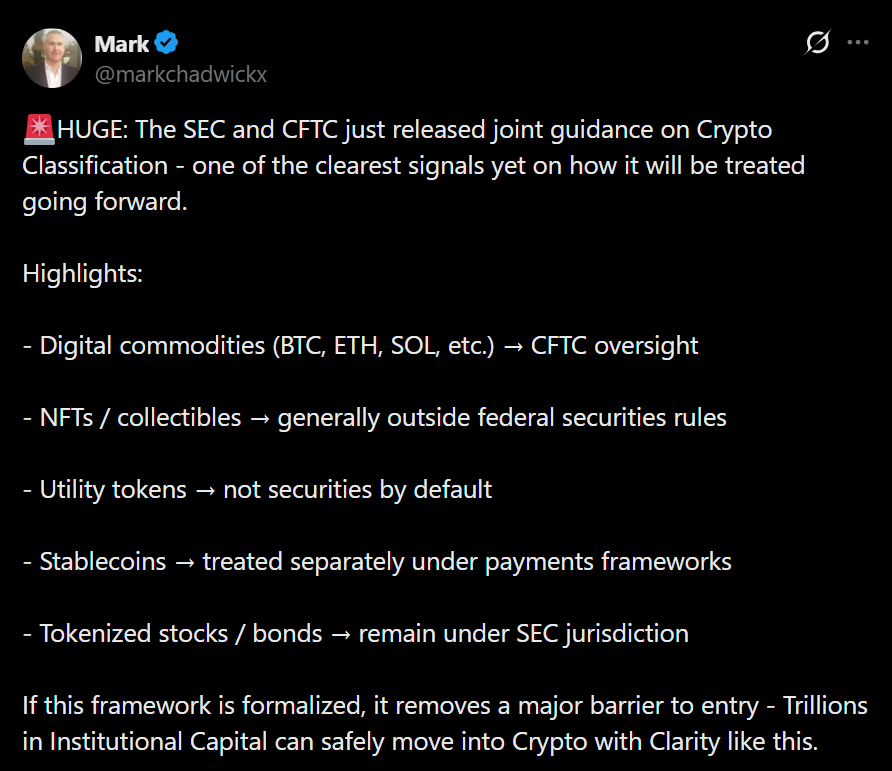
This isn’t just a legal technicality. Moving oversight toward the CFTC changes how these assets are viewed across the financial system. The constant risk of enforcement, which has hovered over the market for years, starts to ease. And when that pressure lifts, behavior tends to change pretty quickly.
From Legal Risk to Capital Deployment
Once crypto assets are no longer treated as securities, the entire investment framework becomes simpler. Funds don’t need complicated structures just to gain exposure. Custodians, exchanges, and asset managers can operate with clearer guidelines, which removes a lot of friction that previously slowed adoption.
That shift does something important. Institutions stop asking whether they’re allowed to participate, and start deciding how much capital to allocate. It’s a subtle change in mindset, but historically, that’s when flows begin to accelerate.
A New Market Hierarchy Is Emerging
Not every asset benefits equally from this change. By drawing a line between commodities and potential securities, regulators have effectively created a filter. Assets that fall into the “compliant” category gain legitimacy and easier access to capital, while others remain in a more uncertain position.
This naturally leads to concentration. Liquidity tends to flow toward assets that institutions can hold without hesitation, leaving smaller or less clearly defined tokens competing for attention. Over time, that could reshape the structure of the entire market.
Institutional Capital Changes Market Behavior
When institutional capital enters at scale, it doesn’t just increase prices, it changes how markets behave. Liquidity deepens, volatility can shift, and long-term positioning becomes more prominent. But that capital is selective, and it typically flows where rules are clear and risk is manageable.
With regulatory clarity improving, the conditions for that next phase are starting to form. It may not happen all at once, but the groundwork is clearly being laid.
Crypto Is Splitting Into Two Markets
What this ultimately creates is a divide. On one side, assets that are clearly classified and institutionally accessible. On the other, assets that remain uncertain, operating without the same level of structural support.
This isn’t just clarity, it’s selection. Crypto is no longer a single, uniform market. It’s becoming segmented, and capital will determine which side grows and which side struggles to keep up.