- Samsung affiliates are buying a combined $408 million stake in Upbit parent company Dunamu
- The investment reflects growing interest in stablecoins, tokenized securities, and blockchain finance
- South Korea’s largest corporations appear to be preparing for a regulated digital asset economy
Samsung is making one of the clearest institutional crypto bets South Korea has seen yet, and the timing feels anything but accidental. Three Samsung affiliates, including Samsung Securities, Samsung SDS, and Samsung Card, are reportedly acquiring a combined 4% stake in Dunamu, the parent company behind Upbit, South Korea’s largest crypto exchange.
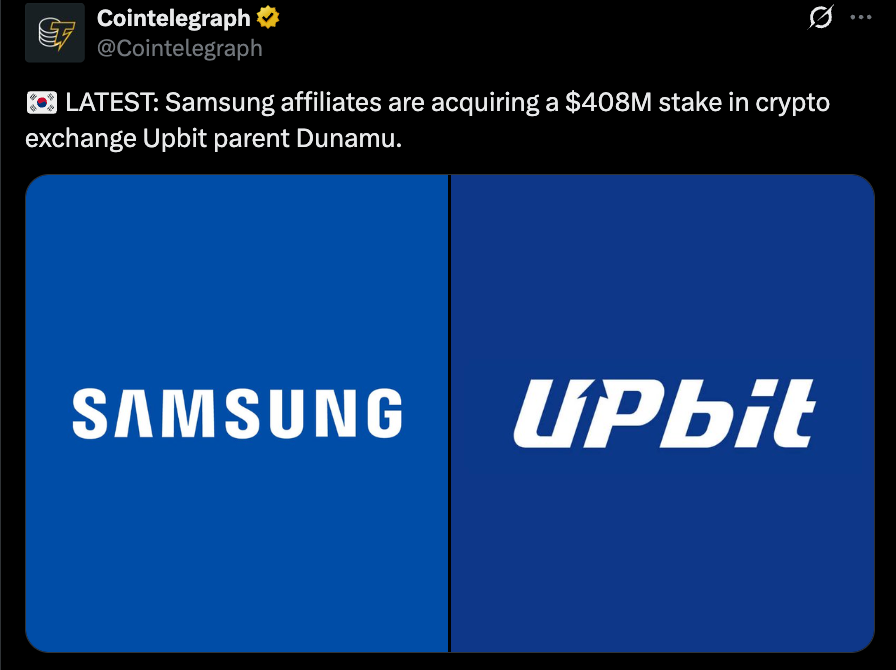
The deal is valued around $408 million, giving Samsung direct exposure to one of Asia’s most influential digital asset platforms at a moment when Korea’s regulatory environment is rapidly evolving.
And honestly, corporations usually do not commit hundreds of millions to industries they think are disappearing anytime soon.
Samsung Is Positioning For The Next Financial Infrastructure Layer
According to reports, Samsung Securities will take the largest position with a 2% stake, while Samsung SDS and Samsung Card each acquire 1%. The investment is expected to officially close sometime in June.
What makes the move especially important is that it reportedly extends far beyond simple crypto exchange exposure. Samsung’s interest appears connected to much broader initiatives involving tokenized securities, blockchain infrastructure, stablecoin integration, and digital asset payments tied directly into its financial ecosystem.
In other words, this doesn’t look like a speculative gamble on short-term crypto prices. It looks much more like positioning for future financial rails.
That distinction matters quite a bit.
South Korea Is Quietly Becoming One Of Crypto’s Most Important Markets
South Korea has spent years building one of the world’s most active crypto trading ecosystems, though recent developments suggest the country is now entering a more mature institutional phase.
Regulators are actively preparing new frameworks covering stablecoins, tokenized securities, exchange oversight, and investor protections. Instead of waiting cautiously on the sidelines for final clarity, major Korean corporations increasingly appear willing to establish positions early before the next wave of regulated digital finance fully develops.
And Samsung is not exactly known for making impulsive strategic investments.
The company’s involvement signals that some of Asia’s largest financial and technology players increasingly view blockchain infrastructure as something likely to integrate into mainstream financial systems rather than remain isolated as a niche speculative market.
The Institutional Crypto Narrative Keeps Expanding
One of the more interesting parts of this story is how dramatically institutional crypto conversations have changed over the past few years. Earlier cycles focused heavily on whether corporations would hold Bitcoin reserves or speculate on token prices directly.
Now the discussion increasingly revolves around infrastructure itself, stablecoins, tokenized assets, settlement systems, digital identity, and blockchain-powered financial rails operating underneath existing economic systems.
That shift is important because infrastructure narratives tend to attract long-term institutional capital far more consistently than speculative hype cycles alone.
Samsung’s investment into Dunamu reflects that evolution fairly clearly. The company appears interested in the broader digital asset ecosystem powering payments, securities, and financial services rather than simply treating crypto as a volatile trading market.
Traditional Finance Is Quietly Moving Onchain
Ironically, while retail traders continue panicking over every Bitcoin pullback and memecoin rotation, some of the world’s largest corporations are quietly buying stakes in the infrastructure layer underneath future financial systems.
And that trend keeps accelerating globally. Between tokenized securities, stablecoin frameworks, ETF expansion, blockchain settlement systems, and institutional custody platforms, traditional finance increasingly appears focused on integrating digital assets into existing systems rather than fighting against them entirely.
South Korea now seems positioned to become one of the major battlegrounds for that transition, especially as regulators finalize frameworks capable of supporting large-scale institutional participation.
Crypto’s Next Phase Looks Much More Corporate
For years, crypto culture revolved heavily around decentralization, retail participation, and disruption narratives aimed directly at traditional financial institutions. But the industry’s next growth phase increasingly looks far more institutional, regulated, and infrastructure-focused than earlier cycles.
Samsung’s investment into Upbit’s parent company feels like another strong signal that large corporations no longer see digital assets as temporary experiments. They see them as emerging components of future financial architecture.
Whether crypto purists fully love that direction or not, the largest companies in the world increasingly seem interested in owning pieces of the plumbing rather than ignoring it.