
- Quantum advances could threaten Bitcoin and Ethereum cryptography sooner than expected
- Market behavior hints that institutions may already be pricing long-term risk
- Bitcoin has a limited window to deploy post-quantum security upgrades
For years, quantum computing was treated like a distant sci-fi threat in crypto, something people argued about on podcasts but never seriously priced. That posture is getting harder to defend. Quantum machines don’t just compute faster, they compute differently, and once they reach a certain threshold, they can potentially derive private keys from public keys. If that becomes practical, the cryptographic assumptions behind Bitcoin, Ethereum, and most major chains start to wobble.
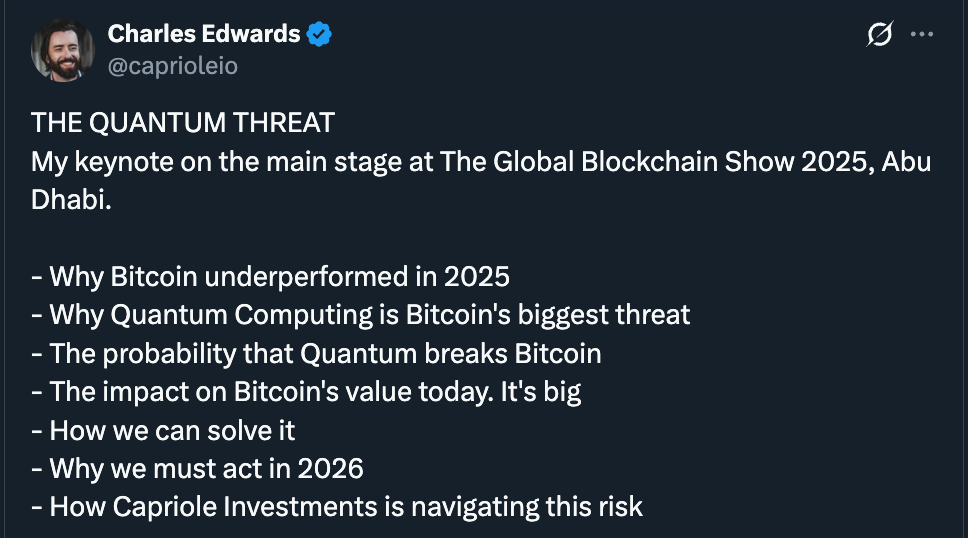
What makes this uncomfortable is the timeline. Credible estimates increasingly cluster around a two-to-five year window for meaningful capability, not a 20-year horizon. And crypto systems move slowly. Even if the entire ecosystem agreed tomorrow, major upgrades take years, not weeks, and that lag is where risk starts to compound.
Market Behavior Suggests Early Risk Pricing
This cycle already feels strange, and not just because prices are choppy. Bitcoin’s first negative post-halving year is arriving alongside heavy selling from long-term holders, older wallets, and institutional participants. That’s not the usual retail fear spiral. It’s experienced capital trimming exposure, and it tends to do that before narratives become mainstream.
Bitcoin has also broken its normal relationship with gold. Gold has attracted massive inflows and expanded its market value, while Bitcoin has not followed in the way many expected. Correlation arguments explain part of the divergence, sure, but not all of it. When capital chooses gold over BTC in a macro environment built for “hard assets,” it raises an awkward question: what risk is being quietly discounted.
Bitcoin Is the Most Valuable Target
If a quantum breakthrough happens, Bitcoin is the obvious first target. The prize is enormous, liquidity is constant, and transactions are final. There’s no rollback, no recovery desk, and no institution that can reverse damage after the fact. That makes the incentive structure brutally clear. A successful exploit wouldn’t just be profitable, it would be historic.

Bitcoin’s cryptography also has a specific weakness: elliptic curve systems can fail earlier than the security standards used across parts of traditional finance. In other words, Bitcoin may not get the luxury of being “the last domino.” It could be one of the first.
The Upgrade Window Is Narrower Than People Think
Post-quantum solutions exist, and the industry is not clueless about this. The problem is deployment. Wallet migrations are messy. Node rules have to change. Hardware security needs updates. Millions of users would need to move funds safely, and many won’t even understand why they’re being asked to do it. Even a well-designed proposal becomes a slow grind once it hits real-world coordination.
Ideas like BIP-360 are a starting point, but they’re not a finish line. Delay is the hidden enemy here. The longer upgrades take, the more the probability curve creeps upward, and markets don’t need certainty to price risk. They only need rising odds.
Probability Alone Can Move Crypto Markets
Quantum computing doesn’t have to arrive tomorrow to matter today. If the market starts believing the timeline is shrinking, that belief alone can reshape capital flows. Bitcoin has a narrowing window to upgrade its security assumptions before probability overtakes preparation.
2026 may not be the moment quantum breaks crypto. But it could be the year investors start treating the threat as real enough to demand action. And if the foundation ever cracks, everything built on top will feel it, fast.