

- Over 800 million XRP is now being vaulted through ETFs and related structures, nearing 1% of total supply
- Zach Rector argues that cumulative ETF, treasury, and DeFi allocations may be tightening effective circulation
- Debate remains over whether ETF-held XRP is truly “locked,” but supply visibility is becoming more relevant
With price action still testing the patience of a lot of market participants, crypto commentator Zach Rector has been nudging the conversation in a different direction. Instead of staring at the chart, he’s asking people to look at where XRP is actually going, and how much of it is quietly being set aside through new financial structures.
In a recent post paired with a short video, Rector argued that XRP supply dynamics are shifting in ways that aren’t obvious from price alone. His focus wasn’t on daily candles or short-term volatility, but on the growing amount of XRP being vaulted through exchange-traded products, digital asset treasury firms, and DeFi-related mechanisms.
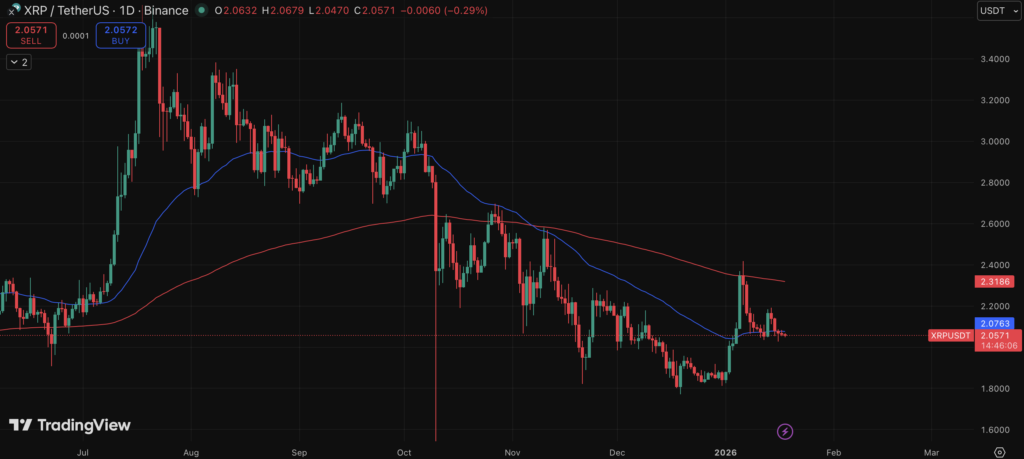
XRP Price Lags While Structural Changes Build
Rector opened by acknowledging what most holders already feel. XRP’s price hasn’t reflected the level of development happening around it. Despite that, he pointed out that XRP tied to ETF-related vaults has continued to grow, largely unaffected by recent market swings.
According to his estimates, more than 800 million XRP have already been vaulted in connection with XRP ETFs. That figure, he noted, is approaching one percent of the total XRP supply. The key point for him was timing. This accumulation has been happening quietly, even while price remains under pressure, suggesting that these flows aren’t reactive or speculative in nature.
Why This May Only Be the Beginning
Rector doesn’t see current vaulting levels as a ceiling. In his view, this is still the early phase. He projects that through 2026, billions of XRP could be allocated across ETFs, digital asset treasury companies, and XRP-focused DeFi applications.
He was careful not to frame this as an immediate supply shock. Instead, his argument leaned toward gradual tightening. As more XRP is funneled into these structures, circulating supply could slowly become more constrained, even if no single mechanism is responsible on its own.
The emphasis here is aggregation. When ETF vaults, institutional treasury strategies, and DeFi participation are viewed together, Rector believes the effective circulating supply may already be lower than many assume. It’s not about one vault locking coins away forever, but the cumulative impact of multiple systems absorbing XRP over time.
Pushback on the Term “Locked Up”
Not everyone agreed with how Rector described the situation. One X user, CryptoBiff, pushed back on the repeated use of the phrase “locked up,” arguing that XRP held in ETFs can be sold just as easily as it’s bought. From that perspective, calling it locked could be misleading, even if the broader analysis still makes sense.
That exchange reflects a familiar debate in crypto circles. How should vaulting, custody, and liquidity really be described? Rector’s view frames these developments as reducing effective circulation, while critics point out that financial products don’t permanently remove assets the way burns or irreversible locks do.
A Shift Toward Supply Awareness
Even with the disagreement over wording, Rector’s core message stayed consistent. Price alone doesn’t tell the full story. Where XRP sits, how it’s being used, and how much of it is tied up in emerging financial structures may matter more over time.
As institutional products and on-chain systems continue to expand, visibility into supply allocation could become a bigger part of the conversation. Not tomorrow, maybe not even this quarter, but gradually. In that sense, Rector’s argument isn’t about predicting the next move. It’s about paying attention to what’s quietly changing underneath it.