

- Morgan Stanley launches MSNXX fund to manage stablecoin reserves
- Product aligns with expected GENIUS Act requirements for backing assets
- High $10M minimum signals focus on institutions, not retail
Morgan Stanley just made a move that, on the surface, looks pretty boring, and that’s exactly why it matters. The firm launched its Stablecoin Reserves Portfolio, trading under MSNXX, a government money market fund designed specifically to hold stablecoin reserves in things like Treasury bills and repo agreements.
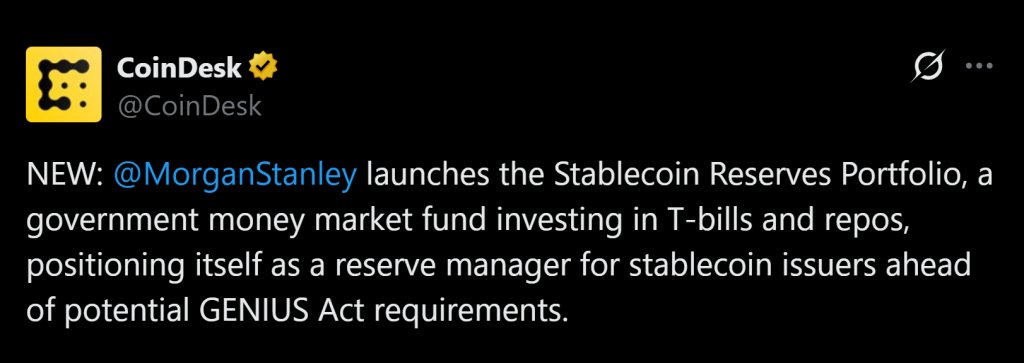
It’s not flashy, not something retail traders will rush into, but it quietly positions Morgan Stanley right at the center of where stablecoin infrastructure might be heading.
A Preemptive Move Before Regulation Lands
The timing here isn’t accidental, not even close. The proposed GENIUS Act is still making its way through Congress, but if it passes, stablecoin issuers will be required to back their tokens with high-quality liquid assets held at regulated institutions.
Morgan Stanley isn’t waiting to see how it plays out, it’s already building the rails. And it’s not alone either, with firms like State Street and Goldman Sachs lining up similar products, which makes this feel less like innovation and more like a quiet race for positioning.
Built for Scale, Not Retail
MSNXX is clearly not aimed at everyday investors, and it doesn’t try to be. With a $10 million minimum investment and a 0.15% annual fee, this is squarely an institutional product, built for issuers and large players who need compliant places to park massive reserves.
The fund targets a stable $1 net asset value with daily liquidity, investing in short-term government-backed instruments, which, while not exciting, is exactly what regulators tend to favor. Stability over yield, predictability over risk.

The Real Prize Is Stablecoin Capital
The bigger picture here is the size of the stablecoin market itself, now sitting at over $300 billion. That’s a massive pool of capital that needs to be held somewhere, and traditionally, that “somewhere” hasn’t always been within tightly regulated financial institutions.
Morgan Stanley is essentially raising its hand and saying it wants to be that custodian, or at least one of them. If regulation tightens, that role becomes even more valuable, and more competitive.
Wall Street Steps Further Into Crypto
This move feels like a classic Wall Street play, identify where regulation is heading, and get there early with the infrastructure already in place. Whether the GENIUS Act passes exactly as expected or not almost becomes secondary at that point.
The signal is already clear, traditional finance isn’t just watching crypto anymore, it’s building the backend that could end up supporting a large part of it. And in doing so, it’s slowly reshaping how the system operates from the inside out.