
- TRON plans to launch quantum-resistant features by 2026
- Other networks like Ethereum and Solana are also exploring similar upgrades
- Quantum threat remains distant, but preparation across crypto is increasing
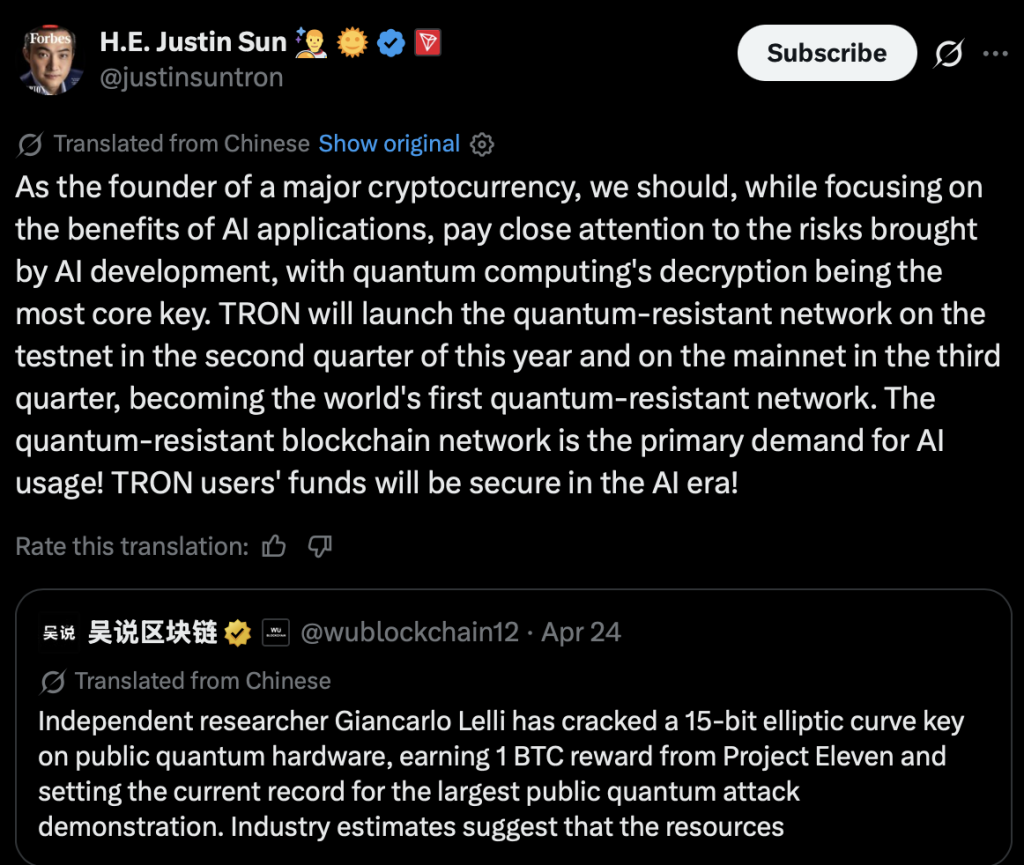
Justin Sun is thinking a few steps ahead, maybe more than a few. The TRON founder recently said the network is aiming to become the “world’s first quantum-resistant blockchain,” with a roadmap that stretches into 2026. It’s an ambitious claim, no doubt, but also one that reflects a growing concern across the crypto space.
Right now, quantum computing isn’t exactly breaking blockchains, not even close. The threat is still mostly theoretical. But still, teams aren’t waiting around for it to become real, they’re starting to prepare early, just in case.
Testnet First, Then Mainnet Rollout
According to Sun, TRON plans to introduce its quantum-resistant features on testnet in Q2 2026. If things go as expected, the upgrade would then move to mainnet by Q3. That’s the timeline, at least, though timelines in crypto… well, they don’t always hold perfectly.
He framed the move as essential, especially with AI development accelerating. The concern isn’t just about computing power, it’s about decryption risks. If quantum systems reach a certain level, they could, in theory, break current cryptographic standards. That’s the part that gets attention.
Sun’s view is pretty direct, post-quantum security isn’t optional, it’s something networks will eventually need.
Other Blockchains Are Moving Too
TRON isn’t alone here. Ethereum developers have already started working on post-quantum plans, even launching a dedicated site earlier this year. Their timeline stretches longer, with core upgrades possibly wrapping up closer to 2029, and full migration taking even more time after that.
Solana has taken a slightly different approach, experimenting with quantum-resistant signatures on testnet already. It’s still early-stage, but it shows the direction things are heading.
Even outside blockchain networks, the conversation is picking up. Coinbase has set up an advisory group focused on quantum risks, and Google has outlined its own shift toward post-quantum cryptography by the end of the decade.
A Race That’s Quietly Starting
What’s interesting is how this is turning into a kind of quiet race. No one is rushing publicly, but multiple players are building in parallel, testing ideas, refining approaches. TRON’s timeline, aiming for 2026, is actually on the more aggressive side.
Whether they hit that target or not, that’s another question. But if they do, it could push other networks to speed things up, or at least take the threat more seriously in the near term.
Preparing for a Risk That Isn’t Here Yet
For now, all of this sits in that “future problem” category. Quantum computing isn’t breaking wallets today, and users aren’t losing funds because of it. But the idea is simple, don’t wait until it becomes urgent.
TRON’s plan is part of that mindset. Build early, test thoroughly, and be ready when, or if, the landscape changes. It’s not the most immediate narrative in crypto, but it might end up being one of the more important ones down the line.