
- Solana remains a top-tier blockchain as institutional interest grows under a shifting regulatory backdrop
- Real-world use cases and major partnerships continue to validate Solana’s technical edge
- While past gains were massive, future upside likely comes with slower growth and higher risk
The crypto market may have closed out 2025 on a shaky note, but interest in the space hasn’t exactly cooled off. If anything, it’s shifting shape. With Donald Trump signaling a far more permissive regulatory stance, the environment looks set to change in ways that could unlock deeper institutional involvement. More traditional financial players, more products, and more capital, that’s the expectation, at least for now.
Solana sits right in the middle of that conversation. As a top-10 cryptocurrency with a market cap hovering around $70 billion, SOL has earned a reputation for speed, scale, and technical ambition. Which naturally leads to the big question investors keep asking, can Solana really turn someone into a millionaire?
Why Solana’s Use Cases Actually Matter
Crypto is tricky to value, there’s no earnings report or free cash flow to lean on. So investors are often left judging networks by strength and usage rather than balance sheets. The logic is simple enough: the more a blockchain is used, the more demand its native token should see over time, at least in theory.
Solana’s network checks a lot of those boxes. Like Ethereum, it operates on a proof-of-stake system, allowing holders to stake SOL to help validate transactions and earn rewards. But Solana adds another layer, proof-of-history, which tackles one of blockchain’s biggest bottlenecks, time coordination. Instead of forcing the entire network to agree on the order of events in real time, PoH timestamps transactions in advance. That small tweak makes a big difference.
The result is speed, lots of it. Solana is designed to handle tens of thousands of transactions per second, and while real-world usage hasn’t hit that ceiling consistently, stress tests have shown the network reaching 100,000 TPS. That kind of throughput is hard to ignore, especially for institutions that care about efficiency.
Big Names Are Already Testing the Network
Solana’s technical edge hasn’t gone unnoticed. Western Union, for example, chose Solana’s blockchain to launch a U.S. dollar stablecoin aimed at improving money movement and expanding treasury operations. That’s not a casual experiment, it’s a legacy financial firm testing real utility.
JPMorgan Chase also made headlines by conducting a debt issuance for Galaxy Digital directly on Solana’s network. The bonds were ultimately purchased by Coinbase and Franklin Templeton, marking one of the first debt issuances ever completed on a public blockchain. Moments like that don’t just add credibility, they suggest Solana is quietly becoming part of the financial plumbing.
It’s hard to pin an exact price impact on these developments, but increased network usage usually helps over time. Utility doesn’t guarantee gains, but it does create a foundation that speculation alone can’t.
So, Is Solana a Millionaire-Maker?
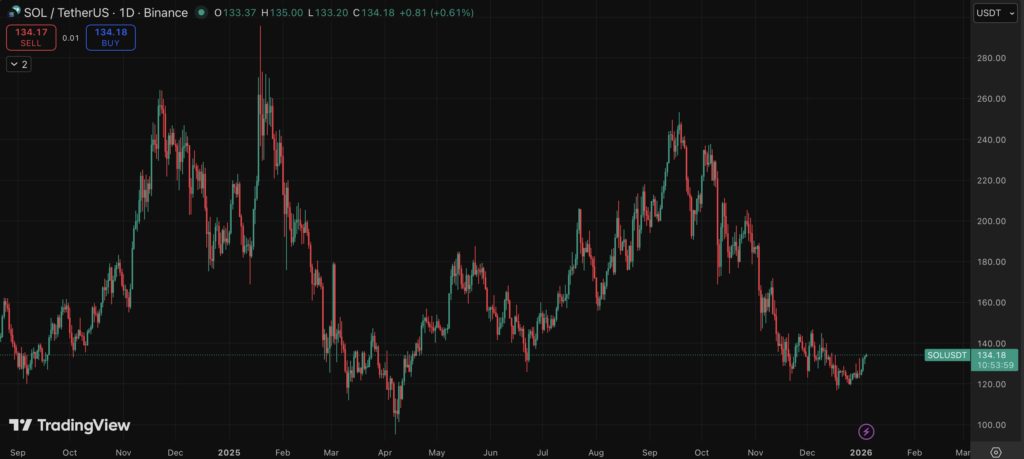
Historically, Solana’s performance speaks for itself. Over the past five years, SOL has surged roughly 6,000%, outperforming Ethereum and even Bitcoin by a wide margin. An early $15,000 investment would, today, be worth well over seven figures. That’s not hype, that’s math.
Looking ahead, Solana’s network is likely to keep improving, processing more transactions and attracting more real-world use cases. Could it still make someone a millionaire? Possibly, yes. But the math is different now. With a much larger market cap, explosive gains are harder to come by, and volatility remains part of the deal.
Solana may still reward long-term believers, but buying in today requires patience and a strong stomach for risk. This isn’t the early days anymore, though the story, clearly, isn’t finished either.