

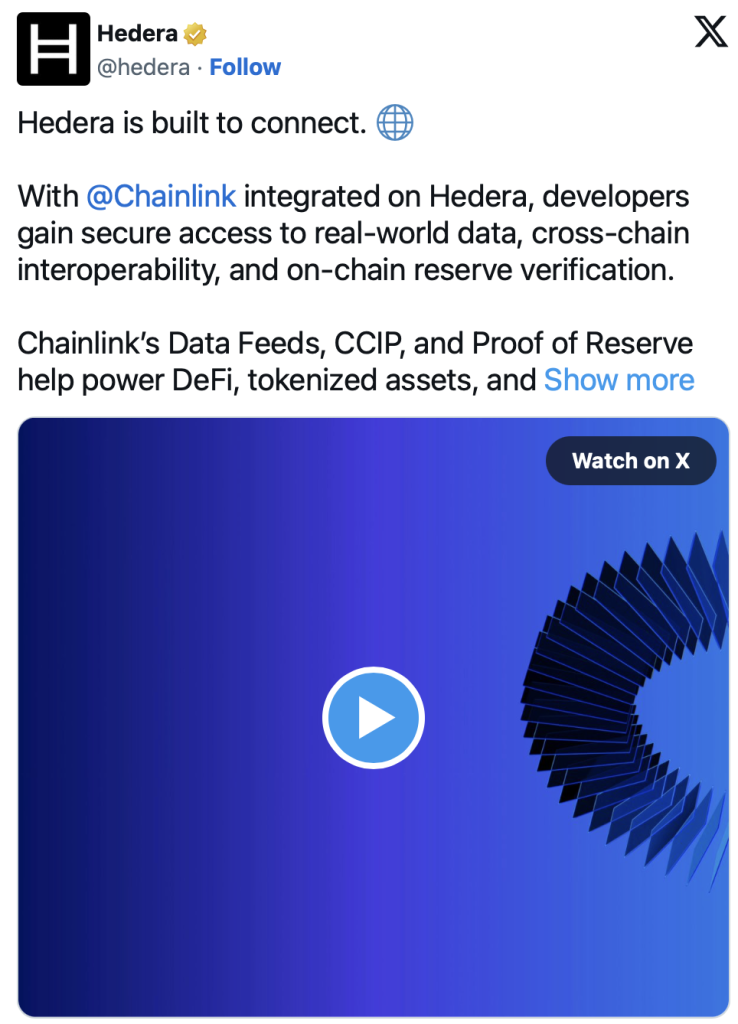
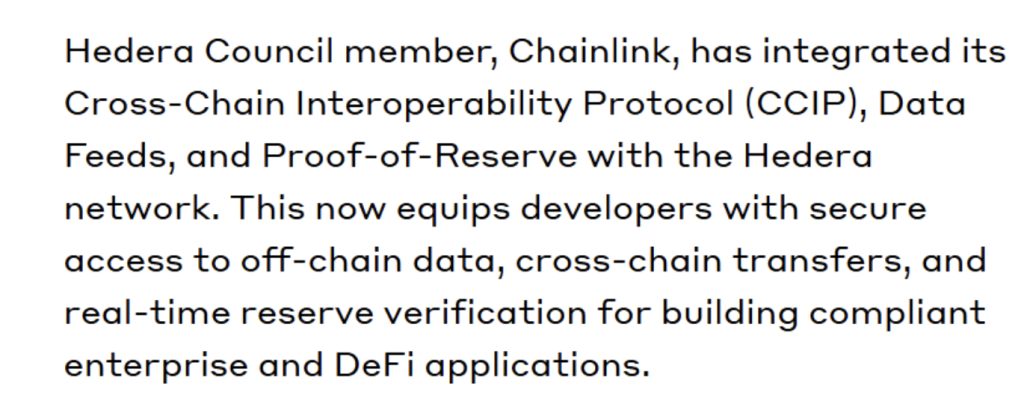
- Hedera has integrated Chainlink’s oracle network, adding Data Feeds, CCIP, and Proof of Reserve to the ecosystem.
- Developers on Hedera can now access reliable market data, cross-chain communication, and automated reserve verification.
- The integration strengthens Hedera’s capabilities for DeFi development, tokenized assets, and multi-chain blockchain applications.
Hedera has taken a notable step forward by integrating Chainlink’s oracle network into its ecosystem, giving developers new tools to connect smart contracts with real-world data. The move strengthens Hedera’s infrastructure by allowing applications on the network to access off-chain information, communicate across blockchains, and verify asset reserves. For developers building on Hedera, it means fewer limitations and far more flexibility when designing decentralized applications.
The integration introduces three key Chainlink services directly into the Hedera network: Data Feeds, the Cross-Chain Interoperability Protocol (CCIP), and Proof of Reserve. These tools allow Hedera-based applications to pull verified market data, interact with other blockchain networks, and confirm that tokenized assets are backed by actual reserves. In practice, it pushes Hedera closer to becoming a fully connected ecosystem rather than a standalone network.
New Tools Expand What Hedera Developers Can Build
With Chainlink services now available, developers building on Hedera gain access to infrastructure that bridges smart contracts with external data sources. One of the most important additions is Chainlink Data Feeds, which provide decentralized price and market data widely used by DeFi platforms. These feeds allow Hedera applications to track asset prices accurately, something that lending markets, trading platforms, and derivatives protocols rely on heavily.
Another key piece is Chainlink’s Cross-Chain Interoperability Protocol, commonly referred to as CCIP. This protocol enables Hedera applications to communicate with other blockchains, making it possible to move data or assets between networks without depending on centralized bridges. Alongside this, Proof of Reserve introduces a system that verifies whether tokenized assets on Hedera are backed by real-world reserves held off-chain.
Taken together, these tools give Hedera developers access to the same oracle infrastructure used across many leading blockchain ecosystems. That alone removes several barriers that once limited how complex or interconnected Hedera-based applications could become.
Cross-Chain Connectivity Strengthens Hedera’s Ecosystem
One of the most important outcomes of the integration is the arrival of cross-chain functionality for applications built on Hedera. Through CCIP, developers can design platforms that interact with assets and information across multiple blockchain networks rather than operating within a single isolated system.
This capability unlocks several potential use cases for Hedera. Developers can create cross-chain token transfers, multi-chain DeFi protocols, and NFT platforms that interact with assets across different ecosystems. Even simple data exchanges between blockchains become possible, which changes how decentralized applications can be structured.
In a broader sense, the integration pushes Hedera further toward interoperability within the blockchain industry. Instead of functioning as a separate ecosystem, Hedera can now play a larger role in a network of connected blockchains.
Reliable Data Infrastructure Supports Hedera DeFi Growth
The availability of Chainlink Data Feeds could play a major role in expanding decentralized finance on Hedera. DeFi applications rely heavily on accurate price data to function safely, whether they are calculating collateral values, triggering liquidations, or pricing derivatives contracts.
Without dependable price feeds, financial protocols become vulnerable to manipulation or incorrect data inputs. By integrating Chainlink’s decentralized oracle network, Hedera now offers developers reliable access to market data that can power secure DeFi applications.
This opens the door for a wide range of financial tools to be built on the network. Lending platforms, synthetic asset markets, stablecoins, automated trading systems, and derivatives platforms can all benefit from the availability of accurate market data. The integration also creates opportunities for tokenizing real-world assets such as commodities or real estate, where reliable pricing is essential.
Proof of Reserve Adds Transparency to Hedera-Based Assets
Another key feature introduced through the integration is Chainlink’s Proof of Reserve system. This service allows Hedera applications to verify on-chain that tokenized assets are backed by corresponding reserves held outside the blockchain.
Proof of Reserve can be used for wrapped tokens, stablecoins, tokenized commodities, and other custodial digital assets issued on Hedera. Instead of relying solely on trust or external reporting, the system automatically verifies reserve backing through smart contracts.
This added transparency can reduce the risks associated with under-collateralized tokens. For Hedera’s ecosystem, it also strengthens confidence among developers, users, and institutions exploring tokenized asset markets on the network.
Strengthening Hedera’s Developer Ecosystem
Overall, the Chainlink integration significantly expands the toolkit available to developers building on Hedera. By combining Hedera’s high-performance distributed ledger technology with Chainlink’s oracle infrastructure, developers now gain access to data feeds, cross-chain communication tools, and automated asset verification systems.
This kind of infrastructure makes it easier to build more advanced decentralized applications on Hedera. Developers can focus on innovation instead of solving foundational challenges like data reliability or cross-chain connectivity.
As Hedera continues to expand its ecosystem, integrations like this could play a key role in attracting new projects, particularly those focused on DeFi, tokenized assets, and enterprise blockchain applications.