

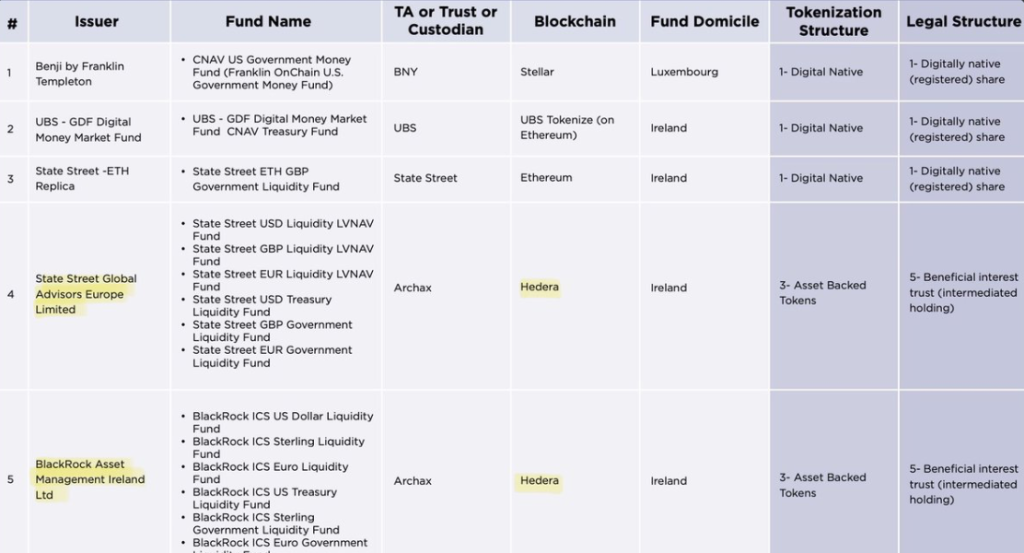
- BlackRock and State Street deployed multiple money market funds on the Hedera network via Archax.
- HBAR’s ISO 20022 compliance strengthens its positioning within institutional and regulatory frameworks.
- ETF inflows and enterprise adoption signal growing institutional validation for Hedera’s infrastructure.
Two of the largest names in global finance just made a quiet but meaningful move. State Street Global Advisors Europe and BlackRock have deployed multiple money market funds onto Hedera Hashgraph (HBAR). The development surfaced through research shared by SMQKE, a blockchain analyst known for tracing institutional integrations long before they hit mainstream headlines.
This isn’t retail speculation. It’s infrastructure.
Six Money Market Funds Go Live on Hedera
On the European side, State Street rolled out six money market funds denominated in USD, GBP, and EUR directly onto the Hedera network. The deployment runs through Archax, which operates as both a crypto custodian and institutional brokerage — and notably works closely with BlackRock.
That detail matters.
Money market funds are typically conservative, highly regulated vehicles. They aren’t experimental DeFi pools chasing yield. When products like that move onto a distributed ledger, it signals trust in the underlying rails. Not hype — compliance.
Hedera falls into the category of ISO 20022-compliant digital assets, similar to XRP and Stellar (XLM). With SWIFT transitioning toward ISO 20022 standards, tokens aligned with that framework suddenly look more compatible with traditional financial plumbing. It’s not glamorous, but it’s strategic.
Institutional Liquidity Is Shifting
What this move implies is subtle but important: compliant digital infrastructure is becoming part of institutional workflows. That doesn’t mean trillions flood in overnight. It means digital assets that fit regulatory standards are being positioned to survive — and operate — inside existing financial systems.
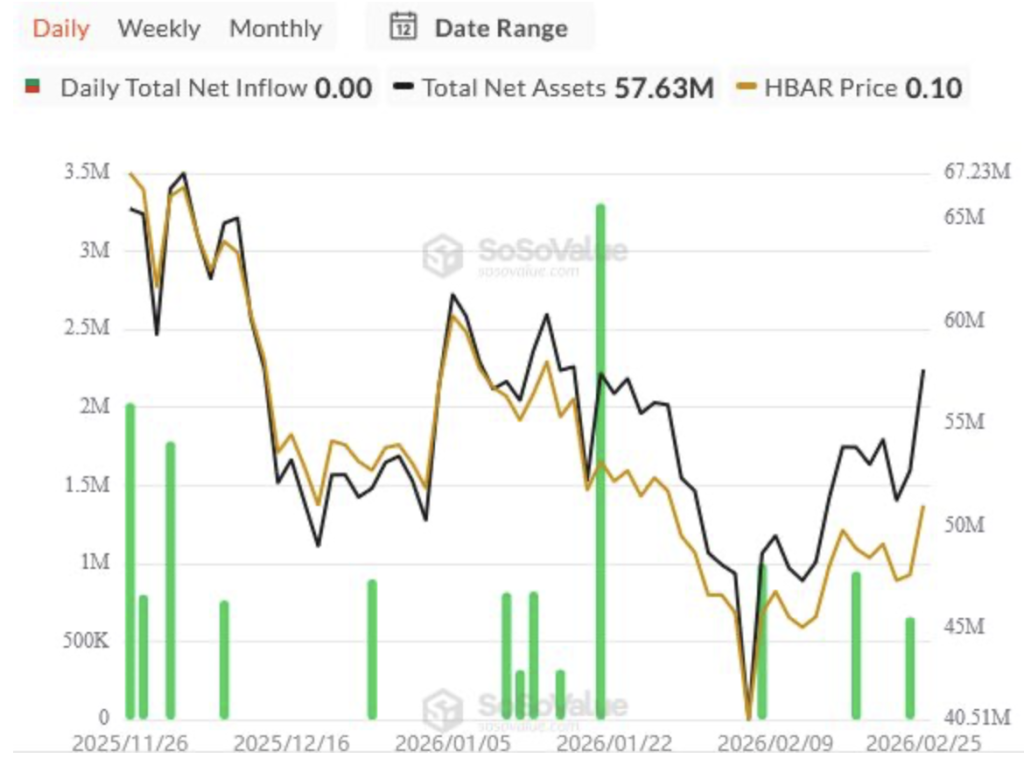
HBAR has already carved out a unique lane in this regard. After XRP, it was among the earliest altcoins to receive a standalone exchange-traded fund. Canary Capital’s HBAR ETF on NASDAQ has attracted roughly $91.88 million in about five months of trading.
That number doesn’t compete with Ripple’s $1.24 billion or Solana’s $932 million in ETF flows over similar periods. But it tells a different story. HBAR has quietly outpaced ETF traction for Litecoin, Dogecoin, and Avalanche. The only altcoin ETF in a similar range right now is Chainlink, with around $85 million combined across two products.
In other words, HBAR isn’t leading the pack — but it’s firmly in the institutional conversation.
Why ISO 20022 Matters More Than Hype
ISO 20022 compliance isn’t flashy. It doesn’t create viral rallies. But as SWIFT upgrades messaging standards across global banking networks, assets aligned with that framework gain practical compatibility. That compatibility reduces friction for institutions testing blockchain rails.
Hedera’s positioning as an “enterprise-safe” distributed ledger becomes clearer in this context. Governance structure, regulatory alignment, and stable infrastructure appeal to asset managers who care less about price volatility and more about operational certainty.
The bigger theme here is liquidity migration. Institutional capital tends to flow toward assets that fit within existing legal and compliance frameworks. When heavyweights like BlackRock and State Street choose specific networks for deployment, the signal extends beyond a single press release.
HBAR isn’t mooning because of this. Not immediately, anyway. But beneath the surface, the groundwork is expanding. Quietly. Methodically.
And in crypto, sometimes the quiet moves matter most.