
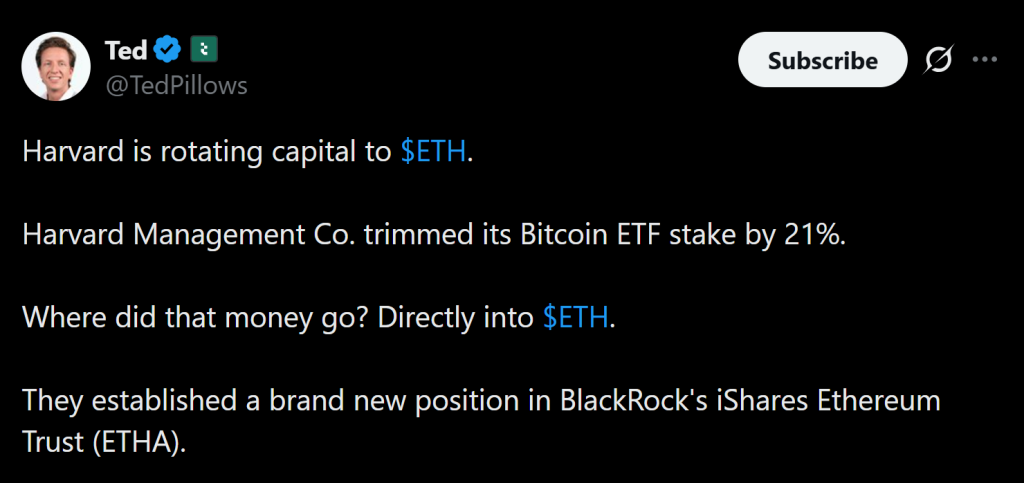
- Harvard’s endowment disclosed a new $87M position in BlackRock’s ETHA
- The fund reduced its Bitcoin ETF exposure in the same quarter
- Crypto-linked holdings now sit near $353M, about 1% of total assets
Harvard Management Company (HMC), the investment arm behind Harvard University’s $56.9 billion endowment, disclosed buying roughly $87 million worth of the iShares Ethereum Trust (ETHA) in Q4 2025. This is the first time the endowment has reported a position directly tied to Ethereum through a U.S.-listed spot ETF, and that detail matters more than the dollar amount.
Harvard doesn’t buy ETH exposure because it wants to trade a narrative. It buys exposure because it wants optionality in a long-duration portfolio. This is an endowment move, not a retail one.
The Bigger Surprise: They Cut Bitcoin at the Same Time
While Ethereum exposure was added, Harvard reduced its Bitcoin position during the quarter. HMC trimmed its iShares Bitcoin Trust holdings from around 6.8 million shares to roughly 5.4 million shares, leaving a stake valued near $266 million.
That doesn’t mean Harvard turned bearish on Bitcoin. But it does suggest a deliberate rebalancing. In plain terms, the endowment appears to be rotating part of its crypto exposure rather than simply increasing it.
And that’s the part people will miss. Institutions don’t always “buy more.” Sometimes they shift the mix.
Crypto Is Still Small, But It’s Officially Real in the Portfolio
At quarter’s end, HMC held $352.6 million in crypto-linked investments, making up about 1% of total assets. That’s not an aggressive allocation, but it’s meaningful because it’s disclosed, structured, and repeated.
Bitcoin remains Harvard’s largest crypto-linked equity position even after the trim, and the endowment first revealed Bitcoin ETF exposure back in Q2 2025 with a $117 million stake. So this isn’t a one-off experiment. It’s a continuing allocation theme.

The Macro Context Matters More Than the Headlines
Harvard also recorded a $113 million deficit in fiscal year 2025, with spending rising faster than revenues amid political and economic pressure. Leadership has warned that future stress could intensify due to shrinking federal research partnerships, tighter student mobility, and the possibility of higher endowment taxes.
That environment matters because it explains why an endowment might diversify into liquid, regulated crypto exposure. Not as a moonshot, but as a hedge against structural instability in traditional funding channels.
Conclusion
Harvard adding Ethereum exposure while trimming Bitcoin isn’t a retail-style “ETH is better than BTC” call. It looks more like institutional portfolio management: rotate, diversify, keep optionality, and stay inside regulated wrappers. Here is what it signals: Ethereum ETFs are now credible enough for top-tier endowments, and the smartest money is starting to treat ETH as its own category, not just Bitcoin’s sidekick.