
- Gary Vaynerchuk says his conviction in NFTs remains stronger than ever despite the market downturn.
- He believes excessive greed during the 2021 boom damaged the sector’s reputation but not the underlying technology.
- Vaynerchuk argues that elite collections like CryptoPunks could be significantly undervalued relative to their long-term cultural importance.
NFTs have gone from being one of crypto’s hottest trends to one of its favorite targets for criticism. Mention them today and you’ll likely hear jokes about overpriced JPEGs, failed projects, and speculative mania. According to entrepreneur and investor Gary Vaynerchuk, however, many people may be misunderstanding what’s actually happening.
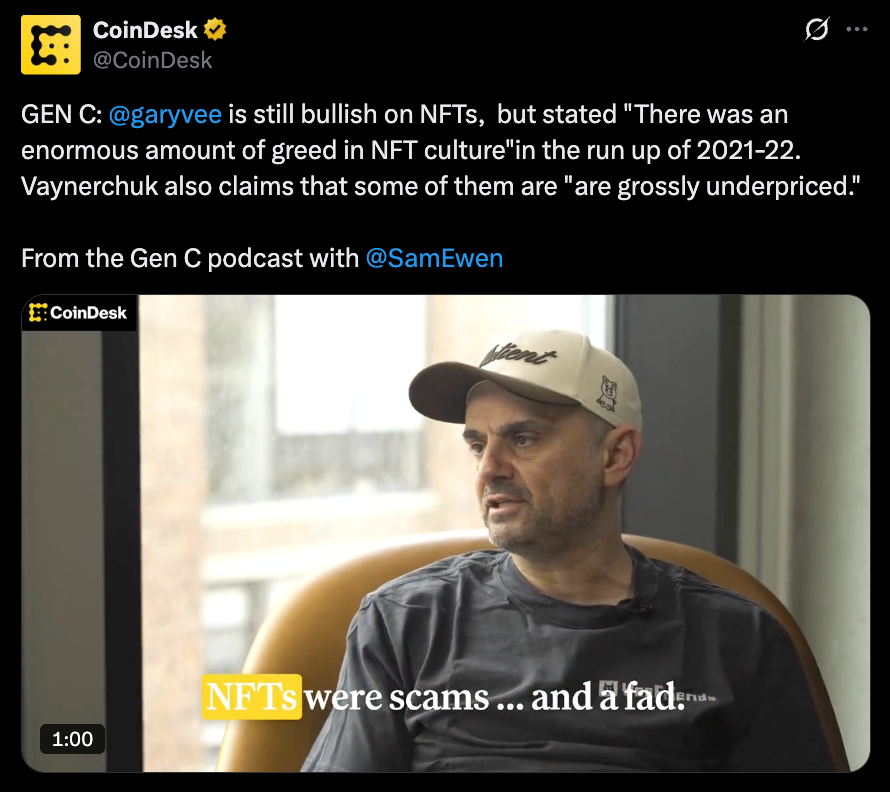
Speaking on the Gen C podcast, Vaynerchuk pushed back against the common belief that NFTs are dead. To make his point, he recently showed a successful business executive that roughly $400,000 worth of Bored Ape Yacht Club NFTs had traded within a 24-hour period. The executive was stunned, assuming NFT activity had essentially vanished.
That reaction, according to Vaynerchuk, highlights just how disconnected public perception has become from what’s still happening inside the market.
The Bubble Burst, But The Technology Didn’t
Vaynerchuk has never denied that the NFT market experienced a dramatic collapse.
In fact, he argues that greed played a major role in creating the problem. During the 2021 and 2022 bull market, countless projects launched with unrealistic promises, speculative hype reached unsustainable levels, and investors poured money into collections with little long-term value.
When market conditions changed, many projects disappeared almost overnight. Prices collapsed, confidence evaporated, and NFTs became synonymous with excess.
Yet Vaynerchuk believes many critics are confusing the failure of speculative projects with the failure of the technology itself.
The Dot-Com Comparison
One of the comparisons Vaynerchuk frequently returns to is the dot-com crash.
In the late 1990s, investors poured money into internet companies regardless of whether they had viable business models. When the bubble burst, countless firms disappeared.
Today, companies like Amazon, Google, and Meta dominate the global economy despite emerging from an industry many once declared dead after the crash.
Vaynerchuk sees a similar dynamic playing out within NFTs.
The vast majority of projects may fail, but that doesn’t necessarily mean digital ownership itself disappears.
The 99% Theory
Interestingly, Vaynerchuk has maintained the same prediction for years.
Back in 2021, he argued that roughly 99% of NFT projects would eventually become worthless. He hasn’t changed that view.
What has remained consistent is his belief that the surviving 1% could become incredibly valuable.
Rather than viewing NFTs as a broad investment category, he sees them as a market where only a handful of culturally significant collections ultimately matter. Identifying those winners is where the real opportunity may exist.
The challenge, of course, is figuring out which projects belong in that category.
Why CryptoPunks Stand Out
Among the collections Vaynerchuk continues to highlight, CryptoPunks remain near the top of the list.
Widely regarded as one of the earliest and most influential NFT projects, CryptoPunks helped establish the foundation for the entire digital collectibles movement. Their historical significance has led many collectors to compare them to rare pieces of digital art rather than speculative assets.
Vaynerchuk believes collections with that level of cultural importance may currently be trading well below their long-term value.
His argument is not based solely on scarcity or price action. It is rooted in the idea that internet culture increasingly assigns value to digitally native assets.
A Different Kind of NFT Market
The NFT landscape today looks very different from the one investors encountered during the bull market. Speculation has cooled. Trading volumes have declined from peak levels. Many projects have disappeared entirely. At the same time, the market has become more selective.
Collectors are increasingly focusing on provenance, cultural relevance, artistic significance, and community longevity rather than simply chasing the latest trend. That shift could ultimately benefit the collections that survive.
As the noise fades, the strongest projects may become easier to identify.
The Long-Term Bet
Gary Vee‘s thesis remains remarkably straightforward. The NFT bubble exploded. Most projects will fail. Many already have. But a small number of collections may emerge as important pieces of internet history, digital culture, and online ownership. If that happens, today’s prices could eventually look surprisingly cheap.
Whether that prediction proves correct remains uncertain. Yet one thing is clear: Vaynerchuk is not treating the NFT downturn as the end of the story. He believes it’s simply the part where the market finally starts separating what matters from what never did.