

BlockNews
FOLLOW ON X
  • BITCOIN
  • CRYPTO
    • ETHEREUM
    • RIPPLE XRP
    • SOLANA
    • CARDANO
    • BINANCE BNB
    • DOGECOIN
    • TRON
    • SUI
    • CHAINLINK
    • LITECOIN
  • FINANCE
  • POLITICS
  • MEMECOINS
  • NFT
  • OPINION
No Result
View All Result
BlockNews
  • BITCOIN
  • CRYPTO
    • ETHEREUM
    • RIPPLE XRP
    • SOLANA
    • CARDANO
    • BINANCE BNB
    • DOGECOIN
    • TRON
    • SUI
    • CHAINLINK
    • LITECOIN
  • FINANCE
  • POLITICS
  • MEMECOINS
  • NFT
  • OPINION
No Result
View All Result
BlockNews
Home CRYPTO

Ethereum’s Next Big Scaling Leap: 5x Gas Limit, Cheaper Fees, and the Race With Solana — Here Is What Comes After Fusaka

Michael Juanico by Michael Juanico
November 28, 2025
in CRYPTO, ETHEREUM, FINANCE, OPINION
Share on XShare in TelegramShare on Reddit
  • Ethereum is preparing for Fusaka in December and a targeted 5x gas limit expansion in 2026 to boost throughput without overloading nodes.
  • Average Ethereum fees have fallen to around $0.31, still above Solana’s ~$0.0022, but the gap has narrowed significantly since 2024.
  • Aggressive scaling is aimed at keeping Ethereum competitive with Solana and other L1s while empowering L2s and preserving decentralization.

Even with the Fusaka upgrade scheduled for early December, Ethereum is already staring further down the road. In a recent post on X, co-founder Vitalik Buterin said he expects “targeted growth” that could support roughly a 5x gas limit increase in 2026, instead of just blindly cranking capacity higher.

For anyone not deep in the weeds, raising the gas limit means more computation per block, which translates into higher throughput and the ability to pack more transactions into each block. In plain terms, that keeps Ethereum faster and helps Layer 2 fees stay lower, even as usage ramps.
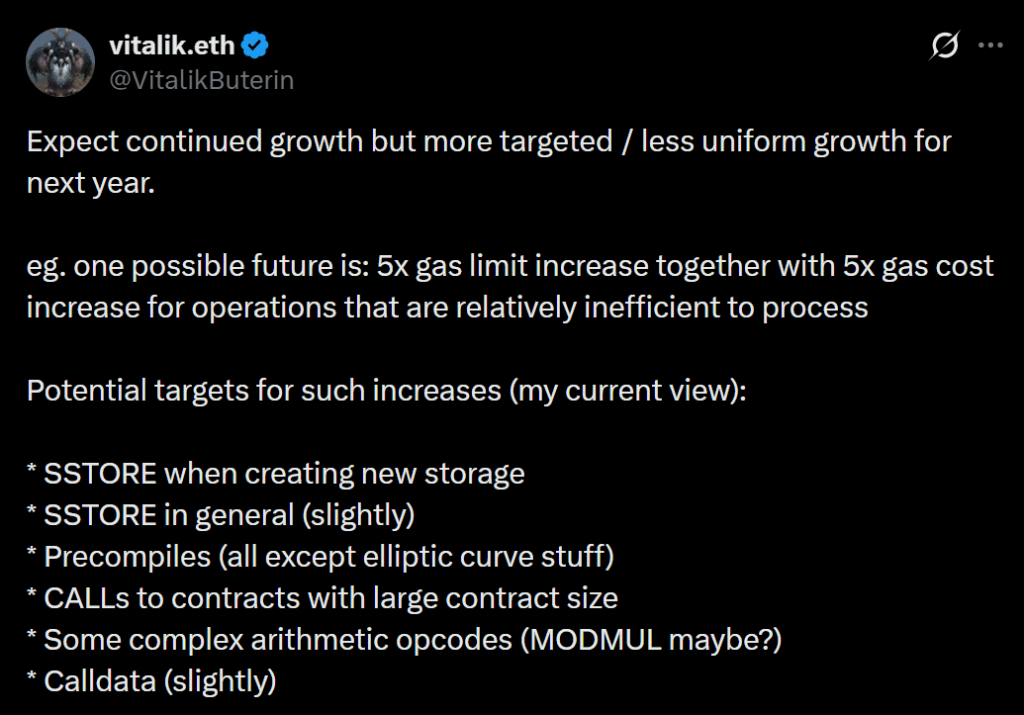
But Vitalik also flagged a key constraint. He doesn’t want a free-for-all where heavy, inefficient operations clog the network. Under his vision, those types of transactions would simply become more expensive, pushing developers toward more efficient designs and preventing nodes from being overloaded with storage and execution bloat.

Where Ethereum Gas Limits Stand Today

As of November 2025, Ethereum’s gas limit sits at about 60 million gas per block. That’s already double what it was roughly a year ago, when researchers like Toni Wahrstätter from the Ethereum Foundation were openly pushing for higher limits. The network has, in other words, quietly been scaling in stages rather than through one huge leap.

This year, the Pectra upgrade was the main pillar of that progress. Pectra improved validator operations, boosted Layer 2 scalability, and made wallet interactions smoother. It didn’t grab headlines like some earlier hard forks, but it laid a ton of groundwork behind the scenes.

Now Fusaka is lined up as the final major scaling step for this cycle. Set for activation in early December, Fusaka aims to raise effective block capacity and simultaneously make node operations lighter. If it lands as designed, the upgrade should increase throughput, trim costs, and create more breathing room for both mainnet and rollups.

The 2026 plan then builds on top of this base: more optimization, more “targeted” efficiency gains, and smart use of gas pricing to steer the network away from wasteful behavior.

Why Ethereum Is Pushing So Hard on Scaling

All this talk about gas limits, validator efficiency, and node load isn’t happening in a vacuum. Ethereum is scaling aggressively because the competitive pressure from other Layer 1 chains, especially Solana, is very real.

Ethereum still holds the stronger decentralization narrative. It has more battle-tested infrastructure, deeper institutional trust, and a massive ecosystem orbiting its base layer and rollups. That’s why big funds still treat it as a core piece of the crypto stack.
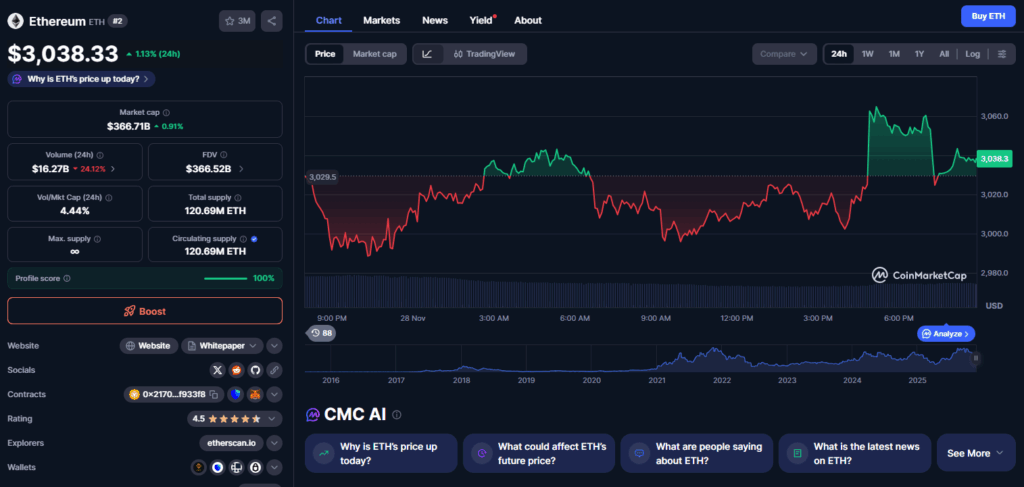
But Solana has carved out a powerful identity of its own: fast, cheap, and very “retail-friendly.” During the memecoin supercycle, that mattered. Traders could spin up and flip tokens for fractions of a cent, while Ethereum mainnet regularly charged $10 or more for similar activity, sometimes much higher whenever things got busy.

Over the past couple of years, Ethereum has been quietly closing that gap. Average transaction fees were cut roughly in half in 2024, settling near $5. Then Pectra and later improvements dragged that number even lower through 2025.

Fee Gap With Solana Is Shrinking (But Not Gone Yet)

Today, the numbers tell a clearer story. According to recent data, average Ethereum transaction fees have dropped below $1 and sit around $0.31 at the time of writing. That is a huge psychological shift compared to the 2021–2022 era, when “gas pain” was a daily meme.

Solana, though, is still dramatically cheaper on paper. Typical transaction costs hover near $0.0022 — essentially fractions of a cent. That cost advantage is one of the reasons Solana became the default playground for high-velocity memecoin trading and micro-speculation.

Ethereum’s answer is not to try to win a pure fee war at the base layer, but to push enough scaling so that:

L2s can reliably offer sub-cent or low-cent fees for end users.
Mainnet remains secure, decentralized, and attractive for high-value settlement.
Heavy or inefficient contracts effectively “self-select” into higher fee tiers.

If Vitalik’s targeted 5x gas limit growth and follow-on optimizations land in 2026, Ethereum will likely narrow the practical gap even further. Users won’t just compare raw base-layer fees; they’ll compare the full experience across rollups, wallets, and apps running on Ethereum’s broader ecosystem versus a single-chain environment.

In that sense, Fusaka is not a finish line; it’s more like the final step before Ethereum hits another gear in 2026, pushing throughput higher while trying to keep its core values intact.


Disclaimer: BlockNews provides independent reporting on crypto, blockchain, and digital finance. All content is for informational purposes only and does not constitute financial advice. Readers should do their own research before making investment decisions. Some articles may use AI tools to assist in drafting, but every piece is reviewed and edited by our editorial team of experienced crypto writers and analysts before publication.
Tags: ethereumEthereum scalingFusaka upgradegas feesLayer 2Solana
Tweet1ShareShare
Michael Juanico

Michael Juanico

Michael is a BSBA Management graduate from Mindanao State University and has been a professional content writer since 2019. He began exploring cryptocurrency in 2021 and has since made blockchain and digital assets his primary focus. For nearly four years, Michael has contributed research and editorial content at Aiur Labs and BlockNews, producing clear and accessible coverage of market trends, trading strategies, and project developments. He is transparent about his personal holdings in Bitcoin, TRON, and select meme tokens, combining writing expertise with hands-on market experience to deliver trustworthy insights to readers.

DON'T MISS THESE! HOT OFF THE PRESS

AVAX Approaches Major Structural Decision Point With Bearish Momentum Still Dominant
CRYPTO

AVAX Approaches Major Structural Decision Point With Bearish Momentum Still Dominant

March 1, 2026
AAVE Price Slides as Governance Rift and Broader Crypto Market Panic Weigh on Investor Sentiment
CRYPTO

AAVE Price Slides as Governance Rift and Broader Crypto Market Panic Weigh on Investor Sentiment

March 1, 2026
CRYPTO

Stellar (XLM) Drops 10% as Bearish Pattern Signals Potential Breakdown Below $0.145

March 1, 2026
Chainlink Consolidation Breaks Down as Rejection Wicks Confirm Seller Dominance Near $9.30
CHAINLINK

Chainlink Consolidation Breaks Down as Rejection Wicks Confirm Seller Dominance Near $9.30

March 1, 2026
Cardano Struggles to Reclaim Momentum as Money Flow Signals Continued Outflows
CARDANO

Cardano Struggles to Reclaim Momentum as Money Flow Signals Continued Outflows

March 1, 2026
Solana Rally Fades as Bearish Weekly Structure Points to Potential Breakdown Below Key Range Support
CRYPTO

Solana Rally Fades as Bearish Weekly Structure Points to Potential Breakdown Below Key Range Support

March 1, 2026
Load More

Related News

AVAX Approaches Major Structural Decision Point With Bearish Momentum Still Dominant

AVAX Approaches Major Structural Decision Point With Bearish Momentum Still Dominant

March 1, 2026
AAVE Price Slides as Governance Rift and Broader Crypto Market Panic Weigh on Investor Sentiment

AAVE Price Slides as Governance Rift and Broader Crypto Market Panic Weigh on Investor Sentiment

March 1, 2026

Stellar (XLM) Drops 10% as Bearish Pattern Signals Potential Breakdown Below $0.145

March 1, 2026
Chainlink Consolidation Breaks Down as Rejection Wicks Confirm Seller Dominance Near $9.30

Chainlink Consolidation Breaks Down as Rejection Wicks Confirm Seller Dominance Near $9.30

March 1, 2026
Cardano Struggles to Reclaim Momentum as Money Flow Signals Continued Outflows

Cardano Struggles to Reclaim Momentum as Money Flow Signals Continued Outflows

March 1, 2026
Twitter Telegram Threads

BLOCKNEWS.COM

BlockNews is your premier source for real-time cryptocurrency, blockchain, political and financial market news.

Stay ahead of the herd with BlockNews

RESOURCES

  • About Us
  • Contact Us
  • Editorial Policies
  • Terms and Conditions
  • Privacy Policy
  • Sitemap

DISCLOSURES AND POLICIES

BlockNews provides independent reporting on crypto, blockchain, and digital finance. Content is for informational purposes only and does not constitute financial advice. Sponsored material is always disclosed. By using this site, you agree to our Terms and Conditions and Privacy Policy.

© 2025 BlockNews

Manage Consent
To provide the best experiences, we use technologies like cookies to store and/or access device information. Consenting to these technologies will allow us to process data such as browsing behavior or unique IDs on this site. Not consenting or withdrawing consent, may adversely affect certain features and functions.
Functional Always active
The technical storage or access is strictly necessary for the legitimate purpose of enabling the use of a specific service explicitly requested by the subscriber or user, or for the sole purpose of carrying out the transmission of a communication over an electronic communications network.
Preferences
The technical storage or access is necessary for the legitimate purpose of storing preferences that are not requested by the subscriber or user.
Statistics
The technical storage or access that is used exclusively for statistical purposes. The technical storage or access that is used exclusively for anonymous statistical purposes. Without a subpoena, voluntary compliance on the part of your Internet Service Provider, or additional records from a third party, information stored or retrieved for this purpose alone cannot usually be used to identify you.
Marketing
The technical storage or access is required to create user profiles to send advertising, or to track the user on a website or across several websites for similar marketing purposes.
  • Manage options
  • Manage services
  • Manage {vendor_count} vendors
  • Read more about these purposes
View preferences
  • {title}
  • {title}
  • {title}
Manage Consent
To provide the best experiences, we use technologies like cookies to store and/or access device information. Consenting to these technologies will allow us to process data such as browsing behavior or unique IDs on this site. Not consenting or withdrawing consent, may adversely affect certain features and functions.
Functional Always active
The technical storage or access is strictly necessary for the legitimate purpose of enabling the use of a specific service explicitly requested by the subscriber or user, or for the sole purpose of carrying out the transmission of a communication over an electronic communications network.
Preferences
The technical storage or access is necessary for the legitimate purpose of storing preferences that are not requested by the subscriber or user.
Statistics
The technical storage or access that is used exclusively for statistical purposes. The technical storage or access that is used exclusively for anonymous statistical purposes. Without a subpoena, voluntary compliance on the part of your Internet Service Provider, or additional records from a third party, information stored or retrieved for this purpose alone cannot usually be used to identify you.
Marketing
The technical storage or access is required to create user profiles to send advertising, or to track the user on a website or across several websites for similar marketing purposes.
  • Manage options
  • Manage services
  • Manage {vendor_count} vendors
  • Read more about these purposes
View preferences
  • {title}
  • {title}
  • {title}
No Result
View All Result
  • HOME
  • BITCOIN
  • CRYPTO
    • ETHEREUM
    • RIPPLE XRP
    • SOLANA
    • CARDANO
    • BINANCE BNB
    • DOGECOIN
    • TRON
    • LITECOIN
    • CHAINLINK
    • SUI
  • MEMECOINS
  • POLITICS
  • FINANCE
  • NFT
  • DEFI
  • GUIDES

© 2025 BlockNews