
- Tokenized U.S. Treasuries on Ethereum surpassed $8 billion in market value
- Major financial firms including BlackRock and Franklin Templeton continue building on Ethereum
- Ethereum price remains stuck below resistance despite rising institutional adoption
Tokenized U.S. Treasuries on Ethereum have officially crossed the $8 billion mark, and honestly, that’s not some tiny experimental milestone anymore. According to Token Terminal data, the sector doubled in size within just six months as major financial players quietly expanded their presence on the network.
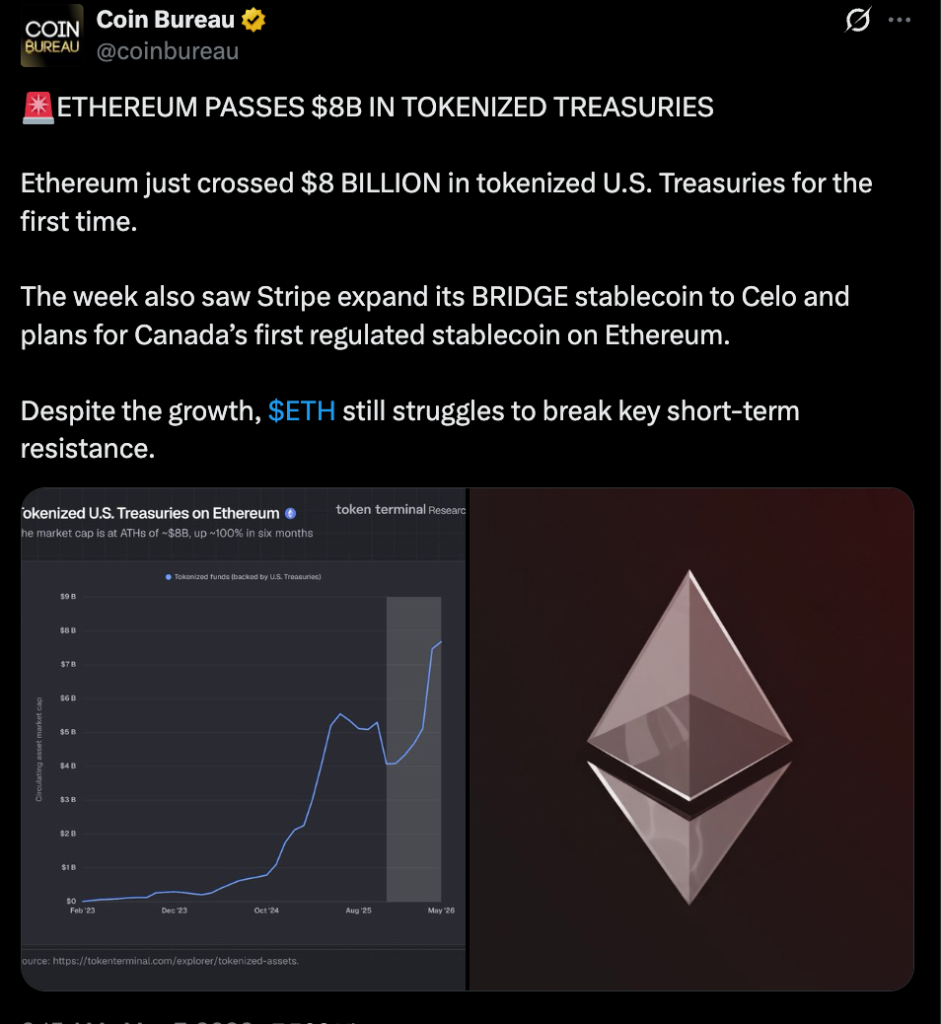
BlackRock, Franklin Templeton, Ondo Finance, and WisdomTree are all building products tied to Ethereum, even while parts of the market still argue over whether crypto has “real” utility. At this point, traditional finance is already showing up on-chain, whether people want to admit it or not.
Ethereum Is Becoming Wall Street’s Settlement Layer
The bigger story here goes beyond the headline number. Tokenized Treasuries are increasingly competing with stablecoin reserves, money market funds, and short-duration ETFs as a place to park idle capital inside the crypto ecosystem.
Ethereum has become the dominant chain for that activity by a pretty wide margin too. BNB Chain sits far behind with roughly $3.4 billion in tokenized Treasuries, while Solana, Stellar, and XRP Ledger each remain below the $1 billion threshold.
That gap says a lot about where institutions currently feel most comfortable deploying serious capital. Stability, infrastructure, and liquidity still matter more than hype, even in crypto markets that move fast and break things constantly.
Stablecoins Are Quietly Expanding Across Ethereum
The institutional expansion doesn’t stop with Treasuries either. Stripe recently pushed its BRIDGE stablecoin onto Celo, Ethereum’s Layer 2 ecosystem, while Canada approved its first regulated stablecoin backed by the Canadian dollar and supported by National Bank alongside Shopify.
And yes, that stablecoin also chose Ethereum as its home base. Shopify’s involvement adds another layer to the story because it hints at something beyond trading speculation — actual retail payment infrastructure slowly forming underneath the surface.

It’s the kind of adoption that usually happens quietly before suddenly becoming obvious to everyone later. Crypto tends to move like that sometimes.
ETH Price Still Refuses To React
Despite all the institutional growth, Ethereum’s price action still looks oddly unimpressed. ETH struggled to break above resistance during its recent consolidation range, even while Ethereum ETFs pulled in more than $157 million in net inflows across two trading sessions.
Institutional demand is clearly increasing, the infrastructure keeps expanding, and real-world financial products are launching directly on Ethereum. Somehow though, the chart still looks hesitant, almost disconnected from the underlying fundamentals.
Maybe the market simply needs more time to catch up. Or maybe Ethereum investors are learning the painful lesson that adoption and price don’t always move at the same speed.