

- Ethereum Foundation publishes a 38-page mandate outlining its long-term role
- The document centers Ethereum’s mission on user self-sovereignty and decentralization
- The foundation plans to gradually reduce its influence as the ecosystem matures
The Ethereum Foundation has released a sweeping new document explaining how it views its role in guiding the development of the Ethereum network. The 38-page publication, called the “EF Mandate,” outlines the philosophy, priorities, and long-term responsibilities the organization believes it holds as a steward of the world’s second-largest blockchain.
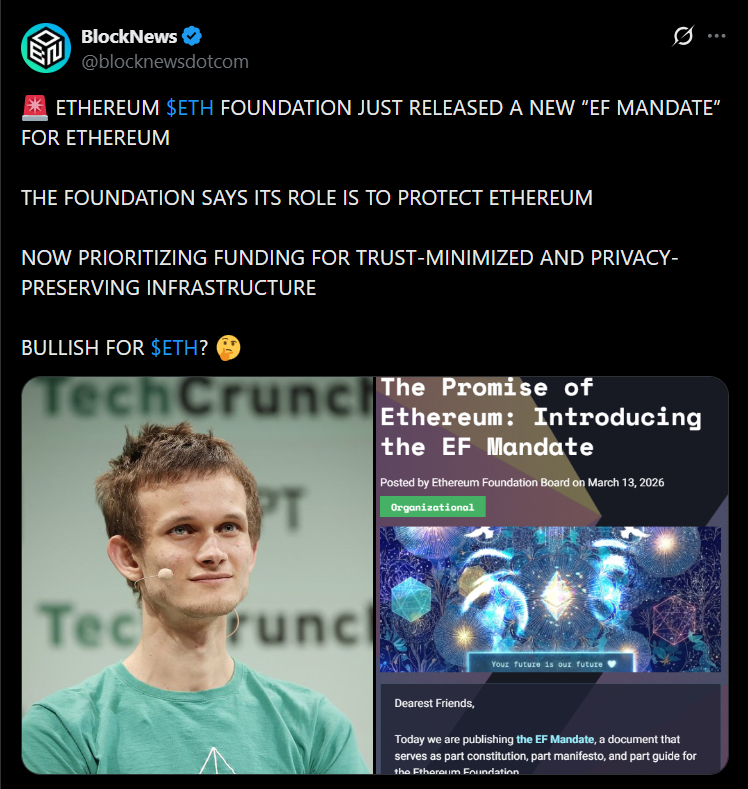
The manifesto arrives during a period of change for the Ethereum ecosystem. The network’s technical roadmap has been evolving, and earlier this year one of the foundation’s co-executive directors stepped down. Against that backdrop, the document attempts to clarify how the foundation sees its position within a decentralized system that ultimately belongs to the broader community.
Ethereum’s Core Mission Is Self-Sovereignty
At the heart of the mandate is the concept of self-sovereignty. According to the foundation, Ethereum exists primarily to give individuals control over their identities, assets, and digital interactions without relying on centralized authorities.
The document argues that decentralized infrastructure is becoming increasingly important in a digital world dominated by large technology platforms and centralized institutions. Ethereum, in this framework, serves as a foundational system that allows users to operate freely within open networks.
The foundation emphasizes that it does not “own” Ethereum and does not act as its governing authority. Instead, it describes itself as an early steward whose role is to guide development while ensuring the network remains decentralized.
Four Principles Guiding Ethereum’s Development
To preserve Ethereum’s mission, the foundation highlights four properties that must remain central to the network’s evolution. These principles are censorship resistance, open source development, privacy, and security, collectively referred to in the document as CROPS.
According to the mandate, these qualities must remain inseparable components of Ethereum’s design. The foundation argues that weakening any of them could compromise the network’s long-term purpose as an open and permissionless system.
By emphasizing these principles, the EF aims to ensure that technological development does not drift toward centralized control or compromise user autonomy.

The Foundation Plans to Step Back Over Time
Interestingly, the document also stresses that the Ethereum Foundation does not intend to maintain permanent influence over the ecosystem. Instead, it sees its success as tied to becoming less necessary over time.
For now, the organization says it will focus on tasks that are unlikely to be handled by other participants in the ecosystem. These include long-term protocol research, security work related to public goods, and coordination between development teams working on the Ethereum network.
As the ecosystem grows and more independent contributors take on these responsibilities, the foundation expects its relative influence to gradually decline.
Ethereum as Part of an “Infinite Garden”
The manifesto also frames Ethereum as part of a broader network of open technologies. The foundation describes the ecosystem as an “infinite garden” made up of developers, communities, organizations, and institutions collaborating to keep digital infrastructure decentralized.
Within this vision, Ethereum functions as what the document calls the “World Computer,” a decentralized system capable of supporting permissionless computing, communication, and coordination across global networks.
The long-term goal, according to the foundation, is not to dominate markets or empower centralized entities but to strengthen individual freedom within digital systems.
A Long-Term Vision for Ethereum’s Future
The EF Mandate ultimately serves as a philosophical statement about what Ethereum should become over the coming decades. Rather than focusing purely on market competition or technological dominance, the document emphasizes preserving open systems that allow individuals and communities to coordinate without centralized intermediaries.
If the ecosystem continues expanding, the foundation believes Ethereum could evolve into a durable layer of digital infrastructure supporting open financial systems, decentralized applications, and global coordination networks.
For the Ethereum Foundation, success would mean something unusual for a technology organization: gradually stepping aside as the network becomes strong enough to sustain itself.