

- Ethereum’s biggest technical bottleneck has largely been solved, not on paper, but in production.
- The challenge has shifted from engineering limits to how the network is actually used.
- Ethereum’s future now depends more on values and incentives than raw technology.
For years, Ethereum accepted the hard tradeoffs of the scalability trilemma. It prioritized decentralization and security while absorbing criticism for slower throughput, especially as newer chains marketed speed-first narratives. That phase is ending. With upgrades like PeerDAS and production-grade ZK-EVMs now live, Ethereum has removed its most persistent technical ceiling in practice, not theory. Bandwidth can scale, verification remains decentralized, and security assumptions have not been compromised.
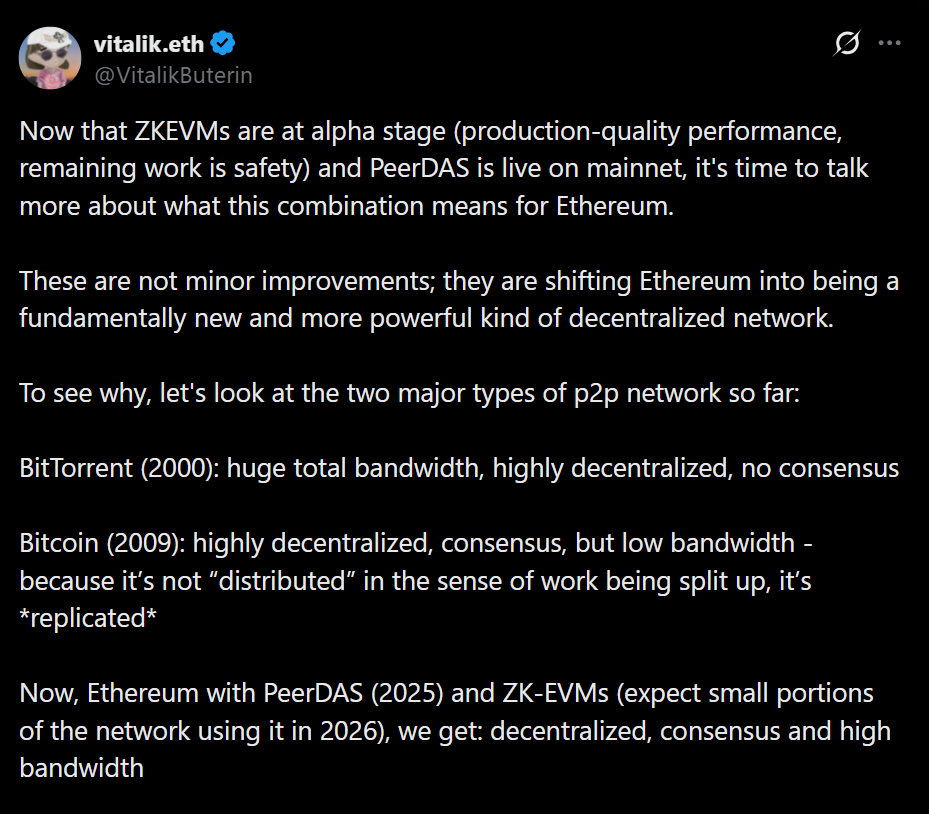
This matters because Ethereum is no longer constrained by what it cannot do. It is constrained by what it chooses to do with that capacity.
From Engineering Limits to Value Choices
When systems are boxed in by technical limits, priorities are forced. Once those limits disappear, values take over. Ethereum has crossed that threshold. The same infrastructure that enables censorship-resistant finance, identity, coordination, and settlement can also be used to manufacture noise, financial churn, or shallow engagement loops. The protocol does not enforce purpose. The ecosystem does.
This is the cultural fork Ethereum now faces. Not speed versus safety, but durability versus convenience. Long-term public infrastructure versus short-term extraction. The technology will not decide which direction wins.
Ethereum Is Infrastructure Now
Ethereum increasingly resembles shared global infrastructure rather than an experiment. It can support applications that survive their creators, resist capture, and operate without trusted intermediaries. That was always the promise, but only now does the system have the technical headroom to fulfill it at scale. Many forgot that goal while chasing faster chains and louder narratives, yet Ethereum quietly kept building.

The network is ready. The question is whether builders, users, and capital align around systems meant to last.
What Comes Next Is the Hard Part
Ethereum’s future is no longer about scaling debates. It is about incentive design, cultural norms, and collective discipline. The trilemma was an engineering problem. This next phase is a human one, and it will be harder to navigate.