
- Vitalik Buterin introduced EIP-8141, consolidating account abstraction proposals with Frame Transactions for smarter, multi-call execution.
- The Glamsterdam upgrade enables parallel transaction validation and introduces multidimensional gas for more accurate resource pricing.
- Ethereum’s long-term roadmap includes ZK-EVM deployment and blob-based scaling to improve verification efficiency and network scalability.
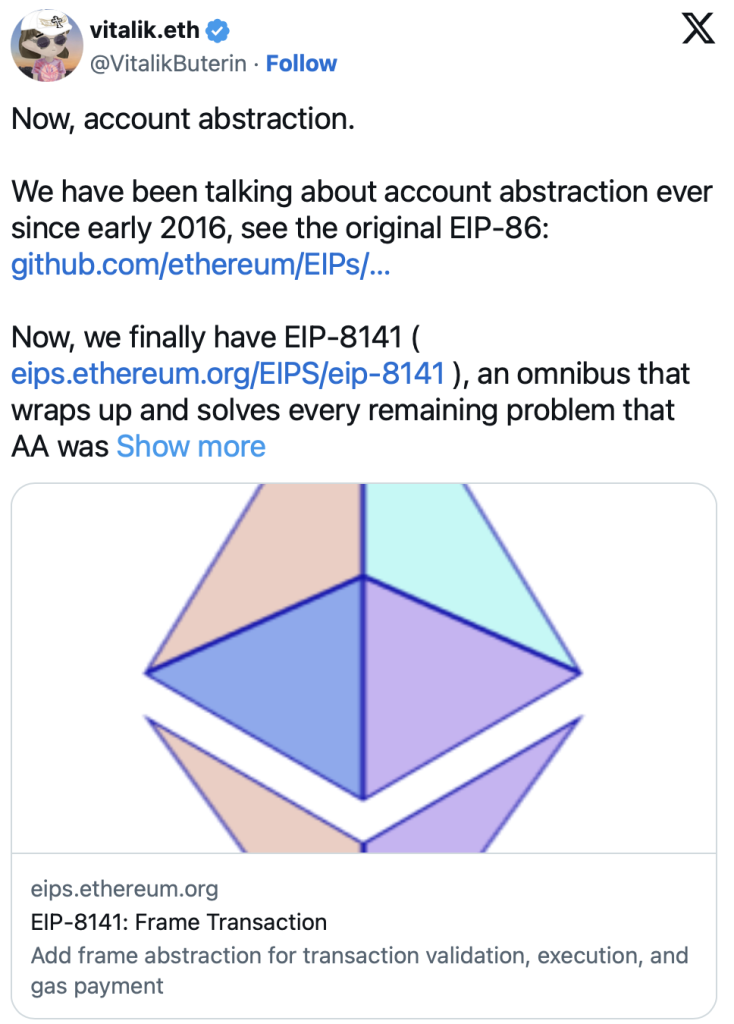
On Feb. 28, Ethereum co-founder Vitalik Buterin resurfaced an idea that’s been quietly evolving since 2016: account abstraction. It’s one of those concepts that sounds technical — and it is — but the goal is actually pretty simple. Make Ethereum accounts smarter, more flexible, less clunky.
The new proposal, EIP-8141, tries to tie together years of scattered drafts and unfinished threads. At the center of it is something called “Frame Transactions,” a structure that allows multiple calls to happen inside a single transaction. These calls can share data with each other, decide who’s authorized to send them, and even manage gas payments directly at the protocol level. In short, fewer workarounds. More native logic.
Smarter Transactions, Fewer Headaches
What does that mean in practice? Complex actions like multi-signature approvals, quantum-resistant signatures, and sponsored gas payments suddenly become much easier to handle. Instead of stitching together multiple steps across contracts and relayers, users can deploy contracts, validate actions, and execute logic — all in one go. Clean. Efficient. Finally.
Paymaster contracts are another key piece here. They allow gas fees to be paid in tokens other than ETH, like RAI, without relying on middlemen. That’s a subtle shift, but an important one. The architecture is also designed to stay decentralized even if off-chain infrastructure fails, which feels increasingly relevant these days. Privacy gets a lift too, with ZK-SNARK validation and 2D nonces quietly strengthening transaction security behind the scenes.
Glamsterdam Upgrade and Parallel Validation
At the protocol level, Ethereum isn’t just refining how accounts work — it’s also rethinking how blocks are processed. The upcoming Glamsterdam upgrade introduces block-level access lists, allowing transactions within a block to be validated in parallel rather than sequentially. That may sound like a backend tweak, but it directly impacts scalability.
There’s also ePBS, which creates safer timing windows for block validation. Gas pricing has been recalibrated as well. Instead of lumping everything together, Ethereum now separates state creation costs from execution costs. For example, an SSTORE operation that creates entirely new state consumes significantly more “state creation gas” than a routine update. The overall gas limit doesn’t necessarily rise, but it becomes more precise — more reflective of actual resource usage.
Multidimensional gas is the broader philosophy here. Execution, storage, and state creation are constrained by different gas limits instead of one blunt cap. That separation allows Ethereum to scale more intelligently, without overwhelming any single resource. It’s nuanced work, but it matters.
ZK-EVM, Blobs, and the Long Game
Looking further ahead, Ethereum’s roadmap leans heavily into ZK-EVM and blob-based scaling. Blobs are already used in Layer 2 solutions, but the vision goes further. Eventually, Ethereum blocks themselves may rely on blob data so they can be proven valid without every node needing to download or re-execute each one. That’s a big shift in how validation works.
PeerDAS ensures the data remains accessible, while ZK-SNARKs provide the cryptographic guarantees. Deployment of ZK-EVM will happen gradually. In 2026, attesters may begin using ZK-EVM proofs, though only about 5% of the network will participate at first. By 2027, that figure could rise to 20%, and later, multi-proof verification may allow broader validation across the chain.
None of this flips a switch overnight. Ethereum evolves in layers, sometimes slowly, sometimes in bursts. But taken together — account abstraction, parallel validation, multidimensional gas, ZK scaling — it paints a picture of a network quietly rebuilding itself from the inside out. Not flashy. Just foundational.