

- Dogecoin remains range-bound between $0.10 support and $0.12–$0.13 consolidation, signaling long-term positioning
- Fractal patterns and the 200-week moving average both point toward an ongoing accumulation phase
- Binance trader data shows growing long exposure without price expansion, suggesting quiet accumulation over speculation
Dogecoin (DOGE) is currently trading inside a tight and fairly compressed technical range, and most indicators are pointing toward long-term positioning rather than any clear trend breakout. Fractal behavior, interaction with the 200-week moving average, and derivatives data are all shaping the broader narrative right now. Price action continues to cluster between structural support near $0.10 and a wider consolidation band around $0.12 to $0.13, with little urgency on either side.
Fractal Pattern Suggests a Familiar Dogecoin Cycle
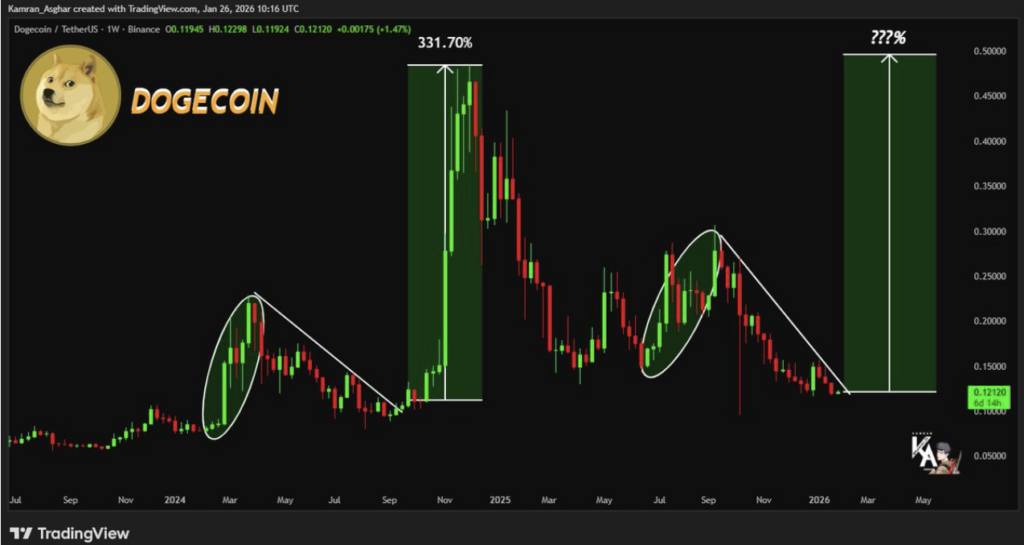
According to analyst Kamran Asghar, the weekly chart shows a repeating fractal structure that closely mirrors a previous accumulation phase. That earlier setup eventually led to a sharp upside move of roughly 331%, following a long stretch of sideways compression. In the current cycle, Dogecoin appears to be forming a rounded base after a prolonged downtrend, which points more toward stabilization than fresh selling pressure.
In past instances, price spent extended periods compressing before finally reclaiming the upper boundary of consolidation. Once that level broke, upside momentum picked up fast, almost abruptly. Structurally speaking, DOGE seems to have shifted out of a corrective phase and into a sideways, wait-and-see environment, not quite bullish but no longer deteriorating either.
Volatility has continued to contract, which usually hints that participants are positioning rather than exiting the market altogether. The projected measured move on the chart outlines potential upside if the fractal symmetry holds, though nothing is confirmed yet. For validation, price would still need to form consistent higher lows and eventually break above descending resistance, which hasn’t happened so far.
DOGE Remains Below the 200-Week Average
Another perspective comes from analyst Surf, who focuses on Dogecoin’s relationship with the 200-week moving average. Price remains below this long-term indicator, a zone that has historically aligned with accumulation phases rather than distribution. In prior cycles, extended trading below the 200-week average often coincided with longer-term value building.
At the moment, DOGE is stabilizing in the $0.12 to $0.13 range, an area that has repeatedly attracted buyers and limited deeper downside moves. Downside momentum also appears to be fading, suggesting selling pressure is slowly losing strength. It’s not dramatic, but the shift is noticeable if you zoom out.
Historically, Dogecoin has spent time oscillating around the 200-week average before reclaiming it decisively. Those moments tended to mark the transition from accumulation into early expansion phases. For now, the key downside level remains the $0.10 to $0.11 region. Holding above that area keeps the broader structure intact, while a clean reclaim of the 200-week average would signal a meaningful technical change.
Binance Data Points to Quiet Accumulation
Derivatives data adds another layer to the picture. CW’s analysis of Binance’s top trader positioning on the four-hour timeframe shows a steady increase in long exposure among leading accounts. Rather than aggressively hedging, these traders appear to be gradually building positions, even as price continues to move sideways.
The long-to-short ratio remains tilted toward longs despite the lack of price expansion. This type of divergence often reflects anticipatory accumulation, where traders position early ahead of a larger move. Notably, this buildup is happening without sharp volatility spikes, which suggests patience rather than speculation.
That said, positioning data on its own doesn’t dictate direction. If Dogecoin fails to hold current support levels, leveraged long positions could unwind quickly and add downside pressure. Still, the data reinforces the idea that larger participants are watching closely and treating this range as an accumulation environment rather than a distribution one.