
- Hyperliquid open interest hit a record $1.43B, driven by both crypto and non-crypto markets
- HYPE price is rising independently, suggesting weaker correlation with major crypto assets
- SEC’s new commodity classification brings clearer rules, supporting broader market growth
Hyperliquid crypto is starting to draw serious attention again, and not just from the usual crowd. A mix of rising open interest and a fresh regulatory shift out of the US is changing how traders are looking at the space. It’s not one single factor driving this… it’s more like several pieces lining up at once.
Trading desks have noticed. So has the broader market. And when both start paying attention at the same time, things tend to move.
Open Interest Hits Record as New Markets Take Over
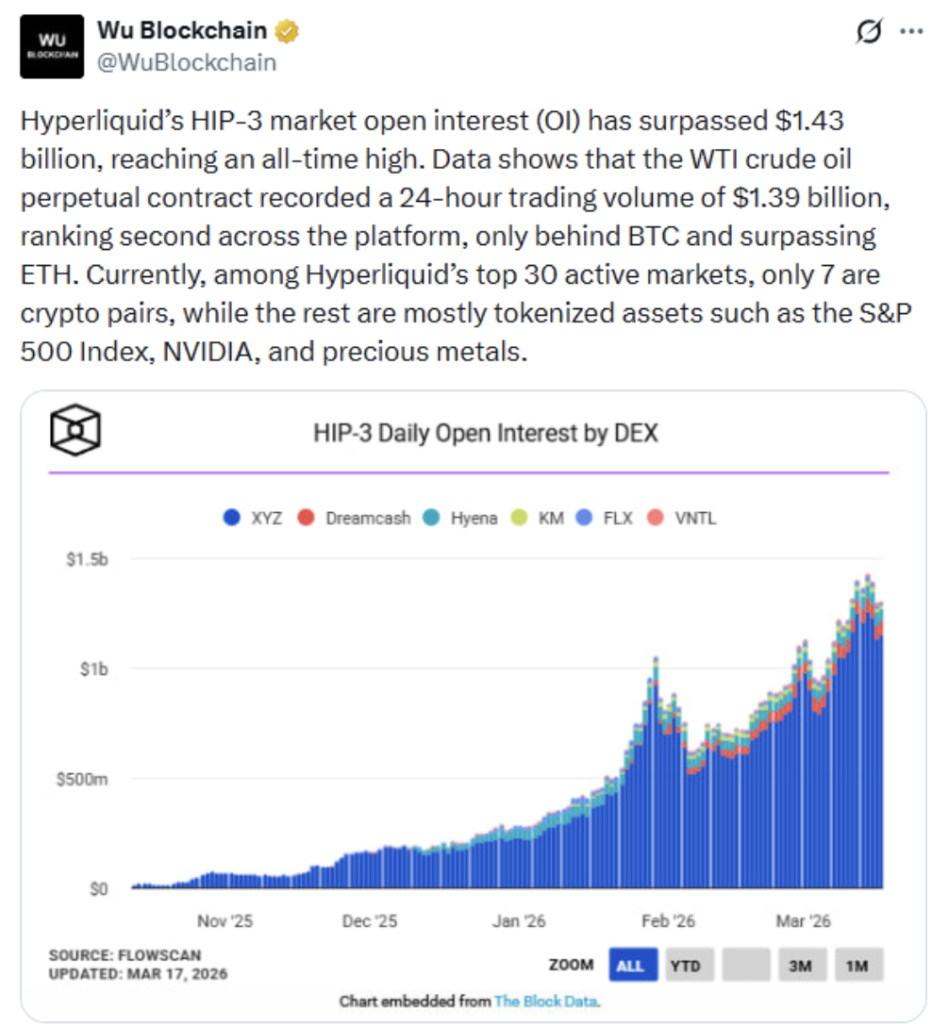
Hyperliquid just pushed its open interest to a new high, with the HIP-3 market crossing $1.43 billion. That’s the largest level the platform has seen so far, which, honestly, says a lot about how quickly it’s growing.
But what’s more interesting is where that activity is coming from. The WTI crude oil perpetual contract alone pulled in about $1.39 billion in 24-hour volume, second only to Bitcoin, and ahead of Ethereum. That’s not something you’d expect from a “crypto” exchange, at least not traditionally.
Looking deeper, the shift becomes even clearer. Out of the top 30 markets on Hyperliquid, only 7 are actually crypto pairs. The rest are tied to tokenized versions of assets like the S&P 500, Nvidia, and even metals.
So the narrative is changing. Hyperliquid isn’t just about crypto anymore, it’s slowly turning into a broader trading platform where multiple asset classes live side by side.
And as open interest rises, it usually means more positions are being held, more traders are active, more liquidity flows in. For now, demand looks strong… and it’s coming from more than just crypto traders.
HYPE Price Moves on Its Own Path
At the same time, the HYPE token itself has climbed back above $42, marking its highest level since November 10. That might not sound huge on its own, but context matters. Back then, Bitcoin was sitting around $103,000, Ethereum near $3,400, and Solana close to $163.
Fast forward to now, and those numbers look very different. BTC is closer to $74,000, ETH around $2,320, and SOL near $94. Yet Hyperliquid has managed to return to similar price levels anyway.
That’s… interesting. Because historically, assets like this would move closely with Bitcoin or Ethereum. But that correlation might be weakening. Hyperliquid is growing in its own direction, and that could start shaping how HYPE behaves going forward.
As more non-crypto markets gain traction on the platform, the drivers behind price might shift too. Instead of just following the broader crypto trend, activity within the exchange itself could play a bigger role.
Still, let’s be real, crypto sentiment always leaks through. Big moves in BTC or ETH can still ripple across everything.
SEC Decision Adds a Layer of Clarity
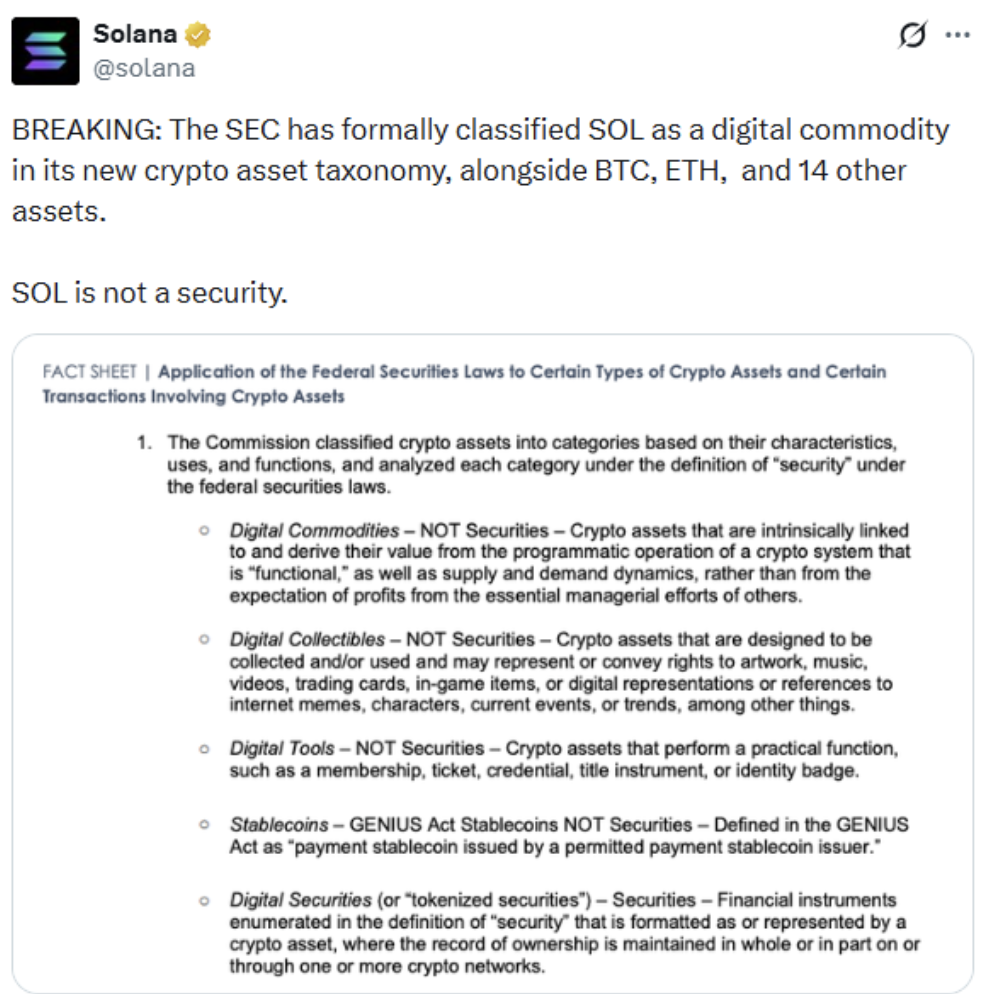
Meanwhile, on the regulatory side, the US SEC has introduced a new classification framework for crypto assets. It’s something the market has been waiting on for a while, and it finally brings a bit more structure to what’s been… a pretty unclear space.
Under this system, certain assets, including Bitcoin, Ethereum, and Solana, are now categorized as digital commodities. That classification matters, because it means they’re not treated as securities, which changes the regulatory requirements around them.
The SEC also outlined other categories, digital collectibles, tools, stablecoins, and securities, each based on how the asset functions. It’s a more segmented approach, and arguably, a more practical one.
A Market That’s Still Evolving
For platforms like Hyperliquid, this kind of clarity could make a difference. It becomes easier to list assets, expand into new markets, and build products without constantly navigating uncertainty.
And when you step back, both developments, Hyperliquid’s expansion beyond crypto and clearer rules from regulators, point to the same thing. The market is evolving.
It’s not just about coins anymore. It’s about infrastructure, access, and how different asset classes start blending together. Hyperliquid seems to be leaning into that shift early.
Whether it pays off long term… that part is still unfolding.